
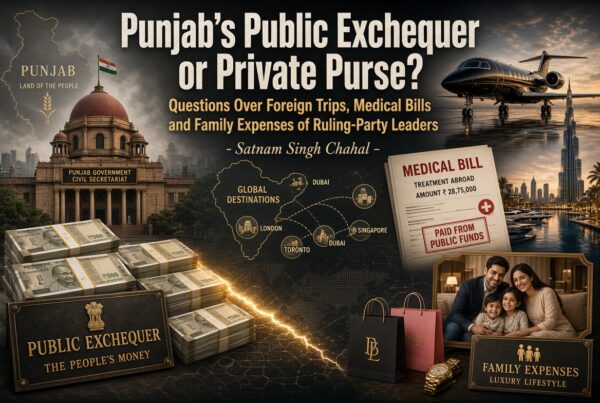
Punjab is facing a serious financial challenge. The state government frequently talks about limited resources, mounting debt, financial pressures and the need to control expenditure. At such a time, every rupee spent from the state treasury deserves public scrutiny. This raises an important question: How much public money is being spent on the foreign travel, medical treatment and other reimbursable expenses of political leaders and their eligible family members?
There is nothing inherently wrong with elected representatives receiving facilities that are legally available to them. Ministers and MLAs may be entitled to travel allowances, medical facilities and other benefits under government rules. The real question, however, is whether every claim is being made strictly according to those rules and whether the people of Punjab are being given enough information about how much of their money is being spent.
Foreign travel deserves particular scrutiny. Whenever a minister or senior political leader travels abroad on official business, the public should be able to know the purpose of the visit, who approved it, who accompanied the leader and how much the government ultimately paid. If the journey was entirely private, then the government should make it clear whether any part of the expenditure was subsequently reimbursed from the public treasury.
There must be a clear distinction between official travel and private travel. A foreign trip undertaken for investment promotion, government negotiations, conferences or another clearly defined public purpose may legitimately involve expenditure from the state exchequer. But if a trip is personal, the burden should ordinarily remain personal unless a specific law or rule provides otherwise.
The same principle applies to medical treatment. If a minister, MLA or eligible dependant requires medical treatment and the applicable government rules permit reimbursement, there is no reason to object merely because the person is a politician. Public representatives are citizens and can face genuine medical emergencies. But when public money is used, the expenditure should be properly documented, approved and disclosed in accordance with transparency requirements.
The issue becomes more sensitive when treatment takes place in expensive private hospitals, outside Punjab or in foreign countries. Ordinary Punjabis often struggle to pay their own medical bills. Families sell land, borrow money and spend their life savings to obtain treatment. Therefore, when substantial amounts are reimbursed from the public treasury for the treatment of political leaders or their family members, people naturally want to know the rules, the amount and the justification.
The government should therefore consider publishing comprehensive information about medical reimbursements and major travel claims made by ministers and legislators. Such disclosure should include the nature of the expenditure, the amount claimed, the amount approved, the authority that sanctioned the payment and the applicable rule under which the reimbursement was made.The question of family members also deserves clarity. If government rules allow certain medical or travel facilities for eligible dependants, the government should clearly explain who qualifies under those rules. There should be no ambiguity about whether a particular family member was legally eligible for reimbursement and whether the expenditure met all prescribed conditions.
Punjab’s legislators have previously come under RTI-based scrutiny regarding travel expenditure. An Indian Express report based on RTI information reported that Punjab legislators’ travel bills amounted to ₹1.60 crore in 2023–24. Such disclosures show that public expenditure on elected representatives can be examined through the Right to Information framework and should not be treated as a matter beyond public scrutiny.The issue should not be turned into a partisan attack. The same standard must apply to every political party. Whether the person belongs to the ruling AAP, Congress, Shiromani Akali Dal, BJP or any other party, public money remains public money.
A government cannot demand financial discipline from ordinary citizens while refusing to explain expenditure involving those in power. If a payment is legitimate, the government should have no difficulty explaining it. If a claim follows the rules, the relevant rule should be made available. If an expenditure was official, the official purpose should be disclosed. Transparency should protect legitimate claims rather than create suspicion around them.
The Punjab government should also consider conducting a comprehensive audit of foreign travel and medical reimbursements involving ministers, MLAs and eligible family members. The audit should examine whether claims were submitted within the prescribed rules, whether the necessary approvals were obtained, whether bills were genuine and whether any amount was paid twice or without proper authorization.The government should publish the findings rather than waiting for journalists, opposition parties or RTI activists to uncover them. Proactive disclosure would demonstrate that the government has nothing to hide and would strengthen public confidence in the administration.
Punjab is not merely facing a political crisis; it is facing a financial challenge. Every department is expected to justify its expenditure. Every development project is examined for cost. Every demand for additional funds is measured against the state’s ability to pay. Political expenditure should be subject to the same principle.The treasury of Punjab does not belong to the ruling party. It does not belong to the Chief Minister, ministers or MLAs. It belongs to the people of Punjab. Governments merely hold that money in trust and are responsible for spending it according to law and in the public interest.
Therefore, the question is not whether politicians should receive legitimate benefits. The question is whether the public is entitled to know exactly how those benefits are being used.If the answer is yes, then Punjab should open the books.Let the people know how much has been spent on foreign travel. Let them know how much has been reimbursed for medical treatment. Let them know what has been claimed for eligible family members. Let the government disclose the rules, approvals and audit records.If everything is legitimate, transparency will silence the critics.
If there are irregularities, transparency will expose them.Either way, the people of Punjab deserve to know where their money is going.Public office is a responsibility, not a private financial privilege. And whenever the bill is paid from the Punjab exchequer, the final question should always remain the same:
Who paid the bill—and was the expenditure truly in the public interest?
Disclaimer: This article and accompanying images are for informational and illustrative purposes only. Some visuals may be AI-generated or digitally enhanced and may not depict actual events or persons.Views expressed are based on publicly available information and analysis