
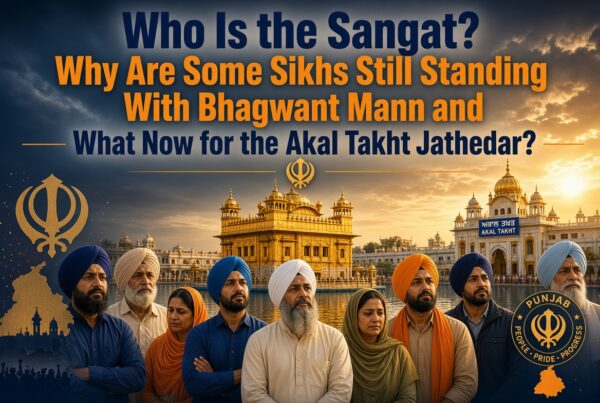
The word “Sangat” is among the most important words in Sikh religious life, but it is also one of the most frequently used and least understood. Sangat does not simply mean a crowd of people standing behind a political leader, attending a political programme or publicly supporting a personality. In Sikh tradition, Sangat refers to the congregation or fellowship of people who come together in the spirit of devotion, reflection, prayer and collective engagement with the Guru’s teachings. Sadh Sangat carries an even deeper meaning—the company of those seeking spiritual and moral elevation. (SikhiWiki)
That distinction has become particularly important in Punjab today. Some Sikhs continue to move around Chief Minister Bhagwant Mann, appear with him publicly, defend him politically or demonstrate their support for him, even after the Sikh religious leadership has taken an exceptionally serious position against him. The question therefore is not whether every Sikh must automatically agree with every statement issued by a Jathedar. The deeper question is: Where does personal political loyalty end and Panthic responsibility begin?
Sangat is not a political crowd
In Sikh tradition, Sangat developed as a community institution from the time of Guru Nanak. It was a fellowship of Sikhs connected to a locality and united around the Guru’s teachings. The concept was not created as a mechanism for supporting a political party or an individual ruler. It was about collective spiritual life, learning, prayer and moral discipline.
This is why the present political situation deserves careful examination. If Sikhs gather around a political leader, that gathering may certainly include Sikh citizens exercising their democratic rights. But it should not automatically be described as Sangat. A political gathering and Sadh Sangat are not interchangeable concepts.
The distinction matters because once religious terminology is attached to political loyalty, the boundaries between Panthic institutions and partisan politics can become dangerously blurred.
The Akal Takht and the question of authority
The importance of Sri Akal Takht Sahib comes from its unique place in Sikh history. The institution was established by Guru Hargobind Sahib in the early seventeenth century as a seat of temporal authority. Scholarly research describes the Akal Takht as a central seat of authority in the Sikh tradition, while emphasizing that the legitimacy and authority of its leadership ultimately depend upon its relationship with the Sikh community. (MDPI)
The Jathedar is therefore not a king, dictator or political ruler of the Sikhs. Nor does the Jathedar replace Guru Granth Sahib. The Jathedar serves as the custodian and spokesperson of the institution and exercises Panthic authority through established Sikh institutional processes. The office derives its strength from the institution, from Sikh tradition and ultimately from the confidence of the Panth.
That distinction is crucial.Respect for the Jathedar does not mean worship of the Jathedar. But undermining the office of the Jathedar is also not a trivial matter.
A timeline of the Akal Takht’s authority
1606–1609: The creation of the Akal Takht
Guru Hargobind Sahib established the Akal Takht after the martyrdom of Guru Arjan Sahib. It represented the Sikh principle that spiritual life could not be separated from responsibility toward justice, society and temporal affairs. (MDPI)
18th century: Collective Sikh authority
As Sikh power and institutions developed, the Akal Takht became increasingly associated with the collective authority of the Khalsa Panth. Important Panthic matters were discussed and collective decisions were made around the institution.
1920: The modern office of Jathedar
The modern institutional use of the title “Jathedar of Akal Takht” developed during the Gurdwara Reform movement. Historical accounts record that in October 1920, the Sangat took control of the Akal Takht and appointed Teja Singh Bhuchar as its Jathedar. This is an important historical reminder: the Jathedar’s authority is fundamentally connected with the Sangat and the Panth, not with a political party.
1947–1984: Increasing institutional and political tensions
After Partition, Sikh institutions increasingly operated within the political framework of independent India. The relationship between the SGPC, Akali politics and the Akal Takht became increasingly complicated.
1984: Attack on the Akal Takht
The military operation of 1984 caused enormous destruction at the Akal Takht and became one of the deepest wounds in modern Sikh history. The institution thereafter acquired an even greater symbolic significance as a representation of Sikh sovereignty, dignity and collective memory.
Post-1984: The question of political influence
The decades following 1984 also produced continuing debate over political influence on Sikh institutions. The central question has remained: Can the Akal Takht exercise independent Panthic authority while political interests influence the institutions surrounding it? That question remains relevant today.
2026: Bhagwant Mann and the Akal Takht confrontation
The current confrontation is therefore not an ordinary disagreement between a chief minister and a religious leader.In January 2026, the Akal Takht summoned Bhagwant Mann over remarks concerning Sikh institutions and religious matters. The confrontation escalated significantly in June. The Sikh clergy at Akal Takht took an exceptionally serious position against Mann following controversy surrounding a viral video. Reports stated that the Akal Takht leadership characterized Mann in terms including “Guru Dokhi” and “Khalsa Panth Virodhi.” The matter subsequently expanded beyond the Chief Minister. Sikh AAP ministers and MLAs were summoned in connection with the state’s anti-sacrilege legislation, and reports said Sikh legislators appeared before the Akal Takht.
Most recently, an Akal Takht-appointed panel has sought a compliance report from the Punjab government before further discussions concerning the anti-sacrilege law. This means the confrontation is no longer merely a personal dispute between Bhagwant Mann and a Jathedar. It has become a test of how a democratically elected government responds when a major Sikh institution exercises Panthic authority.So what is the position of the Jathedar now?The present position appears to be that the Akal Takht has not simply withdrawn from the matter. The institution has continued pursuing the issue through its appointed panel and has sought compliance from the Punjab government.
That creates an important question for Jathedar Kuldeep Singh Gargaj: What is the next step?
A religious directive cannot remain indefinitely in the realm of speeches and statements. If the Akal Takht has taken a formal Panthic position, there must ultimately be clarity about what compliance means, what consequences follow from non-compliance, and how the decision will be implemented.At the same time, the Jathedar must ensure that every subsequent step is based on established Panthic procedure, evidence and maryada. The stronger the decision, the greater the responsibility for institutional transparency.
Why are some Sikhs still standing with Mann?
There can be several reasons, and it would be unfair to assume that every Sikh who supports Mann is acting against the Panth.Some may support him because they voted for AAP and continue to support its government. Some may distinguish between Mann’s political performance and religious controversies. Others may believe that the evidence or institutional process does not justify the conclusions reached by the Akal Takht. Still others may simply be responding to political loyalties.In a democracy, Sikhs are citizens with political rights. They cannot be stripped of those rights because of their religious identity.But another question remains: Can political disagreement with an Akal Takht decision become an excuse for publicly ridiculing, humiliating or deliberately undermining the institution itself?That is where the debate becomes much more serious.The danger on both sidesThere are dangers on both sides.
If political leaders attempt to control, intimidate or manipulate Sikh religious institutions, the independence and credibility of the Panth are weakened.But if religious authority is exercised without adequate transparency, due process or consistency, the credibility of the institution can also suffer.Therefore, the answer cannot be blind obedience to personalities. Nor can it be blind loyalty to political leaders.The answer must be Gurmat, institutional integrity, due process and accountability.
What could happen next?
The coming months could be extremely important.If the Punjab government cooperates with the Akal Takht process, the confrontation could gradually move toward a structured institutional resolution.If the government refuses to comply, the Jathedar and the Panj Singh Sahibaan could face pressure to determine what further Panthic action is appropriate.If Sikh ministers and MLAs continue to appear before the Akal Takht while the Chief Minister maintains a separate political position, the distinction between individual political responsibility and collective government responsibility will become increasingly important.And if sections of the Sikh community continue openly supporting Mann despite the Akal Takht’s position, the Panth could face a deeper debate about the meaning of religious authority itself.
The real test is bigger than Bhagwant Mann
The future of this controversy should not be reduced to the question of whether one likes or dislikes Bhagwant Mann.Governments come and go. Political parties rise and fall. Chief ministers change.Sri Akal Takht Sahib remains.That is why the present crisis should ultimately be used to strengthen, rather than weaken, Sikh institutions.The Jathedar must demonstrate that the office is above party politics. The government must demonstrate that democratic authority does not mean contempt for religious institutions. Political Sikhs must demonstrate that political loyalty does not require abandonment of Panthic principles. And the Sangat must demonstrate that its understanding of Sikh authority is based on Guru Granth Sahib, Gurmat and collective responsibility—not personalities.
The Sikh Panth does not need a confrontation between “Bhagwant Mann supporters” and “Akal Takht supporters.”
It needs a mature conversation about what Sangat really means, what the Jathedar’s authority really is, what the limits of political power are, and how Sikh institutions can regain the unquestioned moral credibility that history demands of them.The final question is therefore not simply:
“Who is standing with Bhagwant Mann?”
The more important question is:
“When political loyalty and Panthic responsibility appear to collide, what should a Sikh stand for?”That is the debate Punjab and the Sikh Panth cannot afford to avoid.
Disclaimer: This article and accompanying images are for informational and illustrative purposes only. Some visuals may be AI-generated or digitally enhanced and may not depict actual events or persons.Views expressed are based on publicly available information and analysis