
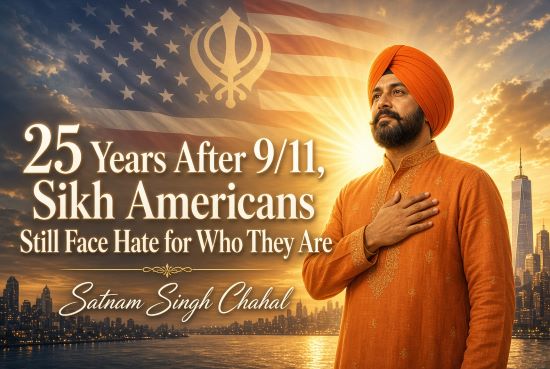
 Twenty-five years after the September 11, 2001 terrorist attacks, Sikh Americans continue to confront a painful reality: hate crimes, racial profiling, harassment and discrimination have not disappeared. For a community that had absolutely nothing to do with the attacks, the post-9/11 era became a period in which many Sikh Americans were targeted simply because of their turbans, beards and visible religious identity.
The story of Sikh Americans after 9/11 is therefore not only a story of tragedy. It is also a story of resilience, survival and the continuing struggle to ensure that every American can live openly according to his or her faith without fear.
The first deadly post-9/11 hate crime against a Sikh American occurred just four days after the terrorist attacks. On September 15, 2001, Balbir Singh Sodhi, a Sikh American and gas-station owner in Mesa, Arizona, was fatally shot. His attacker mistakenly believed that Sodhi was Muslim or Arab and targeted him because of his appearance. Sodhi’s murder became one of the most painful symbols of the hatred that followed 9/11.
But Sodhi’s killing was not an isolated incident. In the weeks and months following the attacks, Sikh Americans across the country reported harassment, threats, assaults, vandalism and discrimination. Many discovered that wearing a turban or maintaining an uncut beard could make them targets of people acting on ignorance and stereotypes.
Between 2002 and 2009, Sikh Americans continued to face discrimination in schools, workplaces and public places. Sikh children experienced bullying, while adults reported harassment because of their religious appearance. For many families, the challenge was not simply building a successful life in America but doing so while remaining visibly Sikh in a society where many people knew very little about Sikhism.
By 2010 and 2011, nearly a decade had passed since 9/11, yet the problem had not disappeared. The experience of Sikh children was particularly troubling. Bullying and religiously motivated insults demonstrated that ignorance about Sikh identity was being passed from one generation to another. Parents increasingly had to explain to their children why some people might treat them differently because they wore a turban or carried other visible signs of their faith.
Then came August 5, 2012, one of the darkest days in the history of Sikh Americans. A gunman entered the Sikh Temple of Wisconsin in Oak Creek and opened fire on worshippers. Six people were killed in the attack, while another victim later died from injuries suffered that day. The massacre shocked the nation and demonstrated in the most devastating way that anti-Sikh hatred could move beyond insults and discrimination and become deadly violence.
The Oak Creek tragedy was a reminder that a gurdwara is not simply a building. It is a place where families gather, where children learn, where community members pray and where people come together in peace. The victims were worshippers who had gone to their place of faith and never returned home.
The years from 2013 through 2019 brought continued reports of harassment, bullying, discrimination and hate incidents against Sikh Americans. The national debates surrounding terrorism, immigration, race and religion repeatedly created an environment in which visible minorities could become targets. Sikh Americans continued to confront the same fundamental misunderstanding: their appearance and religious identity were sometimes wrongly interpreted as signs of extremism.
Then came 2020 and 2021, when America approached the twentieth anniversary of 9/11. The passage of two decades had not erased the memory of Balbir Singh Sodhi. His story remained a powerful reminder of what happens when ignorance and prejudice replace understanding. He was not killed because of something he had done. He was killed because someone looked at his appearance, made a false assumption about his identity and turned that prejudice into violence.
In 2022, the tenth anniversary of the Oak Creek massacre again brought attention to the safety of Sikh Americans and their places of worship. The six people who died that day were not statistics. They were members of families and communities who lost their lives while practicing their faith. Their deaths remain one of the most painful chapters in the Sikh American experience.
The problem has also remained visible in federal hate-crime statistics. In 2024, anti-Sikh incidents remained among the most frequently reported hate crimes targeting a specific religious identity, with Sikhs continuing to rank among the three most targeted religious communities in America. The FBI data also needs to be understood carefully because hate-crime statistics depend on incidents reported by participating law-enforcement agencies and therefore may not capture every incident experienced by Sikh Americans.
The 2025 data was particularly disturbing. Analysis of preliminary FBI data found 226 anti-Sikh hate-crime incidents, compared with 142 in 2024. That represented an increase of approximately 59 percent and was the highest number of anti-Sikh incidents recorded in the FBI dataset. The numbers should serve as a serious warning that the problem of anti-Sikh hatred has not disappeared twenty-five years after 9/11.
The experience of Sikh truck drivers has also highlighted the continuing vulnerability of visibly Sikh Americans. Following the August 2025 Florida truck crash involving Sikh driver Harjinder Singh, national political debate over immigration and trucking was accompanied by reports of increased harassment and hostility toward Sikh truckers. Whatever the facts of an individual case may be, an entire religious community cannot fairly be blamed for the actions of one individual.
Now, in 2026, America is twenty-five years removed from September 11. A generation has grown up since that terrible day. Yet Sikh Americans continue to face questions that should have been settled long ago. Why should a turban make someone a target? Why should a beard invite suspicion? Why should a Sikh child have to explain that his or her faith has nothing to do with terrorism? And why should Sikh families continue to worry about hatred while simply living, working, worshipping and raising their children in America?
These are not demands for special treatment. They are demands for equal treatment.The Sikh American experience after 9/11 represents a larger test of the American promise. A Sikh wearing a turban is exercising his or her religious freedom. A Sikh maintaining an uncut beard is practicing a deeply held faith. A Sikh family attending a gurdwara is participating in American religious life. A Sikh truck driver crossing the country is doing his or her job. None of these things should make anyone a target.
Twenty-five years after 9/11, America should look beyond the statistics and remember the human beings behind them. Remember Balbir Singh Sodhi. Remember the victims of Oak Creek. Remember the children who have been bullied. Remember the workers who have faced discrimination. Remember the Sikh Americans who have been threatened, assaulted or attacked simply because they were visibly Sikh.
And remember the basic truth that should never have needed to be repeated: Sikh Americans did not cause 9/11, and they should never have been forced to pay the price for a crime they did not commit.Twenty-five years later, the responsibility belongs to all Americans—to reject stereotypes, challenge hate and ensure that no person is judged by a turban, beard, skin color, religion or ancestry.The passage of twenty-five years should have made the lesson obvious: being visibly Sikh is not a threat, being Sikh is not a crime, and no American should ever have to live in fear simply because of who they are.