
Every few weeks now, someone revives the old spreadsheet. Add BJP’s vote share to SAD’s, divide the Assembly’s 117 seats by a formula redolent of 1997, and declare, with the confidence peculiar to armchair psephologists, that Punjab has found its challenger to AAP and Congress.
It’s convenient arithmetic, not strategy.
A limited, seat-specific understanding between the two parties may have real value in a handful of constituencies, stopping a split vote from handing a close contest to a stronger rival. A statewide alliance that resurrects the old Akali-senior, BJP-junior hierarchy is a different proposition, and BJP would be unwise to sleepwalk into it. What BJP has to weigh is whether it should mortgage its long-term Punjab project to the survival needs of an Akali Dal that today brings a fraction of the capital it carried a decade ago, not whether the old arrangement can be rebuilt. BJP’s real horizon runs past 2027, to 2032 and 2037.
The Ledger Fallacy
The old alliance rested on a genuine division of labour: the Shiromani Akali Dal’s (SAD’s) rural, Sikh, agrarian network paired with BJP’s urban Hindu and commercial-class base, with SAD unmistakably the senior partner. That division no longer describes the ground.
In the 2024 Lok Sabha election, BJP polled 18.56 percent in Punjab against SAD’s 13.42, a quiet reversal of the old hierarchy. Add them together and the combine reaches 31.98 percent, ahead of Congress’s 26.30 and AAP’s 26.02. Yet the seat tally looked nothing like it: BJP zero, SAD one, Congress seven, AAP three, Independents two.
That gap between vote share and seat share is the argument in miniature. Percentages do not transfer on command; a BJP voter does not become an SAD voter merely because a shamiana carries both flags. The 2020 rupture, the farm-law agitation, competing religious narratives and a thicket of local factionalism have rearranged the chemistry since the two last stood together. A fifty-fifty seat formula settles nothing beyond an internal filing dispute; it does not prove the combine can win the 59 seats a majority requires. That still depends on booth-level detail: candidate credibility, caste alignment, anti-incumbency, whether the other side’s voters actually cross over when asked.
Who Needs Whom?
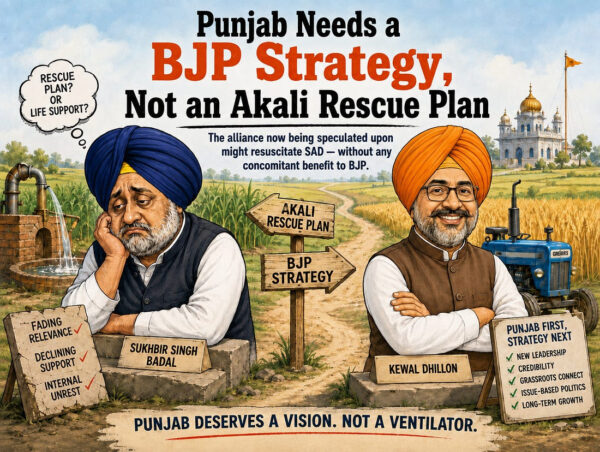
For SAD, a revived alliance is fairly straightforward: it is oxygen. Access to BJP’s machinery and urban reach would blunt the narrative of a shrinking, faction-riven party struggling to hold what remains of its religious and political authority. Sukhbir Badal needs a revival mechanism; an alliance can serve as one.
For BJP the calculation is not remotely as tidy. It now polls ahead of SAD, has been building an independent Sikh and rural-facing presence of its own, and gains nothing by entering on terms that restore SAD’s claim to seniority. This is closer to a rescue acquisition than a merger of equals — and rescue acquisitions are priced by the party doing the rescuing, not the party being rescued. SAD’s residual Panthic association and local pockets are real assets, but they need valuing seat by seat, not romanticised by invoking a Punjab that has since moved on. Sukhbir Badal’s own standing, weighed down by repeated internal departures, cannot be assumed to still command its old premium.
A young but seasoned political analyst, who has worked at various points both for and against the BJP in different states and knows the political landscape well, put the same dynamic more bluntly: “SAD was heading towards a probable political demise. BJP will definitely put him on a ventilator. But remember, the option to switch off will remain not with him, but with the saffron party.”
Whose Seat Is It, Anyway?
The most neglected cost in this debate is candidate displacement. Alliances are agreed over real workers and aspirants, who have to be told to stand down.
Take the Ropar belt, where SAD’s Dr Daljit Singh Cheema sits alongside a BJP claim built through Iqbal Singh Lalpura. Why concede that ground purely on SAD’s seniority? Or Ludhiana’s urban Hindu-majority seats, natural BJP territory where figures such as Hira Singh Gabria and Sharanjit Dhillon have spent years building a base. Gurdaspur cuts the other way. BJP’s marquee pickup for the district was Ravikaran Singh Kahlon, son of the late Speaker Nirmal Singh Kahlon: SAD expelled him in May 2024, and BJP absorbed him within a day. Run that November in Dera Baba Nanak, the seat his father once represented, he polled 5.25 percent and finished third. The Akali vote there never moved with him; it still runs through Sucha Singh Langah, three-decade president of Gurdaspur’s SAD unit, out campaigning alongside Sukhbir Badal in the same constituency as recently as March 2026. A famous surname changing parties is not the same as a vote bank changing parties.
And in Malwa, Jagmeet Singh Brar’s move into the BJP fold this January shows the same bind at scale. A party cannot recruit prominent entrants, let them build ground support, and then tell them the space belongs to a revived Akali Dal after all.
The real problem here is structural: an expanding party cannot keep treating its own new blood as bargaining chips for an old partner.A straight fifty-fifty split would be irrational for BJP: it is ahead of SAD on the 2024 numbers, yet a fifty-fifty formula would cap it near 58 or 59 seats, self-containment dressed up as partnership. Even the reported negotiating positions reflect the shift: BJP holding out near 55, SAD offering only around 45. Fifty-five should be a tactical floor, not an aspiration. The round number alone is not the safeguard, either. Fifty-five seats stacked with the hardest constituencies while SAD keeps the easier rural contests only repeats the imbalance more slowly. Without a constituency-by-constituency read (2024 segment vote, 2022 result, booth structure, rebel risk, actual crossover probability), a round seat number invites sabotage more than it secures agreement.
An Opening, Not an Obligation
This August’s signalling has been almost entirely one-sided. Sukhbir Badal’s twenty-minute meeting with the Prime Minister at Parliament House on August 7 revived the speculation; Harsimrat Kaur Badal dropped her own hint at a Sangrur rally on August 20; her brother Bikram Majithia went further on August 21, saying Punjab wanted the two parties back together, while conceding the final call rested with senior leadership. BJP’s organisational response has run the other way: Punjab BJP president Kewal Singh Dhillon has repeatedly waved off the buzz, while national general secretary B. L. Santhosh reiterated in Patiala on August 24 that the party intends to contest all 117 seats and form the next government on its own.
That’s the right call. AAP carries the anti-incumbency of an incomplete term, Congress remains split by faction, and SAD continues its post-rupture decline: an opening BJP does not need an alliance to exploit, though it will not deliver a majority alone either. A solo contest across all 117 seats forces the harder, slower work: booth organisation where none exists, genuine Sikh and rural outreach, a second rung of leadership that a borrowed alliance would never require it to build. That investment may not pay off by February 2027; it is meant to pay off in 2032 and 2037.
A Tactical Nod, Not a Strategic Merger
None of this rules out a narrow, evidence-based local understanding where the numbers genuinely support one. That is a different proposition from resurrecting a statewide hierarchy on nostalgia and a round number. BJP has to decide, fairly soon, whether it wants a convenient arrangement for one election or a Punjab of its own making. An alliance may help in a few seats; rebuilt at scale, it risks freezing BJP back into its old subordinate role, rescuing a declining partner at BJP’s own expense, and denying the party the room it needs to grow. Any seat-sharing talks in the coming months should be judged against the 2024 numbers, not against memories of 1997.