
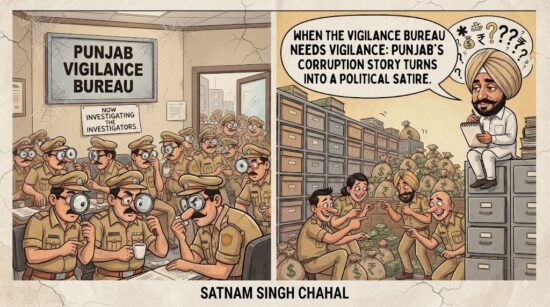
 Punjab has been promised “zero tolerance” against corruption for years. Governments have come and gone, slogans have changed, press conferences have multiplied, raids have been conducted and arrests have been announced. Yet corruption, like a seasoned survivor, has demonstrated one remarkable quality—it keeps adapting. It changes its office, its telephone number, its intermediary and sometimes, allegedly, even the people assigned to catch it.
The latest development has taken the corruption story to an entirely new level. The CBI has arrested three people in an alleged ₹20-crore bribery case linked to officials of the Punjab Vigilance Bureau. According to the CBI, illegal gratification was allegedly demanded in connection with a complaint pending before the office of the Director General, Vigilance, Punjab. Another accused, identified as O.P. Rana, Reader to the DGP Vigilance Punjab, has reportedly been absconding. The CBI also conducted searches at the Punjab Vigilance Bureau headquarters in Mohali.
And here lies the irony that almost writes its own political satire: the institution created to investigate corruption has itself become the subject of a corruption investigation. Punjab may soon need a new department called the “Vigilance Department for Vigilance.” And if that department also needs investigation, perhaps the government will have to establish a “Super Vigilance Department.” At this rate, Punjab’s government buildings may eventually contain more vigilance offices than ordinary offices.
The story becomes even more serious when viewed against the larger timeline of Punjab’s governance. When the present government came to power in 2022, it promised a new political culture and strong action against corruption. The common citizen was told that the days of paying money to get legitimate government work done were over. The message was powerful, the expectations were enormous and the public gave the government an opportunity to prove that Punjab could actually become cleaner and more accountable.But corruption did not disappear. It simply appeared to understand that governments change while administrative systems often remain the same.
During 2022 and 2023, “zero tolerance against corruption” became one of the most frequently repeated phrases in Punjab’s political vocabulary. Every raid generated headlines. Every arrest generated political congratulations. Every crackdown was presented as evidence that the government was serious. But the ordinary citizen continued to encounter the same old questions: Why is the file not moving? Why does a simple government service take weeks? Why does an application require influence? Why does an honest citizen sometimes feel that knowing the right person is more important than following the right procedure?
By 2024 and 2025, corruption allegations increasingly touched different layers of administration, policing and public institutions. Cases involving government officials, police personnel and intermediaries continued to remind Punjab that corruption is not simply a problem of a few dishonest employees. It can become a network when institutional checks are weak and accountability is delayed.The arrest of senior police officer Harcharan Singh Bhullar in an alleged bribery case became one of the prominent examples of allegations reaching the higher levels of the police hierarchy. Other cases involving police personnel and alleged extortion further intensified questions about whether disciplinary mechanisms are strong enough to prevent misuse of official power.
Then came 2026, when allegations involving police personnel and intermediaries added another disturbing chapter. The alleged involvement of officials in criminal networks and extortion-related investigations created further concern about the relationship between authority, money and political or criminal influence.But the latest CBI action is different because it strikes at the credibility of the very institution expected to fight corruption. If the allegations are ultimately established in court, the damage will not be limited to the individuals involved. It will raise a much larger institutional question: Who watches the watchdog?
A citizen approaching the Vigilance Bureau should have complete confidence that the complaint will be investigated fairly, independently and without fear or favour. The citizen should never have to wonder whether reporting corruption could somehow expose him or her to another layer of alleged corruption.This is why the alleged ₹20-crore case cannot be treated merely as another arrest story. It demands answers about internal supervision, financial monitoring, complaint handling, political influence, departmental accountability and the independence of anti-corruption investigations.
Punjab has already seen arrests, raids, suspensions, FIRs and investigations. But arrests alone do not reform a system. If one officer is removed and another simply occupies the same position under the same system, the problem has not been solved. If an intermediary is arrested but the network that allegedly enabled the transaction remains intact, the system remains vulnerable.The government must therefore move beyond slogans and publish measurable information about its anti-corruption campaign. How many complaints have been received? How many were investigated? How many resulted in FIRs? How many officials were suspended? How many cases reached trial? How many convictions were secured? How much public money was recovered? And how many cases were closed without prosecution?
Without transparent answers to these questions, “zero tolerance” risks becoming another political slogan rather than a measurable policy.The most dangerous form of corruption is not always the small bribe demanded from an ordinary citizen. The deeper danger begins when people start believing that nothing can be achieved in government offices without money, influence or political connections. Once that belief becomes normal, democracy itself becomes expensive. Justice begins to look selective, honest officers become discouraged and ordinary citizens lose faith in government institutions.Punjab therefore needs more than another anti-corruption speech. It needs structural reform. Sensitive departments must be subjected to stronger independent oversight. Complaints should receive digital tracking numbers. Investigations should have clear deadlines. Officers dealing with high-value or politically sensitive cases should face stronger accountability mechanisms. Whistle-blowers and witnesses should receive meaningful protection.
Most importantly, the government must understand that catching corruption is not the same thing as eliminating the conditions that produce corruption.The satire is now almost too obvious to ignore. The government says, “We will catch corruption.” The Vigilance Bureau says, “We will investigate corruption.” The CBI arrives and asks, “But who is investigating the investigators?”Meanwhile, the ordinary Punjabi citizen is still standing outside a government office with a file in one hand and hope in the other, wondering why obtaining a simple certificate sometimes feels like entering a national-level investigation.
Punjab does not need another slogan promising “zero tolerance.” Punjab needs a system in which corruption becomes too risky, too difficult and too costly for anyone to attempt.The CBI arrests announced today should therefore not become another 48-hour headline. They should become a turning point. If the institution established to fight corruption itself comes under a corruption probe, Punjab cannot merely change the accused. It must change the system.Otherwise, perhaps the next government slogan will have to be the most honest one yet:
“Zero Tolerance Against Corruption—Except Where Somebody Knows Somebody.”
Disclaimer: This article and accompanying images are for informational and illustrative purposes only. Some visuals may be AI-generated or digitally enhanced and may not depict actual events or persons.Views expressed are based on publicly available information and analysis