
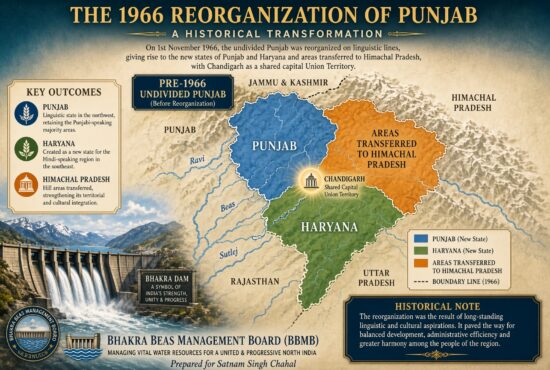
 The Partition of 1947 fundamentally changed the geography of Punjab, but it was not the last major territorial transformation the state would experience. Less than two decades after losing nearly half of its historic territory during Partition, Punjab was once again reorganized. The reorganization of 1966 reshaped the political map of northern India, creating the present-day state of Haryana, transferring the hilly regions to Himachal Pradesh, and introducing constitutional and administrative arrangements that continue to influence politics in the region today. Nearly six decades later, issues relating to Chandigarh, river waters, and the management of major hydroelectric projects remain among the most discussed subjects in Punjab’s public life.
The demand for the reorganization of Punjab emerged in the years following Independence. Across India, several regions sought the creation of states based primarily on linguistic identity. Supporters argued that administering states in the dominant regional language would strengthen governance, improve education, and preserve cultural heritage. Similar demands led to the creation or reorganization of states such as Andhra Pradesh, Gujarat, Maharashtra, Karnataka, and Kerala. In Punjab, many political leaders and organizations advocated the formation of a Punjabi-speaking state where Punjabi would be the principal official language.
The movement generated considerable debate. While supporters viewed linguistic reorganization as consistent with the broader national policy adopted elsewhere in India, others feared that the proposal could deepen communal or regional divisions. After years of discussion, political negotiations, and public campaigns, Parliament enacted the Punjab Reorganisation Act, 1966, which came into effect on 1 November 1966.
Under the new arrangement, the Hindi-speaking districts became the newly created state of Haryana. The predominantly hilly regions were transferred to Himachal Pradesh. The remaining Punjabi-speaking areas constituted the present-day state of Punjab. The reorganization significantly reduced Punjab’s geographical area and altered its demographic and administrative structure.
Although the creation of Haryana and the expansion of Himachal Pradesh resolved certain administrative questions, it also introduced new constitutional and political issues that have remained unresolved for decades. Among these, none has attracted greater attention than the future of Chandigarh.
After Partition in 1947, Punjab had lost Lahore, its historic capital, to Pakistan. The Government of India therefore decided to construct an entirely new capital city. Chandigarh was conceived as one of independent India’s most ambitious urban planning projects, designed by internationally renowned architects and intended to symbolize the optimism of a newly independent nation. Built largely to serve as the capital of post-Partition Punjab, Chandigarh soon became one of India’s most modern planned cities.
However, following the reorganization of 1966, Chandigarh was designated as a Union Territory and made the joint capital of both Punjab and Haryana. This arrangement, initially regarded by some as temporary, has continued for decades. Successive governments at the Centre, in Punjab, and in Haryana have expressed differing views regarding the city’s long-term status.
Many political leaders and organizations in Punjab have argued that Chandigarh should become the exclusive capital of Punjab, pointing to its historical association with the state after the loss of Lahore. On the other hand, many leaders in Haryana have maintained that the state also has legitimate administrative interests arising from the 1966 settlement and have sought either continued shared arrangements or an alternative solution. As a result, Chandigarh remains both the capital of Punjab and Haryana while continuing to function as a Union Territory administered by the Government of India.
The issue has been discussed repeatedly through political negotiations, parliamentary debates, commissions, and committees. Various proposals have been advanced over the decades, including the transfer of Chandigarh to Punjab along with adjustments involving certain territories, as well as alternative administrative arrangements. Despite these discussions, no final political consensus has emerged.
Closely connected with the question of Chandigarh are the broader issues of river waters and major hydroelectric infrastructure. Punjab is traversed by some of the most significant river systems in northern India. Water has always been central to the state’s agriculture, economy, and social development. Following reorganization, the sharing of river waters among Punjab, Haryana, Rajasthan, and other neighbouring states became one of the most sensitive issues in Indian federalism.
The construction of the Bhakra-Nangal Project and the Beas Project ranks among the greatest engineering achievements of independent India. These projects transformed agriculture across large parts of northern India by providing irrigation, hydroelectric power, and flood control. The Bhakra Dam, in particular, became a symbol of India’s developmental ambitions during the early decades after Independence.
To administer these projects, the Bhakra Beas Management Board (BBMB) was established under the provisions of the Punjab Reorganisation Act. The Board was entrusted with the operation and maintenance of the Bhakra, Beas, and associated projects and with the distribution of water and electricity among the partner states in accordance with applicable laws, agreements, and government decisions.
Supporters of the BBMB have argued that a central management structure promotes coordinated operation of complex river systems, ensures technical efficiency, and facilitates equitable distribution of water and power among beneficiary states. They maintain that interstate river systems require cooperative institutions capable of balancing competing needs while protecting national interests.
However, many political leaders, farmer organizations, legal scholars, and civil society groups in Punjab have expressed concerns over the years regarding the extent of the state’s control over resources originating within or flowing through its territory. They argue that Punjab has made an exceptionally large contribution to India’s food security and therefore requires sufficient access to water to sustain its agricultural economy. These concerns have frequently featured in state politics and public debate.
River water allocation has also generated extensive legal proceedings. Questions concerning the interpretation of constitutional provisions, interstate agreements, tribunal awards, and legislative enactments have been considered by the courts on multiple occasions. These disputes illustrate the complexity of balancing federal principles, constitutional obligations, agricultural requirements, and the interests of multiple states dependent upon shared river systems.
For ordinary citizens, these constitutional debates have practical consequences. Water availability directly affects agricultural productivity, groundwater depletion, industrial development, drinking water supplies, and environmental sustainability. Farmers often view water not simply as a legal or political issue but as the foundation of their livelihoods. Consequently, discussions concerning river management frequently evoke strong emotions across the region.
The reorganization of Punjab also influenced the state’s economic trajectory. With reduced geographical area and changing administrative boundaries, Punjab entered a new phase of development. The state continued to excel in agriculture and later became a major contributor to India’s industrial production in sectors such as textiles, sports goods, bicycles, machine tools, and agricultural equipment. Nevertheless, many observers have argued that unresolved constitutional questions periodically diverted public attention from long-term economic planning.
Another important consequence of the 1966 reorganization was its impact on regional identity. Punjabi language and culture received greater institutional recognition within the reorganized state, while Haryana and Himachal Pradesh developed their own distinct administrative and cultural trajectories. Over time, all three states achieved notable progress in different sectors, demonstrating that reorganization reshaped the development paths of the entire region.
Nearly sixty years after the Punjab Reorganisation Act came into force, its legacy continues to influence political discourse. Elections, legislative debates, judicial proceedings, and intergovernmental discussions frequently revisit questions concerning Chandigarh, river waters, and the administration of shared infrastructure. These issues have remained remarkably resilient because they involve constitutional principles, historical memory, regional aspirations, and practical governance.
A balanced assessment of the 1966 reorganization must recognize both its achievements and its continuing challenges. The Act provided administrative clarity by creating new states that reflected linguistic realities. At the same time, certain questions arising from the reorganization have proved more difficult to resolve through political consensus. The continued discussion surrounding these issues demonstrates the complexity of Indian federalism, where national unity must coexist with regional aspirations and constitutional obligations.
The history of Punjab after 1966 therefore cannot be understood solely through maps and legislation. It is also the story of how constitutional decisions continue to shape public policy, economic development, regional identity, and political debate. Whether viewed from the perspective of Punjab, Haryana, Himachal Pradesh, or the Union Government, the reorganization remains one of the most consequential developments in the constitutional history of independent India.
For Punjab, the events of 1966 marked another turning point in a long history of adaptation. Having rebuilt itself after the devastation of Partition, the state entered a new era defined by both extraordinary achievements and continuing constitutional conversations. Those conversations remain an important part of India’s democratic process, reflecting the ongoing effort to reconcile history, federalism, development, and the aspirations of diverse regions within a united nation.
Disclaimer: This article and accompanying images are for informational and illustrative purposes only. Some visuals may be AI-generated or digitally enhanced and may not depict actual events or persons.Views expressed are based on publicly available information and analysis