
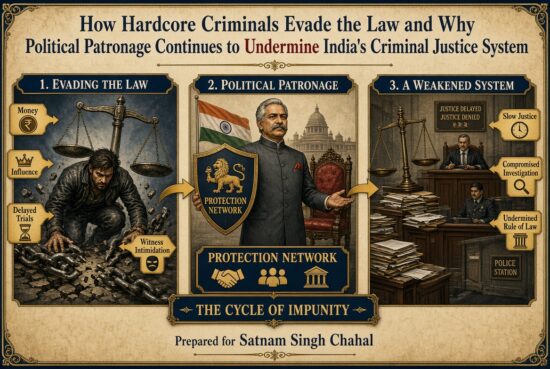
 For decades, governments have promised that “no one is above the law.” Yet, across India—and particularly in Punjab—history tells a more complicated story. Again and again, individuals accused or convicted of serious crimes have managed to secure bail, parole, sentence remissions, executive pardons, political protection, or lengthy judicial delays that kept them out of prison for years. While courts have often delivered landmark judgments after painstaking legal battles, implementation has frequently been slow, inconsistent, and, in some cases, ineffective.
The recent developments involving dismissed Punjab Police DSP Jaspal Singh have once again drawn national attention to these long-standing concerns. Convicted in the abduction and murder of renowned human rights activist Jaswant Singh Khalra, Jaspal Singh’s reported absence from his listed address after court proceedings reignited public debate about the effectiveness of law enforcement and the accountability of public institutions. Equally significant was the revelation that years earlier he had received executive clemency in another criminal case following a recommendation by the government of the day. These developments have raised legitimate questions about whether justice is influenced solely by law or whether administrative and political decisions sometimes alter its course.
While this case has become a symbol of the debate, it is by no means unique. Successive governments in Punjab, led by different political parties, have at various times faced criticism over controversial remission policies, withdrawal of criminal prosecutions, delayed investigations, recommendations for pardons, and allegations of shielding politically influential individuals. The names of the governments have changed over the decades, but the public debate has remained remarkably consistent.
The issue extends beyond Punjab. Across India, numerous high-profile criminal cases have illustrated how legal proceedings can stretch across decades. Accused persons often obtain bail while appeals remain pending. Convicted prisoners may receive parole, furlough or sentence remissions under existing legal frameworks. Governments possess constitutional authority in certain circumstances to recommend clemency. Each of these legal mechanisms serves a legitimate purpose within the justice system. However, when they are applied inconsistently or appear to benefit only the powerful, public confidence in the rule of law inevitably suffers.
The greatest strength of any democracy is not the number of laws on its statute books but the certainty that those laws will be applied equally. When influential individuals repeatedly appear to receive preferential treatment while ordinary citizens face swift prosecution, the perception of unequal justice becomes almost as damaging as injustice itself. The rule of law depends not only on judicial independence but also on fair investigations, impartial prosecution, transparent executive decisions and effective enforcement of court orders.
Punjab’s experience during the years of militancy left deep scars on society. Thousands of families continue to seek answers regarding disappearances, custodial deaths, targeted killings and unresolved criminal investigations. Some cases eventually reached the courts after years of investigation; others remain unresolved even today. Human rights organizations, retired judges, former police officers and civil society groups have repeatedly called for greater transparency and accountability in addressing this legacy.
Another disturbing feature of India’s criminal justice system is the extraordinary length of criminal trials. Murder cases frequently remain pending for ten to twenty years. During this time, witnesses relocate or die, documentary evidence deteriorates, investigating officers retire, governments change, and public attention shifts elsewhere. By the time a final verdict is delivered, victims’ families have often spent decades pursuing justice through an exhausting legal process.
Delays also create opportunities for manipulation. Repeated adjournments, procedural challenges, multiple appeals, witness intimidation and administrative delays can transform criminal proceedings into prolonged legal battles rather than timely determinations of guilt or innocence. Although the Constitution guarantees due process to every accused person, excessive delay ultimately harms both the rights of the accused and the interests of victims.
The criminal justice system also depends heavily upon independent investigations. Whenever police investigations become vulnerable to political influence, the credibility of the entire judicial process is placed at risk. Numerous commissions over the years—including police reform committees and judicial bodies—have recommended insulating investigative agencies from political interference. Despite repeated recommendations, meaningful structural reforms have progressed slowly.
Executive clemency presents another area requiring careful scrutiny. The Constitution allows governments to recommend pardons, remissions and commutations in appropriate cases. These powers are intended to address exceptional humanitarian circumstances or correct potential injustices. However, whenever executive clemency is exercised in cases involving serious crimes without complete public transparency, questions naturally arise regarding the basis of such decisions. Transparency, consistency and independent review would strengthen public confidence while preserving the constitutional intent of these powers.
Victims’ families often pay the highest price. Long after public attention fades, they continue attending court hearings, meeting investigators, arranging legal representation and waiting for judgments that may take decades to arrive. Many parents die before seeing the conclusion of cases involving the loss of their children. Others exhaust their savings pursuing justice. For them, every adjournment represents another year without closure.
The consequences extend far beyond individual cases. Every unresolved prosecution, every delayed investigation and every controversial remission weakens public trust in democratic institutions. When citizens begin to believe that justice depends upon influence rather than evidence, respect for the rule of law gradually erodes. Restoring that confidence requires not only strong courts but also accountable governments, professional policing and transparent administrative decision-making.
The challenge before India today is therefore larger than any single criminal case. It is whether democratic institutions can ensure that justice remains independent of political considerations, administrative convenience or personal influence. The answer will determine not only the credibility of the criminal justice system but also the strength of India’s constitutional democracy.