
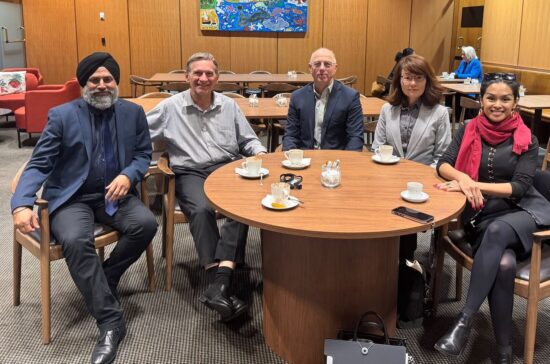
 MELBOURNE: Senior Sikh community leader Amarinder Singh Bajwa recently met with Stephen Bali MP along with colleagues from the Multicultural Communities Council of NSW (MCC NSW), using the interaction to highlight issues affecting multicultural communities and the need for stronger representation of diverse voices in Australian public life.
Bajwa, who has been actively engaged with community affairs in Australia, shared details of the meeting through social media, describing it as an opportunity to discuss issues confronting different communities and to advocate for stronger multicultural voices.
The meeting with Stephen Bali, a prominent Australian political representative, assumes significance at a time when Australia’s multicultural communities are seeking greater participation in policy discussions affecting their social, economic and civic lives.
Bajwa and his colleagues from MCC NSW focused attention on the importance of ensuring that community concerns are heard by elected representatives. The discussion also reflected the increasingly important role played by multicultural organisations in connecting grassroots communities with government and political institutions.
For the Sikh community and the wider Punjabi diaspora, engagement with Australian political representatives is particularly important. Australia’s Sikh population has expanded significantly over the past several decades, with Sikh Australians contributing to business, healthcare, education, transport, community services and numerous other sectors of Australian society.
Community leaders such as Bajwa have increasingly sought to ensure that the concerns of migrant and multicultural communities are not confined to community halls but reach decision-makers at the parliamentary and governmental levels.
The interaction with Stephen Bali also highlighted the importance of multicultural representation beyond symbolic participation. Community leaders argue that Australia’s diverse communities need meaningful opportunities to contribute to policy discussions, particularly on issues involving settlement, employment, discrimination, community safety, education and social cohesion.
The meeting further demonstrated how community organisations can serve as a bridge between Australia’s diverse population and its political institutions. By bringing local concerns directly to elected representatives, such organisations can help policymakers better understand the challenges experienced by communities on the ground.
For Bajwa, such engagements are part of a broader effort to strengthen the voice of multicultural communities and encourage greater civic participation. His meeting with Bali sends a message that community leadership is not only about representing cultural interests but also about participating constructively in Australia’s democratic process.
The interaction comes at a time when Australia’s multicultural character continues to evolve, making dialogue between political leaders and community representatives increasingly important. Sikh and Punjabi Australians, in particular, have established themselves as an important and increasingly visible part of the country’s multicultural landscape.
The meeting between Amarinder Singh Bajwa and Stephen Bali MP, therefore, was more than a social coffee gathering. It provided an opportunity for community representatives to put local concerns before an elected political representative and reinforce the principle that every multicultural community deserves to be heard in Australia’s democratic conversation.
As Australia’s multicultural population continues to grow, sustained engagement between community leaders and elected representatives could play an important role in ensuring that diversity is translated into meaningful participation, representation and policy dialogue.