
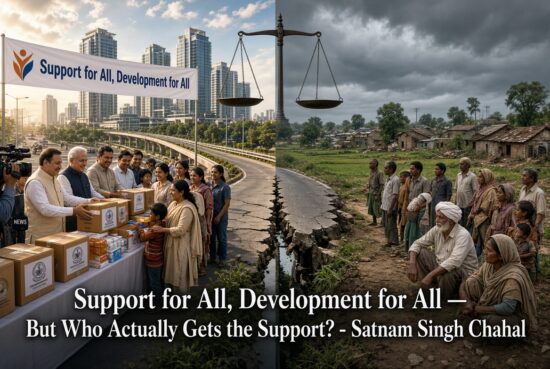
 Support for all, development for all” is one of the most attractive promises in politics. It sounds inclusive, democratic and reassuring. Political leaders repeat such phrases from public stages, election rallies, legislative assemblies and television interviews. The message is simple: every citizen will be treated equally, every region will receive attention, and development will reach every section of society. But the real test of politics is not what is said from a podium. It is what happens after the microphone is switched off. That is where the gap between “support for all” and “support for some” often becomes visible.
In many places, citizens increasingly feel that government attention depends on political connections, electoral calculations, personal relationships or the ability to influence those in power. The person who has access to a minister, MLA, MP, senior bureaucrat or influential political worker may find the doors opening more quickly. The ordinary citizen, despite having the same constitutional rights, may continue waiting outside those doors.
The same contradiction can be seen in development. Governments announce that every village, town, district and community will be part of the development journey. Yet people often ask why some areas receive repeated projects while others remain neglected for years. Why does one constituency receive new roads, institutions, beautification projects and government attention while another continues to struggle with basic infrastructure?
Development should not become a reward for political loyalty. A road should be built because people need a road—not because the area voted for the ruling party. A hospital should be established because citizens require healthcare, not because an influential leader belongs to that constituency. Employment opportunities, education, infrastructure and welfare should be based on public need, transparent criteria and constitutional principles.
Democracy gives governments a mandate to govern for everyone, not only for those who supported them. A citizen who voted for the opposition does not become a second-class citizen. A village that did not support the ruling party does not lose its right to development. A political critic does not lose his or her constitutional rights.
During election campaigns, political leaders approach every household. They ask for every vote and promise to represent every citizen. Once the election is over, however, there can be a temptation to divide society into political supporters and political opponents. That is precisely where democratic governance must rise above party politics.
“Support for all” should mean support even for those who disagree with you. “Development for all” should mean development even in areas where you received the fewest votes. “Justice for all” should mean justice even when the affected person has no political influence.
There is another serious problem: the politics of visibility. Projects that can be inaugurated with cameras, speeches and publicity often receive greater attention than problems that require years of patient administrative work. A foundation stone ceremony is easy to photograph. Completing the project is much harder. Announcing a scheme is easy. Ensuring that every eligible person actually receives its benefit requires accountability.
That is why governments should be judged not by the number of announcements they make, but by measurable outcomes. How many projects were completed? How many jobs were actually created? How many villages received the promised infrastructure? How many hospitals became functional? How many schools have adequate teachers? How many citizens received welfare benefits without political interference?
These are the questions that transform political slogans into measurable governance.The danger of selective development is not merely economic. It damages public trust. When citizens repeatedly believe that political connections matter more than merit or genuine need, confidence in democratic institutions begins to weaken. Good governance should eliminate that feeling.A citizen should not have to ask, “Whom do I know?” before approaching the government for a legitimate public service. The question should simply be, “What are my rights?”
Political parties may disagree over ideology, policies and priorities. That is normal in a democracy. But there should be one area where there is no disagreement: public resources must serve the public.Governments change. Political parties change. Ministers change. Chief ministers change. But the people remain. The taxpayer who votes for the ruling party and the taxpayer who votes against it contributes to the same treasury. The farmer, worker, student, businessman, professional, elderly person and unemployed youth all have the same right to expect fair governance.The real meaning of democracy is therefore not “supporters first.” It is “citizens first.”
Political leaders should remember that elections provide a mandate to govern, not ownership of the government. A victory at the ballot box does not give anyone the right to treat public institutions as party property.The ultimate measure of a government should be very simple: Does an ordinary citizen, without political connections, receive the same respect, opportunity and access to government as a politically influential person?If the answer is yes, then “support for all, development for all” is more than a slogan.
If the answer is no, then perhaps the slogan needs to be rewritten:
In speeches support for all, development for all.
On the ground support for some, development for some.
And the responsibility of citizens, media, civil society and opposition parties is to keep asking one uncomfortable but necessary question:
“If development is truly for all, where is the evidence?”
Because democracy should not be judged by the promises made from the stage. It should be judged by what reaches the last citizen standing outside the stage.