
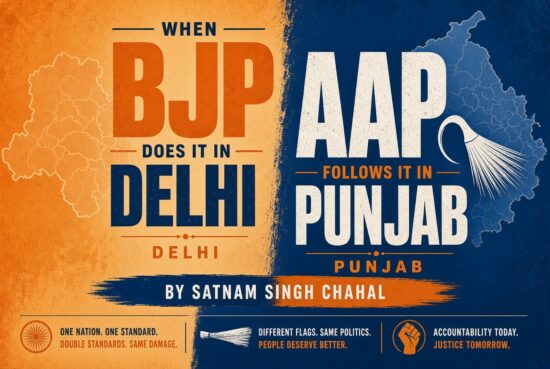
Punjab politics increasingly looks like a strange political mirror. What the BJP does in Delhi, the AAP government is often accused of doing in Chandigarh only with a different press release.AAP built much of its political identity by presenting itself as an alternative to the established parties. It promised a new style of politics, greater transparency and accountability. Yet critics now argue that once in power, AAP has adopted many of the same political habits that it once condemned.
The irony becomes sharper when the subject is the use of government institutions. AAP has repeatedly accused the BJP-led Centre of misusing agencies such as the ED and CBI against political opponents. Those are serious allegations and deserve scrutiny. But the same principle should apply in Punjab: if political power must not be used to silence opponents in Delhi, it must not be used to silence opponents in Chandigarh either.
The same contradiction can be seen in the treatment of the Opposition. When AAP was in Opposition, it demanded that Parliament and state assemblies give the Opposition adequate time to raise public issues. Today, Punjab’s Opposition parties frequently accuse the government of refusing to listen to them and of limiting meaningful debate.
There is nothing wrong with a government having a strong majority. But democracy is not simply about counting government MLAs. Democracy also means allowing uncomfortable questions to be asked — and answering them.
AAP has also spent years accusing the BJP of excessive centralisation of power. Yet critics in Punjab now raise similar concerns about decision-making becoming increasingly concentrated around the Chief Minister’s office and a small political circle.
This creates an obvious question: Is centralisation wrong only when the BJP does it?
The same double standard appears whenever governments face controversy. When something goes wrong under the BJP, AAP demands accountability and asks why the responsible minister has not resigned. But when controversy reaches Punjab, the response can sometimes become denial, political counterattack or an accusation that the Opposition is trying to destabilise the government.
That is not a standard. That is a political convenience.
The people of Punjab also deserve clarity about responsibility. AAP frequently blames the Centre for Punjab’s financial difficulties, withheld funds, agricultural problems and other challenges. The Centre may indeed have responsibilities, and Punjab has every right to demand its legitimate share.
But a state government cannot blame Delhi for everything that goes wrong in Chandigarh.
If schools have vacancies, the Punjab government has responsibility. If the health system struggles, the Punjab government has responsibility. If law and order deteriorates, the Punjab government has responsibility. If recruitment is delayed or allegations of irregularities arise, the Punjab government must answer.
Government cannot operate on the formula: success belongs to Chandigarh, failure belongs to Delhi.
Perhaps the biggest irony is that AAP once presented itself as the party that would change Indian politics. Instead, critics now argue that it is slowly becoming another establishment party — defending its own government with the same arguments that it once rejected when used by others.
The BJP has often been accused of saying one thing in Opposition and another thing in government. AAP should be careful not to fall into exactly the same trap.
Punjab does not need BJP-style politics with an AAP label. It does not need one party copying another party’s worst habits while claiming to represent a new political culture.
The test of a government is not how it treats supporters. The real test is how it treats critics, protesters, journalists, Opposition leaders and ordinary citizens who ask difficult questions.
If misuse of institutions is wrong in Delhi, it is wrong in Punjab. If suppressing dissent is wrong in Parliament, it is wrong in the Punjab Assembly. If accountability is necessary for the BJP, it is equally necessary for AAP.
The people of Punjab are not asking for political perfection. They are asking for consistency.
Because ultimately, the question is not whether BJP does it in Delhi or AAP does it in Punjab.
The question is: why should any government get away with it?