
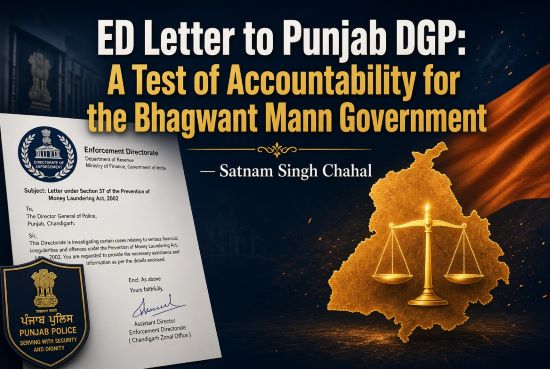
The Enforcement Directorate’s reported communication to Punjab DGP Gaurav Yadav seeking registration of a case against Chief Minister Bhagwant Mann’s Officer on Special Duty (OSD) Rajbir Singh Ghumman has turned into one of the most politically explosive controversies in Punjab. The issue is no longer merely about political allegations exchanged between the ruling AAP and opposition parties. The central question is simple: what will the Punjab Police do when a central investigating agency places serious allegations and investigative material before the state police?
According to reports, the ED communication arose from an investigation under the Prevention of Money Laundering Act (PMLA) involving a Chandigarh-based housing society and its associates. The agency reportedly conducted searches at multiple locations between May 7 and 10, 2026, during which approximately ₹21 lakh in cash was seized. The ED is also reported to have examined digital material, including WhatsApp conversations, which allegedly contained discussions concerning transfers and postings of government officials.
The most serious aspect of the reported material is the allegation that an organised network may have been attempting to influence government transfers, postings, licences, tenders and land-related matters. The ED has reportedly referred to more than 20 alleged instances between 2023 and 2026 involving IAS, IPS, PCS and DSP-rank officers. It has also reportedly mentioned allegations involving cash payments and hawala transactions. These are allegations at this stage, not established findings of guilt, and every person named or implicated is entitled to due process and the presumption of innocence.
But that legal principle cuts both ways. If the allegations are false, the government should welcome a transparent investigation so that the record can be cleared. If the material does disclose cognisable offences, however, there can be no justification for burying the matter under political arguments, administrative delays or claims that the controversy is merely opposition propaganda.
The reported ED letter is particularly significant because it allegedly asks the Punjab DGP to register a case and refers to possible offences under laws including the Prevention of Corruption Act and the Official Secrets Act, along with relevant criminal-law provisions. The ED has reportedly cited Supreme Court directions concerning registration of an FIR where information discloses a cognisable offence.
That puts the Punjab Police leadership in a difficult but straightforward position. The DGP cannot be expected to act on political speeches, but neither can a formal communication from an investigating agency containing alleged evidence simply be treated as political noise. The proper course is investigation according to law.
The controversy has also triggered a fierce political battle. SAD leader Bikram Singh Majithia has questioned Chief Minister Bhagwant Mann over Ghumman’s alleged access to the government and has demanded answers about the alleged transfer-posting network. AAP leader and Finance Minister Harpal Singh Cheema, meanwhile, has accused the opposition of using the issue for political purposes. The dispute has consequently become another battlefield in Punjab’s increasingly bitter politics.
But Punjab’s taxpayers are not interested in a political shouting match. They deserve answers. Was there an organised system for influencing transfers and postings? Were officials approached or pressured? Did money change hands? Were confidential government documents accessed or circulated improperly? Were licences, tenders or land transactions manipulated? And, most importantly, who ultimately benefited?
These questions cannot be answered through press conferences or counter-allegations. They require an impartial investigation, examination of the digital evidence, financial trails, statements of witnesses and scrutiny of every transaction identified by investigators.
The political stakes are enormous because the allegations touch the functioning of the government itself. If an OSD or any unofficial intermediary had the ability to influence postings, transfers or administrative decisions, that would raise a much larger question about the system of governance in Punjab. A government cannot function through unofficial power centres operating behind the formal machinery of the state.
The opposition has every right to demand accountability, but it must also avoid declaring anyone guilty before investigation and trial. Similarly, the government has every right to challenge allegations, but it cannot demand credibility for itself while resisting an investigation that could establish the truth.
The ED’s communication therefore presents an opportunity rather than merely a crisis. The Punjab government can demonstrate that its oft-repeated claims of transparency and zero tolerance for corruption are more than political slogans. Let the Punjab Police register whatever case the law requires, conduct a fair investigation and place the facts before the public and the courts.
If the allegations are baseless, expose them. If they are true, prosecute those responsible. If the evidence leads elsewhere, follow it wherever it goes.What Punjab does not need is another political drama in which one side shouts “corruption” and the other shouts “political conspiracy,” while the actual truth disappears somewhere in between.The real test now is not of the ED, the opposition or the ruling AAP. It is a test of Punjab’s institutions. Will the DGP follow the evidence wherever it leads or will the powerful once again find a way to make an investigation disappear?Punjab deserves an answer, and this time, the answer should come from an FIR, an investigation and evidence not from a press conference.
Disclaimer: This article and accompanying images are for informational and illustrative purposes only. Some visuals may be AI-generated or digitally enhanced and may not depict actual events or persons.Views expressed are based on publicly available information and analysis