
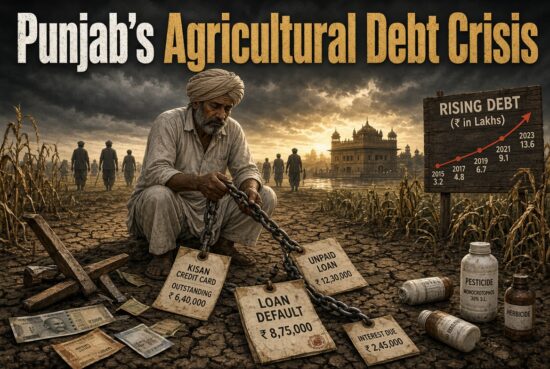
Punjab’s agricultural debt crisis remains one of the most severe in India, despite the state’s central role as the country’s “food bowl” through large-scale wheat and paddy production under the Minimum Support Price (MSP) system.
Scale of the Crisis: As of data up to March 2024 (with later reports confirming continued rise), Punjab’s institutional farm debt exceeded ₹1 lakh crore. Commercial banks alone accounted for around ₹85,460 crore across 23.28 lakh accounts. Cooperative banks held about ₹10,021 crore and regional rural banks ₹8,583 crore, bringing the institutional total to roughly ₹1.04 lakh crore. Non-institutional debt (from commission agents or aarthiyas and moneylenders) is estimated at an additional ₹20,000 crore or more, pushing the overall burden toward ₹1.24 lakh crore.
Average outstanding debt per agricultural household stands at ₹2.03 lakh — the third-highest in India after Andhra Pradesh and Kerala, and nearly three times the national average of about ₹74,000. Over 50–80% of farm households are indebted, with the figure exceeding 80% among marginal and small farmers. Average liability per operational landholding approaches ₹9–10 lakh in some analyses. Outstanding agricultural loans total around ₹97,471 crore across 25.23 lakh accounts (average ~₹3.86 lakh per account). Defaults to cooperative agricultural development banks alone reached ₹3,006 crore involving over 55,000 farmers.Kisan Credit Card (KCC) outstanding debt rose steadily, reaching ₹57,536 crore by March 2025 even as the number of active cards declined, indicating higher exposure per borrower.
Root CausesThe crisis is structural rather than temporary. Punjab’s post-Green Revolution model locked farmers into a high-input, water-intensive wheat-paddy monoculture covering over 90% of cultivated land. Yields have largely plateaued while input costs (seeds, fertilizers, pesticides, diesel, labour, and mechanization) have risen sharply. MSP provides an assured buyer but does not guarantee viable margins; increases have often lagged actual cultivation costs.
Many loans fund not only crop production but also household expenses healthcare, education, marriages, and social obligations due to uneven cash flows. Informal credit from aarthiyas remains pervasive because it is fast and flexible, yet effective interest rates frequently reach 18–24% or higher once compounding and adjustments are included. Falling groundwater tables, soil degradation, and climate risks further erode profitability and force fresh borrowing.
The system prioritizes national food security through procurement while leaving farmers to absorb rising costs and risks with limited institutional support for diversification or risk mitigation.ConsequencesHigh debt has been repeatedly linked to severe psychological stress and farmer suicides. Land alienation risks rise when recovery proceedings target mortgaged holdings, and small farmers face particular vulnerability. The state’s own fiscal stress (public debt exceeding ₹4 lakh crore by 2026 and projected higher) limits its capacity for large-scale relief. Cooperative banks have struggled with non-performing assets, restricting fresh lending and increasing dependence on high-cost informal sources.
Broader fallouts include out-migration, pressure on rural livelihoods, and reduced long-term investment in sustainable farming.Policy Responses and ChallengesGovernments have announced loan waivers and relief schemes periodically, but these offer temporary respite without addressing underlying viability. Recent efforts include targeting recovery from large landholders (over 20 acres) who account for a significant share of cooperative defaults, while exploring one-time settlement options for smaller farmers. NABARD refinancing to cooperative banks has been constrained by poor recovery. The Punjab Agriculture Policy 2023 proposed measures such as debt settlement schemes, pensions for small farmers and workers, and better price mechanisms, but implementation has faced delays.
Calls persist for structural reforms: aligning MSP more closely with real costs, regulating informal credit, expanding crop insurance, promoting diversification (including value addition and non-farm income), improving formal credit access with lower transaction costs, and addressing environmental sustainability.In summary, Punjab’s agricultural debt crisis reflects a high-credit, high-debt model trapped in diminishing returns from the Green Revolution paradigm. Without deeper reforms that improve farm profitability, reduce risk, and integrate formal credit more effectively, the cycle of indebtedness is likely to persist, undermining both rural livelihoods and the state’s long-term economic health.
Disclaimer: This article and accompanying images are for informational and illustrative purposes only. Some visuals may be AI-generated or digitally enhanced and may not depict actual events or persons.Views expressed are based on publicly available information and analysis