
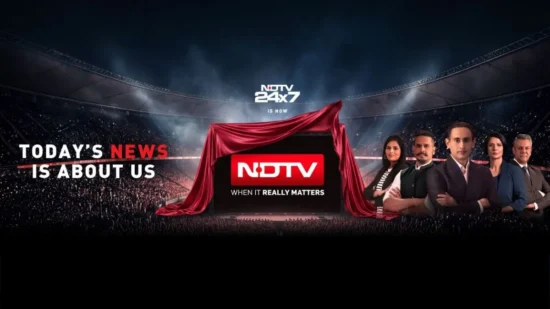
 NDTV may call its new logo a new identity. It may present the dropping of “24×7” as an evolution, from a television channel into a news brand that speaks across screens, platforms and formats. But the fundamental question is not how the channel looks. It is what it chooses to see, what it chooses to say, and whom it chooses to question.
A fresh logo, sleek graphics and an evocative slogan cannot substitute for independent journalism. If the content remains selective, if inconvenient facts are softened or ignored, if those in power are treated with excessive deference while critics are subjected to relentless scrutiny, then the new identity will be no more than cosmetic packaging.
29 November 2022: The Day the Brand Walked Out the Door
Here is the date that matters more than any date on a rebranding press release: 29 November 2022, close of business hours. That is when Dr Prannoy Roy and Mrs Radhika Roy resigned as Directors of RRPR Holding Private Limited — the promoter vehicle through which the Adani Group’s Vishvapradhan Commercial Private Limited had, weeks earlier, converted a decade-old debt instrument into a controlling stake. By 30 December 2022, the exit was complete: the Roys and four independent directors resigned from the NDTV board itself, and Adani Enterprises, through its subsidiaries, held 64.71 per cent of the company they had built from a production house in 1988 into India’s most trusted news brand of its era.
A brand is not a font. A brand is the accumulated credibility of the people who built it — the heart of the institution, kept beating by editorial judgement and objectivity, spent daily rather than banked. When Prannoy Roy left, and when Radhika Roy left with him, what departed was not a name on a masthead — it was the only asset NDTV actually possessed that a competitor could not simply replicate with a bigger studio and a better transmission tower. Brand equity rarely shows up on a balance sheet until the day it has evaporated. Ask any working journalist in Delhi, and they will tell you: the NDTV that mattered left with its founders, in instalments, between August and December of 2022.
What remains is a collaboration of sophisticated equipment and communication channels. Transponders, OB vans, a bouquet of language feeds, a distribution footprint most rivals would envy. Nothing else. An editorial board perceived, rightly or wrongly, to answer to its new owner’s interests cannot manufacture the two things a newsroom cannot buy off the shelf: an ethics that holds under pressure from the people who sign the cheques, and the presumption, in the viewer’s mind, that what appears on screen was chosen because it was true and important, not because it was convenient.
The Test Remains the Test
The credibility of a news organisation is not designed in a branding studio. It is earned in the newsroom — through the stories it pursues, the questions it asks, the voices it includes, the integrity it protects when protecting it costs something, and the powerful interests it refuses to spare. A channel that routinely amplifies official claims without adequate interrogation, marginalises dissent, and converts public debate into spectacle cannot repair its reputation by changing fonts and colour palettes.
There was a time when NDTV carried a certain expectation: that news would be reported with restraint, that facts would precede noise, and that power would be held to account. That legacy cannot be invoked merely as heritage. It must be practised daily. In a democracy, journalism is not public relations for the government of the day; nor is it a competition in patriotic theatrics.
If the new NDTV is to be more than an old shell with a new emblem, it must show its change in editorial conduct. It must cover unemployment, inequality, agrarian distress, communal violence, institutional erosion and the concerns of India’s margins with the same energy it reserves for officially curated narratives. It must invite genuine plurality of opinion — not a stage-managed balance in which criticism is outnumbered, interrupted or caricatured.
It shows up in decibel levels — anchors who mistake volume for authority, and panels where the dissenting guest is talked over while the ruling party’s spokesperson is heard out in full. It shows up in a moderator whose allegiance is no longer disguised, so that the viewer stops asking whether the studio is neutral and starts asking which party the anchor is actually there to defend — the channel’s own, or the one in power. It shows up in advertiser arrangements struck on terms no ordinary business would be offered, and in advertorials carried under a reporter’s byline, without the disclosure any honest newsroom would insist on.
The test is straightforward. Does the channel scrutinise the government with the same rigour it applies to the Opposition? Does it distinguish national interest from the political interest of those who govern? Does it allow facts that discomfort its owners, advertisers, allies or political patrons to reach its audience unvarnished?
Unless the answers change, the logo changes nothing.
For a media house widely perceived as part of the Godi Media ecosystem since ownership changed hands, a rebranding exercise cannot by itself restore trust — that will show up in headlines, debates and investigations, not promotional films. Otherwise, “When It Really Matters” will remain a slogan of unintended irony, dressed in a new typeface.
At one time, I was of the opinion that India has a free press, but not an independent press. Full stop. Today, I am doubting even the first postulate. That is not cynicism speaking. It is conscience.
A news channel does not become credible because it declares a new identity. It becomes credible when it has the courage to retain its old purpose — a purpose that, in NDTV’s case, left the building on 29 November 2022 and has not yet found its way back in.
Was I the only one who read it as WHEN IT RE_ALLY MATTERS?