
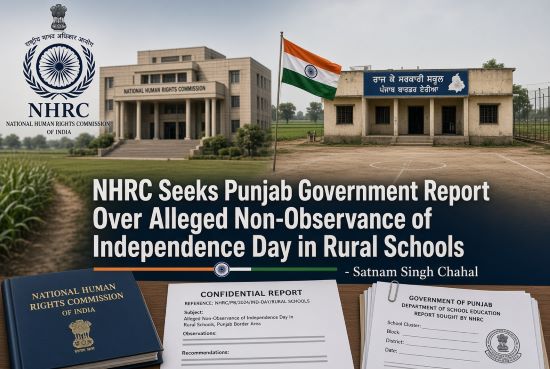
 The National Human Rights Commission (NHRC) has taken cognizance of a complaint alleging that Independence Day was not properly observed in certain government schools located in Punjab’s rural, remote and border areas.The development has raised serious questions about the functioning of government schools in some of the state’s most geographically vulnerable regions. Independence Day is not merely a ceremonial occasion; the hoisting of the national flag, singing of the National Anthem and participation of students are important aspects of civic and constitutional awareness in educational institutions.
According to the complaint, there were allegations that some government schools failed to observe the occasion in the prescribed manner. The NHRC has now sought school-wise information from the Punjab Government to establish what actually happened on Independence Day.The Commission has reportedly asked the state government to provide detailed information regarding flag hoisting, the playing or singing of the National Anthem and student participation in each concerned school. The government has also been asked to explain the reasons for any alleged non-compliance.
The matter has been taken seriously enough for the Punjab Chief Secretary to be directed to submit a compliance report within four weeks. The direction effectively puts the state administration under an obligation to verify the allegations rather than treating them as a routine administrative complaint.The school-wise nature of the information sought is particularly significant. Instead of accepting a general statement from the Education Department, the NHRC wants the government to establish what happened at the individual-school level. This could reveal whether the alleged lapses were isolated incidents, administrative failures or part of a wider problem affecting schools in remote areas.
Questions for the Punjab Government
The controversy also raises several basic questions. Were head teachers and school authorities properly instructed regarding Independence Day celebrations? Were flags available at every government school? Were teachers and students present? Was the National Anthem observed? If students did not participate, what were the reasons?These questions become even more important in Punjab’s border and remote areas, where government schools often serve as the primary institutional link between the state and local communities.The government should therefore treat the NHRC notice not simply as another administrative requirement but as an opportunity to conduct a transparent assessment of the functioning of its schools.
Accountability Must Reach the Ground
Government orders and departmental circulars have little meaning if they do not reach the last school, the last teacher and the last student.If the allegations are found to be correct, responsibility should not end with an explanation from the Education Department. The administration must determine why instructions were allegedly not followed and whether there were failures at the district, block or school level.At the same time, allegations should not be treated as established facts until the government’s verification is completed. The NHRC’s intervention provides an opportunity for an objective fact-finding exercise.
The Punjab Government now has four weeks to place its compliance report before the Commission. The public will reasonably expect that report to contain facts, school-wise figures and clear explanations not merely a routine bureaucratic response.
For a state that regularly speaks about education, equality and the rights of children, ensuring that every government school observes the national occasion properly should be the most basic responsibility.The real test will now be whether the Punjab Government produces a transparent, school-wise account—and whether action follows if the allegations are proved.