
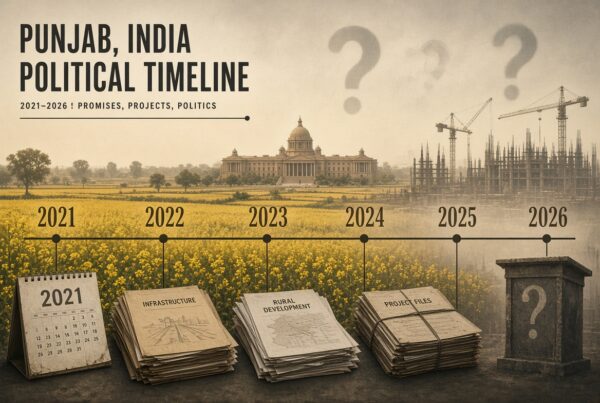
Punjab Chief Minister Bhagwant Mann’s recent announcement to add 10 lakh new beneficiaries to the ration-card system, including around 3 lakh e-Shram-registered and migrant workers, has been welcomed as a food-security measure. Every deserving family should receive food support, and nobody should object to genuine welfare reaching the poor. But the announcement also raises a legitimate question: why are court-directed or long-pending welfare measures being presented years later as major new achievements?
The chronology is particularly important. During the COVID-19 crisis in 2021, the Supreme Court directed states to provide dry rations to migrant workers, including workers who did not possess ration cards, and directed that appropriate schemes be implemented.
Then, in April 2023, the Supreme Court directed States and Union Territories to issue ration cards under the National Food Security Act to eligible migrant and unorganised workers registered on the e-Shram portal who did not have ration cards. Reports at the time said the direction covered around eight crore people nationally.
The Supreme Court again pressed governments in July 2024 to issue ration cards to eligible migrant and unorganised-sector workers registered on e-Shram. The court’s intervention made it clear that food security could not be delayed indefinitely simply because beneficiaries were outside existing administrative databases.
Yet Punjab is now, in July 2026, announcing that around three lakh e-Shram and migrant workers will be brought under the NFSA as part of a 10-lakh-beneficiary expansion. The other seven lakh are to come through fresh applications and inclusion of new family members in existing cards.
This creates a very reasonable public question: What happened between 2023, 2024 and 2026? If eligible e-Shram workers were already covered by Supreme Court directions, why did it take so long for Punjab to announce their inclusion? How many eligible people were identified earlier? How many applications were pending? How many were rejected? And how many people actually received benefits during those years?The government should answer these questions with data rather than political speeches.
There is an additional reason for scrutiny. Official data placed before Parliament in August 2026 showed that Punjab deleted 2,89,334 NFSA ration cards between 2021 and 2025. Punjab had around 40.93 lakh ration cards covering about 1.52 crore NFSA beneficiaries according to the cited central data. Therefore, the public deserves to know the complete picture: How many cards were deleted? How many were added? How many beneficiaries were removed as ineligible? How many genuine beneficiaries were subsequently restored? And how many of the newly announced 10 lakh beneficiaries are genuinely new beneficiaries rather than people who were previously excluded from the system?This is not an argument against ration cards. It is an argument for transparency in welfare administration.
There is also a political contradiction worth examining. In 2025, the Punjab government and the Centre were engaged in a major dispute over ration-card verification and alleged deletions. Mann accused the Centre of attempting to remove large numbers of beneficiaries, while opposition leaders accused the Punjab government of misleading people and pointed to the state’s own role in beneficiary verification. In August 2025, BJP leaders also alleged irregularities in Punjab’s ration-card database, including duplicate beneficiaries, deceased beneficiaries and other allegedly ineligible entries. Those were political allegations and should not be treated as established facts without independent verification, but they demonstrate why the database needs a transparent, publicly verifiable audit. The government should therefore publish a 2021–2026 ration-card white paper. It should clearly show the number of cards and beneficiaries year by year, additions, deletions, e-KYC status, pending applications, rejected applications, reasons for rejection and the number of migrant and e-Shram workers brought into the NFSA system.
The Same Question Applies to Other Announcements
The ration-card issue is part of a larger political culture in which governments often announce schemes at the moment they become politically useful, even when the groundwork, court directions or budgetary commitments began years earlier.Take the Meri Rasoi scheme. The Punjab Budget for 2026–27 allocated ₹900 crore for the programme, covering nearly 40 lakh families with additional food items. The government also announced expansion to another 10 lakh beneficiaries. Again, the welfare objective is positive. But the public question should be: How much money has actually been spent, how many families have actually received the promised kits, how regularly are they being distributed, and what is the administrative cost?
The same principle should apply to every major welfare announcement—health insurance, employment, education, housing, pensions, ration, electricity subsidies or infrastructure.A government should not receive political credit simply because it announces a benefit. Credit should come when the benefit reaches the intended citizen.
Announcements Are Not Deliveries
Punjab’s people have heard thousands of announcements from governments of different political parties. Foundation stones have been laid, projects announced, schemes launched and committees formed. But the real test is always the same:
How much was promised?
How much money was allocated?
How much was actually spent?
How many people benefited?
When did they receive the benefit?
And what happened to those who were left out?
This is particularly important as Punjab moves closer to the 2027 Assembly election. Welfare announcements inevitably acquire political significance during an election year. Opposition parties will call them election gimmicks; the ruling party will call them governance. The public should do neither automatically.Instead, citizens should demand the numbers.If the Mann government has genuinely corrected years of exclusion and is finally bringing three lakh e-Shram and migrant workers into the food-security system, it should be able to proudly publish the complete record.But if a Supreme Court-directed obligation has taken years to implement, the government should also explain why the delay occurred and who was responsible for it.
The Supreme Court Should Not Become a Political Credit Certificate
There is a fundamental constitutional principle here.When the Supreme Court directs governments to protect the rights of vulnerable citizens, implementation is not a favour to the people. It is an obligation.Therefore, if today’s ration-card expansion is connected to previous Supreme Court directions, the government should not merely say, “We are giving ration cards because of our commitment to the poor.”
It should say:
“Here was the Supreme Court’s direction. Here is what Punjab did. Here is what remained pending. Here is why it remained pending. And here is what we are completing today.”That would be genuine accountability.The people of Punjab do not need political packaging. They need food in their homes, jobs for their children, functioning hospitals, good schools, roads, law and order and transparent government.Announcements can make headlines for one day.Delivery remains in the lives of the people for years.And that is why the question surrounding the latest ration-card announcement is perfectly legitimate:
If the need was identified years ago and the courts had already intervened, why did Punjab wait until 2026 to make it a major political announcement?
The answer should come not through slogans, but through a public 2021–2026 performance report.
Disclaimer: This article and accompanying images are for informational and illustrative purposes only. Some visuals may be AI-generated or digitally enhanced and may not depict actual events or persons.Views expressed are based on publicly available information and analysis