
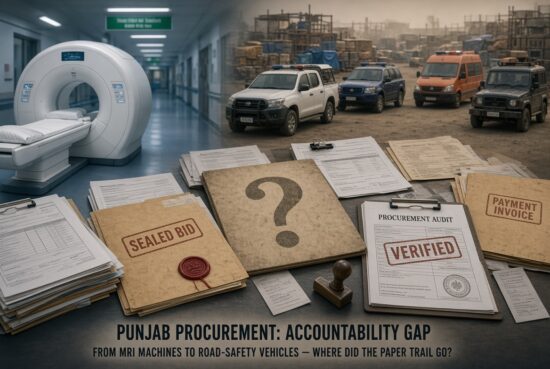
Punjab has witnessed a steady expansion of government procurement in recent years from expensive medical equipment and MRI machines to police vehicles, emergency-response vehicles and the fleet of the Sadak Surakhiya Force. Government officials present these purchases as investments in better healthcare, policing and public safety. But whenever large amounts of public money are involved, one basic question must be asked: Were these purchases made transparently, competitively and strictly in the public interest?
The issue is not whether Punjab needs MRI machines, ambulances, police vehicles or road-safety vehicles. It unquestionably does. The real question is whether taxpayers are receiving maximum value for every rupee spent, whether procurement rules are being followed, and whether there is sufficient independent scrutiny of the contracts.
MRI machines: a procurement trail that deserves scrutiny
The record shows that Punjab has been undertaking procurement of high-end MRI equipment through formal tendering processes. In February 2024, Baba Farid University of Health Sciences, Faridkot, floated a tender for the supply and installation of a 3 Tesla MRI machine, with the tender documents providing for technical and financial bids.
The process continued into 2025–26. In December 2025, Punjab’s Health Department advertised a tender for a 3 Tesla MRI machine on a turnkey basis for the Punjab Institute of Liver and Biliary Sciences in SAS Nagar. The bid was opened in January 2026 and the financial bid was scheduled for February 2026.
Separately, the Punjab Institute of Mental Health procurement process included a tender for a 1.5 Tesla wide-bore MRI machine, along with other diagnostic equipment. The official pre-bid record shows that the tender was advertised in December 2025 and discussed at a pre-bid meeting in January 2026.
These documents by themselves do not establish corruption or wrongdoing. But they establish something important: there have been multiple significant MRI-related procurement exercises, and therefore there should be complete public disclosure of the final cost, winning bidder, technical specifications, warranty, maintenance agreement, installation date and actual operational status of each machine.
Road-safety vehicles: another major area of expenditure
The same questions arise regarding the Sadak Surakhiya Force (SSF).
The concept was announced in 2023, with the government planning a dedicated road-safety force equipped with specially selected vehicles and modern equipment. The initial plan included 144 dedicated vehicles.
By November 2024, the Punjab government had announced the release of ₹55 crore for the Sadak Surakhiya Force and said the force had been equipped with 144 highway patrol vehicles. An additional ₹7 crore was sanctioned for electronic equipment.
The government has subsequently highlighted the SSF as one of its major successes. Official figures cited in 2026 said that from February 2024 to January 2026, the force responded to nearly 44,000 road accidents, assisted more than 47,000 people, provided first aid to nearly 20,000 people and shifted more than 27,000 injured people to hospitals.
There is therefore a legitimate public benefit to the programme. But success of a programme does not eliminate the need for financial scrutiny. How much did each vehicle cost? Which companies supplied them? What were the technical specifications? How were tenders evaluated? What was the cost of maintenance, fuel, equipment and replacement?
Police and emergency-response vehicles: the numbers keep growing
The scale becomes even more significant when police and emergency-response vehicles are included.
In April 2026, Chief Minister Bhagwant Mann flagged off 508 new emergency response vehicles under the Dial-112 system. The government said these vehicles would take the fleet to 764 and were equipped with GPS, dash cameras and mobile-data systems. Mann also stated that Punjab had spent ₹327.69 crore since 2022 on 2,904 new police vehicles.
The same announcement said the government had procured 22 vehicles for the Anti-Narcotics Task Force and allocated another ₹11.45 crore for vehicle procurement in 2026–27.
Again, buying vehicles for police and emergency services is not inherently questionable. In fact, modern emergency services require modern fleets. But the larger the procurement programme becomes, the greater the need for transparent tendering, competitive pricing and independent auditing.
The timeline raises a bigger question
2023: Punjab announced the Sadak Surakhiya Force, initially planning a fleet of dedicated highway vehicles.
January 2024: The SSF was launched, with the government subsequently reporting significant reductions in highway fatalities.
February 2024: A 3 Tesla MRI machine procurement tender was issued through Baba Farid University of Health Sciences.
November 2024: ₹55 crore was sanctioned for the SSF, including its 144 highway patrol vehicles, with another ₹7 crore for electronic equipment.
2025: Punjab continued expanding police modernisation and medical infrastructure procurement.
December 2025–February 2026: A new 3 Tesla MRI procurement process was conducted for the Punjab Institute of Liver and Biliary Sciences, while another MRI procurement process covered the Punjab Institute of Mental Health.
April 2026: The government announced 508 new Dial-112 emergency vehicles and disclosed that ₹327.69 crore had been spent on 2,904 police vehicles since 2022.
Allegations should lead to investigation, not political shouting
If allegations have been made about these purchases, the proper response should not simply be a political exchange of accusations.
The Punjab government should publish a complete procurement dashboard covering major purchases since 2022. It should disclose the original estimated cost, tender value, final contract value, number of bidders, successful bidder, technical evaluation criteria, delivery schedule, warranty and maintenance costs.
For MRI machines, the government should additionally disclose where each machine is installed, when it became operational, how many patients have used it and whether any machine remained unused after purchase.
For road-safety and police vehicles, the government should disclose the per-vehicle purchase price, specifications, supplier, maintenance contract and deployment location.
And if any complaint alleges inflated prices, manipulation of specifications, favouritism toward a particular supplier or violation of procurement rules, the matter should be examined by an independent audit or vigilance investigation, rather than dismissed merely because the equipment serves a legitimate public purpose.
Punjab cannot afford procurement without accountability
Punjab is already under enormous fiscal pressure. That makes every major expenditure more important—not less.
A government can legitimately spend money on hospitals, MRI machines, ambulances, police vehicles and road safety. In fact, these are precisely the areas where public money should be spent. But necessary expenditure must still be economical expenditure.
The central issue is therefore simple:
Punjab does not need fewer MRI machines, fewer ambulances or fewer safety vehicles. Punjab needs greater transparency about how these machines and vehicles are purchased.
Public money belongs to the people. Every procurement should therefore withstand three tests: Was it necessary? Was it purchased at the right price? And was the process completely transparent?
Until those questions are answered with documents rather than political statements, allegations surrounding major government purchases will continue to raise doubts.
The demand should not be for politics—it should be for an independent, transaction-by-transaction audit of major Punjab government procurements since 2022.