
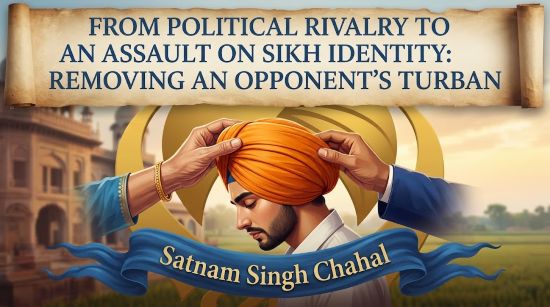
 Punjab’s political culture is facing a deeply troubling question: why does a confrontation with a Sikh opponent so often risk turning into an attack on his turban? Whether the dispute involves political parties, elected representatives, student elections or religious institutions, incidents in which a Sikh man’s turban is pulled off, knocked away or dislodged during a confrontation continue to raise concerns about respect, restraint and accountability.
For Sikhs, the dastaar is not an ordinary item of clothing. It represents dignity, identity, responsibility and a living connection with Sikh tradition. Removing another person’s turban to humiliate or intimidate them is therefore not simply an act of physical aggression; it can also inflict profound personal and religious hurt. Political disagreement must never become an excuse to attack a person’s identity.
Timeline: Incidents that have raised concern
March 28, 2011 — Mohali: During a protest by rural veterinary pharmacists and employees near the Punjab Cricket Association stadium, police forcibly removed a Sikh protester’s turban, according to reports and subsequent fact-checking. The incident became an example of how the handling of a protest can turn into a serious question of Sikh dignity and police conduct.
June 22–23, 2017 — Punjab Vidhan Sabha, Chandigarh: During disorder in the Assembly as Aam Aadmi Party MLAs were being evicted, the turban of AAP MLA Pirmal Singh Khalsa came off in the melee. The episode demonstrated that even the state’s highest legislative forum was not immune to confrontations in which a Sikh representative’s turban became part of the public spectacle. <Cite refs={[“turn224515view1″,”turn223874search11”]} />
January 24–25, 2021 — Singhu border: Congress MP Ravneet Singh Bittu and Congress MLA Kulbir Singh Zira were caught up in a confrontation while attending a gathering linked to the farmers’ movement. Contemporary reporting said Bittu was manhandled and his turban was tossed, while Zira’s turban was also removed. Bittu alleged that he had been attacked; the episode intensified political tensions surrounding the farmers’ protest. The incident illustrated the danger of allowing political hostility to overwhelm basic respect for an opponent.
September 21–23, 2024 — Sri Guru Tegh Bahadur Khalsa College, Delhi: A clash between student groups over election nominations reportedly resulted in a student’s turban coming off. Police registered an FIR relating to assault and hurting religious sentiments. The incident showed that the problem was not confined to senior politicians: the same pattern of confrontation could emerge among young people contesting campus elections.
December 2025 — Dera Baba Nanak, Punjab: Gurdaspur MP Sukhjinder Singh Randhawa protested alleged misconduct during the nomination process for block committee and zila parishad elections. According to his complaint, Sikh candidates were threatened and their turbans were forcibly removed by supporters of an AAP MLA. These were allegations raised by Randhawa and should be distinguished from any final judicial finding. Nevertheless, the complaint brought the issue back into the political spotlight during a local election process.
March 20, 2026 — Shahabad, Haryana: A dispute linked to the management of the Miri Piri Institute of Medical Sciences and Research reportedly escalated into a confrontation in which Haryana Sikh Gurdwaras Management Committee vice-president Gurbir Singh Talakaur was allegedly assaulted and his turban forcibly removed. Police subsequently registered an assault-related case against several religious leaders. The dispute reflected the serious consequences that can follow when institutional and religious disagreements descend into physical confrontation.
Has humiliation become a political tactic?
These incidents span different years, locations and circumstances. They do not establish that every case has the same motive, nor do they by themselves prove a statistically measured increase in turban-removal incidents. But their recurrence is sufficient to demand serious public attention. When similar episodes appear in legislative proceedings, farmers’ protests, campus elections, local political contests and institutional disputes, the public has reason to ask whether the deterrent against such behaviour is strong enough.
A disturbing double standard can emerge in political life: leaders speak about Punjab’s honour and Sikh heritage when addressing the public, yet supporters or opponents may fail to show basic restraint during a heated confrontation. No political party can credibly claim to defend Sikh dignity while excusing an attack on a rival’s turban simply because the person belongs to another party.
The turban must never become a weapon in political theatre. Nor should its significance be used selectively—defended when a political ally is affected but ignored when the victim belongs to a rival organisation. The principle must remain consistent, regardless of party affiliation, religious institution, ideology or social status.
What should the authorities do?
First, police must promptly investigate credible complaints, preserve video evidence, identify those responsible and act according to the law. Second, political parties and election authorities should make clear that violence, intimidation and the deliberate humiliation of candidates are unacceptable during nominations, campaigns, protests and public meetings. Third, where an allegation is substantiated, the consequences should be determined transparently through due process rather than political bargaining.
Sikh religious institutions and community organisations also have a role to play. They should condemn the deliberate removal of a turban consistently, irrespective of who the victim is or who is accused. A turban should not receive protection only when a controversy attracts media attention.
Punjab needs disagreement without humiliation
Democracy depends on the right to oppose, criticise, protest and compete. It does not give anyone the right to assault an opponent or deliberately degrade their religious identity. A person’s political views may be challenged vigorously, but their dignity must remain protected.
The central question is no longer merely who removed whose turban in a particular confrontation. It is whether Punjab’s political and social institutions are willing to establish a clear boundary that nobody is permitted to cross.
Punjab Outlook’s view: The dastaar must remain above party politics. Every incident should be investigated on its own evidence, every victim should receive equal protection, and every person found responsible should face the lawful consequences. If the removal of an opponent’s turban is allowed to become an accepted method of intimidation, the damage will extend far beyond one individual—it will weaken the respect, restraint and democratic culture that Punjab urgently needs.
Disclaimer: This article and accompanying images are for informational and illustrative purposes only. Some visuals may be AI-generated or digitally enhanced and may not depict actual events or persons.Views expressed are based on publicly available information and analysis