
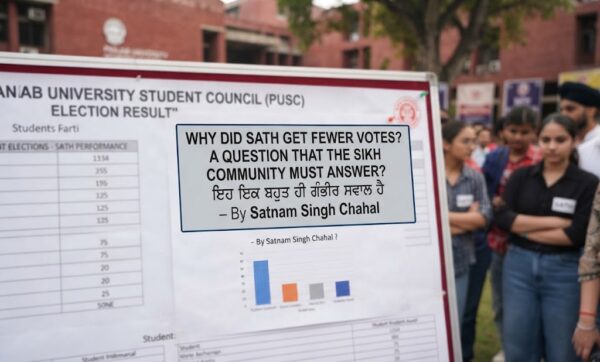
The Panjab University student elections should not be viewed merely as another routine campus election. The voting pattern and performance of SATH deserve serious discussion, particularly among those who genuinely want to see stronger Sikh representation and a more effective voice for Sikh students. SATH may have received fewer votes than expected, but it would be completely wrong to interpret this simply as a rejection of the organisation by students. The result should instead become an opportunity for honest introspection, not only for SATH but also for the Sikh organisations and individual Sikh leaders who claim to be concerned about the political and social future of Sikh youth.
SATH certainly has weaknesses, and its leadership must be prepared to recognise them. No organisation should consider itself beyond criticism. Its campaign strategy, candidate selection, voter outreach, communication with students and organisational structure all need continuous improvement. But there is another uncomfortable question that must be asked openly: What role did the opposition or lack of support from certain Sikh organisations and individual Sikh leaders play in weakening SATH’s electoral position? When people who broadly share the same concerns choose to divide their support instead of finding common ground, the consequences are naturally reflected at the ballot box.
SATH has already demonstrated that it has a meaningful presence among Panjab University students. Its previous electoral success, including winning the vice-president’s position, showed that the organisation has committed supporters and an established campus network. Therefore, it would be simplistic to conclude that SATH lacks public support. The more important question is why that support could not be expanded into a sufficiently broad coalition for the presidential contest. In a closely fought student election, even a relatively small number of divided votes can make the difference between victory and defeat.
This is where the Sikh community must look beyond SATH and examine its own conduct. If Sikh organisations, Sikh student groups and individual Sikh leaders genuinely believe that Sikh representation on campus matters, then they must also consider whether their actions helped strengthen that representation or unintentionally weakened it. Supporting different candidates is certainly a democratic right. Nobody can or should be forced to support SATH. But democratic freedom also comes with responsibility, and the community has every right to ask whether personal disagreements, organisational rivalries and individual ambitions were allowed to become more important than the larger interests of Sikh students.
There is nothing wrong with criticising SATH. In fact, constructive criticism can make the organisation stronger. If a Sikh organisation believes that SATH made mistakes, it should openly explain those mistakes and engage with its leadership. If there are differences over policies or personalities, those differences should be discussed. But there is a fundamental difference between constructive disagreement and organised opposition designed to prevent another Sikh-supported platform from succeeding. That distinction needs to be recognised honestly.
The Sikh community has unfortunately experienced the consequences of internal fragmentation many times. We have no shortage of organisations, committees, leaders, activists and social-media voices. What we often lack is the ability to sit together and develop a common strategy when it matters most. Everybody wants to speak about unity, but unity becomes difficult when personal ego, organisational ownership and political rivalry enter the picture. It is possible to have ten organisations representing different viewpoints, but if all ten ultimately work against one another, the combined strength becomes weakness.
The same lesson applies to SATH itself. The organisation cannot expect Sikh students to support it merely because of its identity or past record. It must earn their confidence. It must reach beyond its traditional supporters and demonstrate that it represents the entire student community. Students are concerned about their education, examinations, fees, hostels, scholarships, employment opportunities, campus safety, infrastructure, administrative accountability and their future after graduation. SATH must demonstrate that it can fight for these issues with the same determination with which it fights questions of identity and representation.
SATH also needs to become much more inclusive. It cannot afford to be perceived as the organisation of one particular group, ideology, department or section of students. If it wants to win the presidency, it must become a platform where every student feels that his or her concerns will receive equal importance. Sikh identity and Sikh representation can remain important components of its political character, but the organisation must simultaneously convince non-Sikh and politically neutral students that SATH stands for a better university and better student governance for everyone.
At the same time, Sikh leaders must understand that young people are watching their behaviour very closely. Students can see when leaders speak about unity publicly but work against one another privately. They can see when community interests are invoked for political purposes. They can also see when personal rivalries are disguised as ideological differences. This creates frustration among young Sikhs and can eventually produce political apathy. If the older generation wants young people to remain connected with Sikh institutions and community organisations, it must demonstrate maturity, cooperation and honesty.
Nobody should misunderstand this discussion as a demand for unquestioning support for SATH. That is not the objective. SATH should be questioned, challenged and held accountable like every other organisation. But the standard must be the same for everyone. If SATH makes a mistake, criticise SATH. If another organisation makes a mistake, criticise that organisation. If an individual leader puts personal interests above the larger community interest, that too should be discussed. Accountability cannot be selective.
The immediate responsibility now lies with SATH’s leadership. Instead of spending its energy blaming other organisations, it should conduct a detailed post-election analysis. It should examine the voting pattern department by department, hostel by hostel and student group by student group. It should identify where its campaign succeeded and where it failed. It should understand why students who may have sympathised with SATH ultimately voted for another candidate. It should also ask why certain Sikh organisations and leaders did not support it and whether those differences could have been resolved through dialogue before the election.
The next election should begin long before the official campaign period. SATH needs a year-round presence on campus. Students should see its representatives working for them when there is no election. A student who receives genuine help with a hostel problem, scholarship issue, examination matter or administrative complaint is much more likely to remember that organisation when voting day arrives. Election-time visibility is important, but year-round credibility is far more powerful.
There is also a larger lesson for Sikh organisations. If the objective is genuinely to strengthen Sikh youth and Sikh representation, then cooperation should not begin only when circumstances are favourable. Different organisations can maintain their separate identities while still agreeing on certain common objectives. There is no requirement for everybody to merge into one organisation. What is required is maturity—to understand when competition is healthy and when competition becomes self-defeating.
Those Sikh organisations and individual Sikh leaders who opposed SATH had every democratic right to do so. But they should also be prepared to answer a legitimate question from the community: Did your opposition strengthen Sikh student representation, or did it divide a vote that might otherwise have produced a stronger result? This is not an accusation; it is a question that deserves an honest answer.
SATH should also take this election as a warning rather than a defeat. A smaller-than-expected vote does not mean that the organisation has no future. It means that the organisation must work harder, broaden its appeal, improve its internal structure and build bridges instead of walls. It must transform itself from a group with a committed support base into a genuinely broad-based student movement.
The Sikh community, meanwhile, must learn an equally important lesson: no individual leader, organisation or group owns the Sikh vote. Every Sikh student has the right to make his or her own political choice. But those who claim to represent the larger interests of Sikh youth also have a responsibility to ensure that unnecessary personal and organisational divisions do not weaken the very representation they claim to support.
The future should therefore not be about blaming one another. It should be about learning from the result. SATH should correct its weaknesses. Supporters should strengthen its grassroots organisation. Sikh organisations should reconsider unnecessary divisions. Individual Sikh leaders should put community interests above personal rivalries. And everyone should recognise that young Sikhs need leadership that is united in purpose even when it is diverse in opinion.
SATH may have received fewer votes in this election, but the real question is not whether SATH has lost one election. The real question is whether the Sikh community has learned anything from the division that contributed to that outcome.
If the answer is yes, then this election need not be remembered as a setback. It can become the beginning of a stronger, broader and more united future for SATH and for Sikh student representation at Panjab University.