
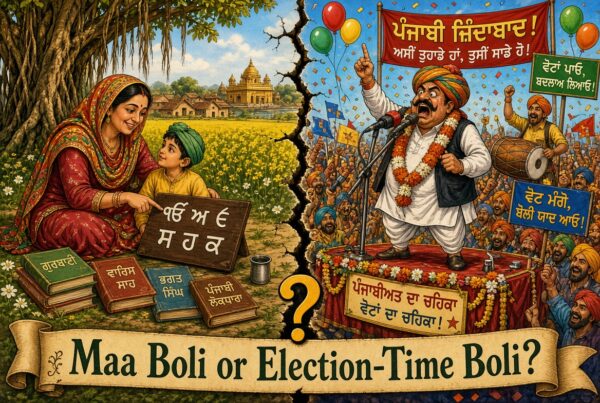
Punjab has a very strange relationship with Punjabi. We call it Maa Boli, we garland it, we celebrate it, we deliver speeches about it, and then, when the speech is over, Punjabi sometimes appears to be sent home while official paperwork continues its journey in English and election posters take a different linguistic route. Punjab even has a Punjabi Language Act and a Language Department. Everything seems ready: the Act is ready, the department is ready, the files are ready, and perhaps Punjabi is the only one still waiting for an appointment.
One can almost imagine Punjabi standing outside a government office asking, “Bhaaji, meri file kithe pahunchi?” The clerk replies, “Punjabi ji, file taan bahut agge hai, tusi pichhe ho.” It sounds like a joke, but unfortunately there is a serious truth behind the comedy.
The concerns being raised from Hoshiarpur during the local-election campaign deserve public attention. There are observations that a significant amount of campaign publicity is appearing in Hindi and that some candidates are perceived by local residents as having roots outside Punjab, including Uttar Pradesh and Bihar. The issue, however, should not be turned into an attack on people because of their birthplace. Punjab has always welcomed people from different parts of India. The real question is much simpler: when political candidates come to Punjab seeking votes from Punjabi-speaking citizens, why should Punjabi not receive its rightful place in their campaign and public communication?
A person coming from Uttar Pradesh, Bihar or anywhere else has democratic rights and should not be discriminated against merely because of his or her origin. But if someone seeks political office in Punjab, represents a constituency in Punjab and asks Punjabis for their votes, it is entirely reasonable to expect that person to respect the language and cultural identity of Punjab. Vote Punjabi ton, par poster Punjabi vich nahi? Eh kehri election technology hai?
This is where our political leaders deserve a little friendly but necessary satire. Before elections, Punjabi suddenly becomes everyone’s favourite language. Leaders proudly declare, “Punjabi saadi jaan hai!” During the election, the message becomes simply, “Vote for us!” And after the election, if citizens complain about the language, they are politely directed toward the Language Department. The Language Department, meanwhile, perhaps responds, “Tuhadi complaint bahut mahatvapooran hai; kirpa karke hor intzaar karo.”
Punjab has developed a remarkable talent for creating laws, departments, committees and speeches. What appears to be in shorter supply is implementation. Every year we hear that Punjabi must be promoted. Every year leaders promise, “Punjabi nu hor agge le ke jaana hai.” The poor language, however, sometimes seems to be going backwards while the speeches are going forward. As the Punjabi saying goes, “Gallan naal pet nahi bharda.” And Punjabi’s stomach is certainly hungry.
Perhaps the government should now introduce a new scheme called the “Punjabi Poster Mission.” Under the scheme, every political leader would receive one Punjabi poster. Then a monitoring committee would be established, followed by a subcommittee, a review committee and finally a report. After three years, the government could proudly announce that the Punjabi poster remains “under active consideration.” By then, of course, the election would probably be over and the next election posters would already be arriving.
The deeper problem is not merely the language printed on election posters. It is the attitude toward Punjabi. If Punjabi is genuinely the language of Punjab, then it should be visible and respected in administration, education, local government, public notices, political campaigns and official communication. Otherwise, Maa Boli risks becoming little more than an election-time slogan and a convenient backdrop for political photographs.
Our intellectuals, writers, journalists and Punjabi-language activists must also look into the mirror. Those of us who claim to be defenders and promoters of Punjabi cannot restrict ourselves to seminars, conferences and speeches. We cannot spend Monday talking about Punjabi, Tuesday writing about Punjabi, Wednesday organising a seminar about Punjabi, Thursday issuing a press statement about Punjabi and Friday celebrating Punjabi culture only to remain silent when Punjabi disappears from public life. “Gallan naal nahi, kamm naal pata lagda hai.” Our actions must demonstrate what our speeches proclaim.
There is also a certain comedy in watching political leaders who struggle to speak two complete sentences of Punjabi suddenly become great Punjabi warriors during elections. They declare, “Punjabi saadi jaan hai!” The voter looks at the poster and quietly asks, “Fer poster kis di jaan hai?” That is where the political leadership needs to provide an answer.
The debate should not become Punjabi versus Hindi, nor Punjab versus migrants. Hindi is an important Indian language, and people from Uttar Pradesh, Bihar and other states are part of Punjab’s social and economic life. They deserve dignity and respect. But respecting Hindi does not require Punjab to surrender Punjabi. A Punjabi poster is not an insult to Hindi. A Punjabi government notice is not an insult to English. A Punjabi political campaign is not an insult to any Indian citizen. It is simply Punjab respecting Punjab.
The Punjab Government and its Language Department should therefore explain what practical steps are being taken to implement the Punjabi Language Act at the grassroots level. Who monitors compliance? What happens when Punjabi is ignored? Are political parties and local bodies encouraged or required where applicable to give Punjabi its rightful prominence? And if the law already exists, why does Punjabi continue to depend upon public campaigns and intellectual appeals to obtain the dignity that should already be guaranteed?
Perhaps the most important question is for our political leaders themselves. If Punjabi is truly “Maa Boli,” why does Maa Boli have to campaign every five years just to prove that she belongs in her own house? Punjab has enough politicians, enough departments, enough Acts, enough committees and certainly enough speeches. What Punjab needs now is implementation.
Otherwise, one day our grandchildren may ask, “Dada ji, Punjabi Language Act kithe hai?” We will proudly point toward a government cupboard and say, “Othe file vich hai puttar.” Then they may ask the question that should frighten every Punjabi intellectual, politician and administrator: “Te Punjabi kithe hai?”
That is the question Punjab must answer today not after Punjabi becomes something we remember only through old books, photographs and speeches. Maa Boli should not be a guest in her own home.(Author:Satnam Singh Chahal)