
The appointment list you have provided includes names associated with Delhi or other states in bodies such as the Punjab Pollution Control Board, the Large Industrial Development Board, Punjab RERA and other public institutions. Some appointments have also drawn criticism from opposition parties. In May 2025, for example, opposition leaders questioned the appointments of Reena Gupta to the Pollution Control Board and Deepak Chauhan to the Large Industrial Development Board. These objections are part of the political debate; they do not, by themselves, establish that any appointment was unlawful or unqualified.
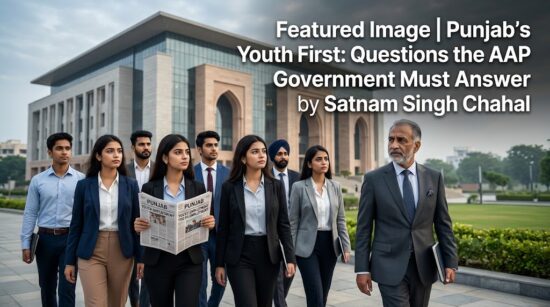
The question becomes particularly significant when the ruling party presents itself as a champion of Punjab’s youth. Young people spend years completing university degrees, preparing for competitive examinations and acquiring professional qualifications. Many then face the difficult choice of accepting work below their qualifications, preparing repeatedly for limited government vacancies, or leaving Punjab and even India in search of better prospects.
According to reporting on the Periodic Labour Force Survey for January–December 2025, unemployment among people aged 15–29 in Punjab was estimated at 17%, compared with a national average of 9.9%. These figures concern the wider employment situation, not just government jobs, but they illustrate why access to employment opportunities remains a serious public concern.
Is political loyalty taking precedence over local talent?
One legitimate question is whether influential appointments are being made primarily because of professional expertise and suitability for the position, or whether political relationships and organisational loyalty are also influencing decisions.A government has the authority to appoint eligible people to positions where the law permits it. Nor should a qualified candidate automatically be rejected simply because they come from another state. India’s constitutional framework and applicable recruitment rules matter. However, when a state government appoints people to its boards, corporations and advisory bodies, it should be prepared to explain the qualifications, selection process and reasons for choosing each person.
The distinction between elected political leadership, contractual advisers, board chairpersons and regular government employees is also important. Different posts may be governed by different rules. A political appointment should not automatically be treated as equivalent to recruitment through a competitive examination.Why should Punjab’s youth have to ask for answers?
The Punjab government has publicly claimed substantial progress in government recruitment. In March 2026, Chief Minister Bhagwant Mann said the total number of government jobs provided since his government took office had reached 65,264.That claim deserves to be examined alongside a separate question: how many of those recruited candidates were Punjab residents, how many came from other states, and what recruitment rules applied to each category of post?
In August 2026, Congress leader Partap Singh Bajwa raised allegations in the Punjab Assembly concerning recruits from Haryana and other states. Health Minister Balbir Singh defended the recruitment framework, saying that candidates from other states were legally eligible under the applicable rules. These are competing political claims that require examination through official recruitment records rather than assumptions about individual candidates.
A transparent government should have no difficulty publishing the relevant information. It should clarify how many positions were advertised, how many applicants competed, the qualifications required, the selection criteria and the domicile or eligibility conditions applicable to each recruitment exercise.
What should the government do?
First, the Punjab government should publish a comprehensive, department-wise report covering appointments to boards, commissions, corporations, advisory committees and senior contractual positions since March 2022. The report should identify the nature of each appointment, the qualifications required, the selection method and the applicable eligibility rules.Second, the government should review whether existing recruitment rules adequately serve Punjab’s legitimate employment interests while remaining consistent with constitutional and statutory requirements. Any preference for local candidates must have a lawful basis; it cannot simply be imposed without regard to the rules governing the post.
Third, Punjab must invest in private-sector employment, industrial development, research, entrepreneurship and professional training. Government employment alone cannot absorb every graduate. The state needs an economy in which young people can build careers without feeling compelled to leave their families and homeland.Finally, political appointments should be subject to greater public scrutiny. Where an appointee has a political connection, the government should disclose the selection process and demonstrate that the individual meets the requirements of the position. Political association is not proof of incompetence, but neither should it substitute for relevant qualifications.
The real question is accountability
The debate should not become a dispute between Punjabis and people from other states. Qualified people from anywhere in India can contribute to Punjab. The concern is whether Punjab’s own young people are receiving a fair opportunity and whether appointments to public institutions are being made in the public interest.Punjab’s taxpayers deserve competent institutions, and Punjab’s youth deserve a fair chance to compete for opportunities in their own state.The AAP government should answer one straightforward question: will it publish a complete, verifiable account of appointments to Punjab’s public institutions since 2022, including the selection criteria, qualifications and applicable eligibility rules?
That is the information needed to establish whether the pattern suggested by the list reflects legitimate appointments under existing rules, shortcomings in the recruitment framework, or decisions that warrant closer scrutiny. Until the records are made public and examined, political allegations should remain allegations—not be presented as proven wrongdoing.
Referance:The Times of india,PTI
Disclaimer: This article and accompanying images are for informational and illustrative purposes only. Some visuals may be AI-generated or digitally enhanced and may not depict actual events or persons. Views expressed are based on publicly available information and analysis