
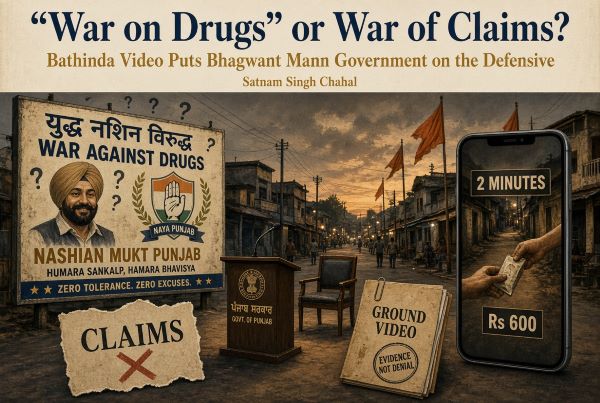
Punjab’s war against drugs has entered a politically uncomfortable phase. For more than a year, the Bhagwant Mann government has presented “Yudh Nashean Virudh” as one of its biggest governance achievements. But a viral video allegedly showing the delivery of chitta within minutes in Sangat Kalan village of Bathinda has once again brought the uncomfortable question back to the centre of Punjab politics: Has the government actually broken the drug supply chain or has it merely become exceptionally good at announcing arrests and recoveries?
The question cannot be dismissed as opposition propaganda. The Shiromani Akali Dal circulated the video alleging that chitta was available for around ₹600 and could be delivered in less than two minutes. More importantly, Sangat police subsequently registered an FIR, arrested a person identified as Gaggu and reported the recovery of 3 grams of suspected chitta. That does not, by itself, prove that drugs can be obtained in two minutes everywhere in Punjab. Nor does it establish every allegation made in the video. But it does establish something politically important: the allegations were serious enough for the police to act. And that is precisely why the government now needs to answer questions rather than simply dismiss the episode as political theatre. The government has numbers. Punjab has questions.
The Mann government has plenty of statistics to defend its campaign. The police have claimed tens of thousands of arrests, thousands of FIRs, major heroin seizures and action against alleged big traffickers. After 500 days of the campaign, the DGP said police had registered 52,432 NDPS FIRs and arrested more than 68,850 traffickers, while properties worth ₹319 crore allegedly acquired through drug money had been attached or confiscated. More recently, official figures reported through the anti-drug campaign said that information received through the Safe Punjab Helpline had contributed to 25,339 arrests between the launch of the campaign in March 2025 and September 3, 2026. These figures are significant. But numbers of arrests are not the same thing as elimination of drugs.
The ultimate test of an anti-drug campaign is not how many people are arrested. It is whether drugs become harder to obtain, whether addiction falls, whether supply networks are dismantled and whether families begin to feel that their children are safer.That is where the government faces a much harder political test.
March 2025: The “Yudh Nashean Virudh” promise
The Punjab government launched Yudh Nashean Virudh on March 1, 2025, presenting it as a comprehensive campaign combining enforcement, public participation, prevention and rehabilitation.The message was ambitious: attack the suppliers, identify the big fish, mobilise villages and simultaneously rehabilitate addicts.That was the right approach in principle.But once a government declares a “war”, it also creates a standard against which its performance will inevitably be judged.And Punjab is now asking: Where is the victory?
June 2026: Government declares the supply line “snapped”
On June 29, 2026, Chief Minister Bhagwant Mann said that the “supply line of drugs has already been snapped” and that the big fish had been put behind bars.The government also highlighted a 1.5-lakh-strong Village Defence Committee network and claimed that more than 13,000 complaints against drug smugglers had been registered through VDCs in three months.That was a major political claim.
But now comes the uncomfortable question:
If the supply line has already been snapped, how does alleged street-level delivery continue?The government must explain the contradiction.
July 2026: Record arrests—but the problem remains
By July, the Punjab Police were celebrating 500 days of Yudh Nashean Virudh, highlighting more than 68,850 arrests and hundreds of alleged major traffickers arrested with large quantities of heroin.Yet the drug problem did not disappear from Punjab’s public life.And the latest evidence is not merely political rhetoric.The Punjab and Haryana High Court has just highlighted another disturbing dimension: 15,768 of 35,449 inmates in Punjab’s jails were reported to be drug-dependent—nearly 50 per cent of the prison population. The court described the situation as a serious challenge requiring the government’s highest priority.That statistic should worry every political party.
Because it suggests that Punjab’s drug crisis is not simply a question of catching peddlers. It is deeply embedded in addiction, health, crime, families and the prison system.September 2026: Bathinda exposes the credibility gapAnd then comes Sangat Kalan.A video emerges alleging that chitta can be obtained almost instantly.The opposition immediately turns it into a political weapon.The government points to the police case and arrest.Both sides have a point but neither side can escape the central question.
Why was the alleged supply possible in the first place?
If the government says the video proves that police acted quickly, that is welcome.But if the government says its supply chain has already been broken, then the public deserves to know how the alleged supplier obtained the drug, who supplied him, who financed the operation, where the narcotics originated and how far the network extends.Arresting one alleged peddler may solve one case.It does not necessarily solve the supply chain.
The timing becomes even more politically sensitive because just days before the Bathinda video controversy, an anti-drug activist, Mohanjeet Singh, protested during the Chief Minister’s programme in Sheron by displaying a black flag and questioning the government’s claims about drugs.He was arrested. He subsequently alleged custodial torture, including mistreatment of his beard and hair. Police denied concluding that he had been tortured and ordered an inquiry into his allegations.Whatever the final outcome of that inquiry, the political optics are damaging.A government claiming success in the war against drugs should be able to tolerate questions from people demanding faster success not create an impression that questioning the campaign itself is unacceptable.
The government needs to demonstrate that criticism of its anti-drug policy is not treated as opposition to the fight against drugs.The Mann government can legitimately point to arrests, seizures, rehabilitation facilities and public participation.But the opposition can legitimately ask whether those achievements are translating into a meaningful reduction in the availability of drugs.That is the political battlefield now.The government cannot win it with advertisements alone.It cannot win it with arrest figures alone.And the opposition cannot win it merely by circulating viral videos whose every allegation has not yet been independently established.Punjab needs evidence.
Where are the major supply networks?
How many kingpins have been convicted—not merely arrested?
How many financial networks have been dismantled?
How much drug money has actually been recovered?
How many villages have seen measurable reductions in drug availability?
How many addicts have successfully completed rehabilitation and remained drug-free?
And most importantly:
Is the street-level availability of drugs actually declining?
The Sangat Kalan episode therefore deserves an independent, transparent investigation—not merely another political blame game.If the video is misleading or fabricated, establish that publicly.If the allegations are true, identify the entire network behind the alleged supply.If one person has been arrested, tell Punjab where the drugs came from.If the supplier is only a small link, find the bigger links.And if the government really has “snapped the supply line”, then Bathinda is the opportunity to prove it.Because Punjab does not need another slogan.It does not need another political war of words.It needs a war against the drug supply chain itself.And the ultimate report card should not be the number of press conferences, arrests or advertisements.It should be whether a young Punjabi can still get “chitta” in two minutes.That is the question the Mann government now has to answer.
Disclaimer: This article and accompanying images are for informational and illustrative purposes only. Some visuals may be AI-generated or digitally enhanced and may not depict actual events or persons.Views expressed are based on publicly available information and analysis