
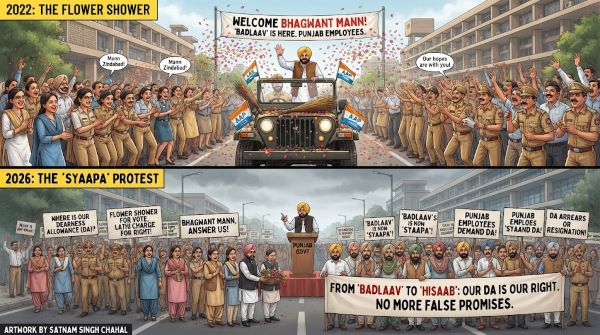
Punjab has witnessed many political transformations, but perhaps none as poetic and comic as the journey of government employees from showering flowers on Bhagwant Mann in 2022 to raising slogans against his government over their pending financial demands. When the AAP government came to power, many employees welcomed the change with enthusiasm, hope and expectations. Flowers were thrown, slogans were raised, and the atmosphere suggested that a new chapter had begun. Four years later, however, those flowers appear to have wilted, while the slogans have become much louder.
The same employees who once celebrated the arrival of the Bhagwant Mann government are today demanding answers from it. Their central question is simple: if the government can find money for announcements, publicity and political programmes, why is it so difficult to honour what employees consider their legitimate Dearness Allowance entitlement? For a government employee, DA is not a political slogan. It is part of the household budget. Inflation does not wait for cabinet meetings, and grocery shops do not accept government promises as payment.
The transformation can therefore be described in one sentence: 2022 was the year of flowers; 2026 is becoming the year of “syaapa.” Then the employees were saying, “Mann Sarkar Zindabad.” Today, many of them are effectively saying, “Sadda DA kithe hai?” That is perhaps the most uncomfortable political punchline of all.
Punjab’s politicians have always understood the importance of flowers. Flowers make beautiful photographs. Flowers make television visuals attractive. Flowers make leaders smile. But employees cannot pay school fees, electricity bills, house expenses and grocery bills with photographs. They need their salaries and financial entitlements to keep pace with the rising cost of living. That is why the DA controversy cannot simply be dismissed as another protest by government employees.
Punjabi poetry has always had a way of exposing the distance between dreams and reality. Shiv Kumar Batalvi wrote about emotions, longing and broken expectations in a language that touched Punjab’s heart. Today, without pretending to rewrite his poetry, one could describe the employees’ political journey in a satirical Punjabi-style line: “Waade de phull taan bahut khirre, par DA da phull ajj vi udeekda ae.” The promises bloomed, but the employee is still waiting for the flower of financial relief.
There is also a lesson here for every political government. People may welcome a government with flowers, but they eventually judge it by performance. Employees may support a new administration with optimism, but they will ultimately look at their salary slips. Political slogans can create excitement for a few months; economic reality lasts every day. The journey from “Badlaav” to “Hisaab” is therefore not surprising. It is the natural consequence of promises meeting reality.
Perhaps Punjab’s political comedy department could now introduce a new scheme called the “Flower Return Programme.” Employees who threw flowers in 2022 could return those flowers to the government and request their DA in exchange. Another possibility could be “One Flower, One Promise; One Promise, One DA Instalment.” The joke may sound funny, but behind the humour lies a serious question: how long can employees be expected to celebrate promises when they are still waiting for their financial rights?
The real test of any government is not how it behaves when people are throwing flowers at its leaders. The real test comes when those same people stand outside government offices with protest banners and slogans. Leadership is measured not by the number of welcome ceremonies but by the ability to resolve genuine grievances. The hands that once carried flowers can also carry protest placards, and the distance between the two is sometimes only a matter of broken expectations.
The political irony is therefore impossible to miss. In 2022, the employees helped create the celebratory atmosphere surrounding the arrival of the new government. In 2026, many of the same employees are demanding that the government listen to them. The flowers have become questions, the celebrations have become protests, and the slogan of “change” has increasingly been replaced by the demand for accountability.
The message from the employees is ultimately very simple: “We welcomed you with flowers; please do not force us to remember you through protests.” If a government wants the flowers to return, the most effective fertilizer may not be another speech or another announcement it may simply be the timely delivery of what employees believe they are owed.And that perhaps is Punjab’s latest political satire: the government received flowers in 2022, but by 2026 the same hands are holding placards. The flowers were temporary; the DA demand was permanent.
Disclaimer: This article and accompanying images are for informational and illustrative purposes only. Some visuals may be AI-generated or digitally enhanced and may not depict actual events or persons.Views expressed are based on publicly available information and analysis