
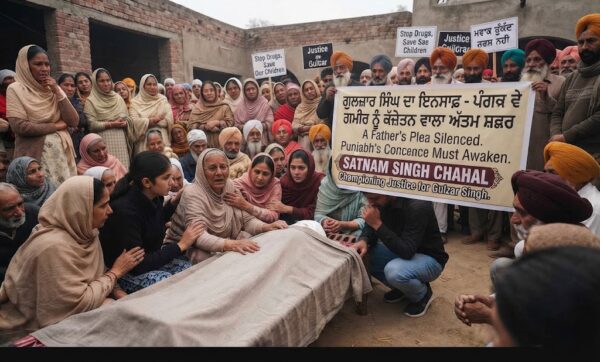
There are funerals where people cry because they have lost someone they loved. And then some funerals make an entire society question itself. Gulzar Singh’s funeral belongs to the second kind. A father who stood up and asked a painful question about drugs in Punjab is no longer alive. His family has been left with grief, unanswered questions and a wound that no words can heal.
Gulzar Singh was reportedly a father desperately watching his son struggle with drug addiction. He raised his voice about the availability of drugs and questioned Finance Minister Harpal Singh Cheema about what was being done. What followed, according to his family and reports, was pressure and alleged intimidation. Gulzar later consumed poison and died. Police have registered a case of abetment to suicide, while allegations concerning threats and the circumstances surrounding his death remain subject to investigation.
But today, forget the politics for a moment and look at the funeral. Look into the eyes of the family standing beside his final journey. Think of the children who will grow up asking why their father is no longer coming home. Think of the relatives who will forever remember the last days of a man who wanted nothing more than to see his son free from drugs and his village free from the poison destroying families.
What kind of Punjab have we created when a father has to stand before those in power and plead for action against drugs? What kind of Punjab will we leave behind if speaking about the drug menace becomes something people fear? A question should never become a crime. A citizen should never feel that raising his voice against drugs can put his life or his family at risk.
The most heartbreaking part is that Gulzar Singh’s story is not just about one man. It is about thousands of Punjabi mothers and fathers who wake up every morning frightened that drugs may destroy their children. It is about families who have sold belongings, borrowed money and exhausted their savings trying to save sons and daughters from addiction. It is about parents who carry their pain silently because they do not know whom to approach.
Standing at such a funeral, political speeches should feel very small. Party flags should feel very small. Publicity campaigns should feel very small. What should stand tallest is the cry of a grieving family asking for justice and the conscience of a society asking how many more families must suffer before the drug crisis is treated as an emergency.
The reported circumstances surrounding Gulzar Singh’s death demand a fair, impartial and transparent investigation. If anyone threatened, intimidated, humiliated or pressured him, that must be established and dealt with according to law. If there were failures in protecting him or providing timely medical treatment, those questions also deserve answers. Justice cannot be selective, and accountability cannot depend on political affiliation.
Today, Gulzar Singh is silent. But the question he raised is not silent. It is echoing through Punjab’s villages, streets and homes: Where is the promised end to the drug menace?
Perhaps the most painful image from his funeral is not the gathering itself, but the thought that a father who wanted his son saved is now the one being mourned. He wanted his child to live. Today, his family is learning how to live without him.
Punjab must not allow Gulzar Singh’s final journey to become just another day’s political headline. Let his funeral become a moment of collective reflection. Let every leader, every police officer, every administrator and every citizen ask one question: Are we protecting the people who speak against drugs, or are we leaving them alone to fight a monster that has already entered thousands of homes?
Gulzar Singh’s voice may have been silenced, but the question he raised must not be buried with him.
A father asked for his son to be saved. Punjab owes him an answer.