
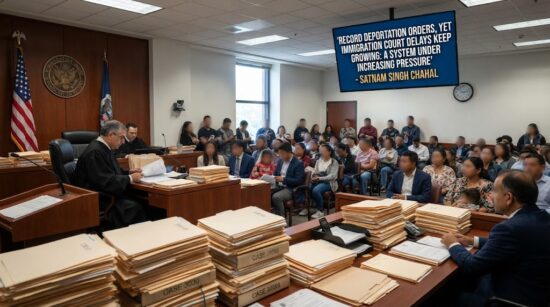
The latest data from the Transactional Records Access Clearinghouse (TRAC) presents a striking picture of the U.S. immigration court system in 2026: Immigration Judges are completing cases at record levels, removal orders are increasing, yet the average time people wait for their cases to be decided is becoming longer. The numbers point to a court system operating under enormous pressure, with a backlog that remains measured in millions of cases.
According to TRAC, Immigration Courts completed 104,029 cases in July 2026, an all-time monthly high. Of those cases, Immigration Judges issued 82,787 removal orders, while another 8,779 individuals were granted voluntary departure. TRAC reports that, when both categories are counted, 88% of July’s completed cases resulted in a removal or voluntary-departure outcome. Through July, Immigration Courts had closed 797,487 cases during fiscal year 2026, while more than 3.14 million cases remained pending.Yet the extraordinary pace of case completions has not translated into shorter waiting periods. TRAC reports that people whose cases resulted in removal orders in July had waited an average of 901 days from the issuance of their Notice to Appear (NTA) to the disposition of their cases. That compares with 597 days in July 2024, representing an increase of approximately 51%. In other words, the immigration courts are processing more cases, but the cases reaching decisions are still carrying the weight of a substantial backlog accumulated over previous years.
The most important figure may not be the monthly removal total, but the size and age of the pending caseload. TRAC reports that at the end of July 2026, 3,141,306 cases were still pending before Immigration Courts. The average age of pending cases was approximately 940 days, compared with 571 days in July 2024 a reported increase of about 71%.This helps explain why completion times can continue rising even when judges are completing more cases. A court can dramatically increase the number of decisions it issues each month and still face a situation in which many of the cases being completed have already spent years waiting for a final decision. TRAC describes the existing waiting time in the backlog as effectively embedded in the average disposition time.The problem is therefore not simply whether Immigration Judges are working faster. It is also whether the overall system has enough capacity to process the enormous accumulated caseload while simultaneously handling new cases entering the system.
The waiting period varies substantially depending on the location of the Immigration Court. TRAC’s July 2026 figures show average times for removal decisions ranging from 308 days in New Mexico to 1,076 days in Indiana.Other states recorded particularly long average waits, including North Carolina at 1,047 days, Florida at 1,031 days, Connecticut at 1,026 days and Massachusetts at 1,007 days. California’s reported average was 815 days, compared with 418 days in July 2024.Some of the largest percentage increases occurred in Hawaii, Arizona, Colorado, Michigan, Minnesota and Utah. TRAC cautions that not every state has an Immigration Court physically located within its borders and that hearing locations can serve people from different jurisdictions.These differences illustrate another challenge: there is no single immigration-court experience across America. The length of time a person waits can depend heavily on the court handling the case and the workload accumulated at that location.
The statistics also demonstrate why raw deportation numbers should not be confused with overall judicial efficiency.A court’s performance cannot be measured solely by the number of people ordered removed. A functioning judicial system must also provide timely hearings, allow both sides an opportunity to present their cases, issue legally sound decisions and manage appeals and other proceedings.TRAC’s data shows that Immigration Judges are issuing removal orders at unprecedented levels while the underlying backlog remains enormous. In fact, TRAC reports that 651,474 people had received removal or voluntary-departure orders during FY2026 through July.At the same time, only a minority of people receiving removal orders had legal representation. TRAC reports that 22.8% of individuals including unaccompanied children in cases where a removal order was issued in July had an attorney.That statistic is important because immigration court proceedings can determine whether a person is allowed to remain in the United States or is ordered removed. The scale and complexity of the caseload make access to competent legal representation and timely adjudication significant issues for the integrity of the process.
The broader message from the data is difficult to ignore: record case closures have not eliminated the structural backlog.TRAC’s July figures show that Immigration Courts closed far more cases than they received during FY2026 through that month 797,487 closures compared with 466,058 new cases recorded during the fiscal year. Yet more than 3.1 million cases remained pending.That means simply increasing monthly removals will not, by itself, solve the underlying problem. The government and the courts face a much larger administrative challenge involving staffing, scheduling, courtroom capacity, legal representation, case management and the accumulation of cases over many years.For immigrants and their families, the consequence is uncertainty measured not in weeks or months but often in years. For the government, prolonged cases mean continued administrative costs and an immigration enforcement system that can issue large numbers of removal orders while still carrying an enormous unresolved caseload.
NAPA Calls for Efficiency, Transparency and Due Process
North American Punjabi Association (NAPA) Executive Director Satnam Singh Chahal said the latest figures should prompt a serious discussion about the effectiveness and capacity of the U.S. immigration court system.
Disclaimer: This article and accompanying images are for informational and illustrative purposes only. Some visuals may be AI-generated or digitally enhanced and may not depict actual events or persons.Views expressed are based on publicly available information and analysis