
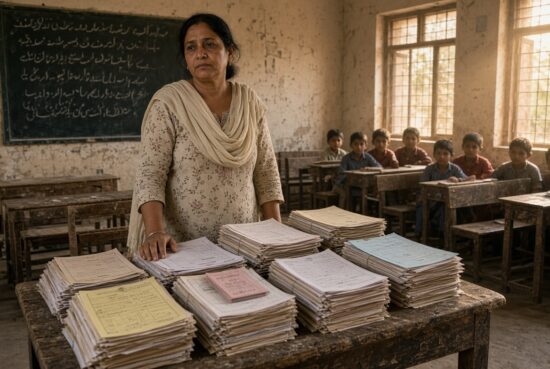
CHANDIGARH: Punjab Chief Minister Bhagwant Mann’s earlier emphasis on keeping teachers focused on teaching is facing renewed scrutiny after government-school teachers have been assigned yet another non-academic responsibility — verification of applications for new ration cards.The latest controversy emerged in Ludhiana, where the district administration deployed 658 government-school teachers to verify applications for new ration cards under the state government’s ‘Meri Rasoi’ scheme. The deployment came just as internal examinations in government schools were approaching.
The teachers’ deployment has triggered questions over the government’s repeated use of school teachers for administrative and field duties when schools themselves are facing staffing and administrative challenges.The issue is particularly sensitive because the Punjab government has repeatedly projected education reform and the ‘Sikhya Kranti’ as major achievements of the Mann government.Ration Cards Added to Teachers’ Duties
The Punjab government announced in July that it would issue 10 lakh new ration cards, including seven lakh cards for newly eligible families and three lakh for e-Shram and migrant workers to be brought under the National Food Security Act. The government said household verification would form part of the process.In Ludhiana, however, the administration turned to government-school teachers for the verification work.
According to the Indian Express report, SDM (East) Jasleen Kaur Bhullar said the deployment was necessary because of a shortage of administrative staff. The order directed the education authorities to relieve the teachers assigned to the task.For teachers, the timing has become another point of concern because school examinations were about to begin.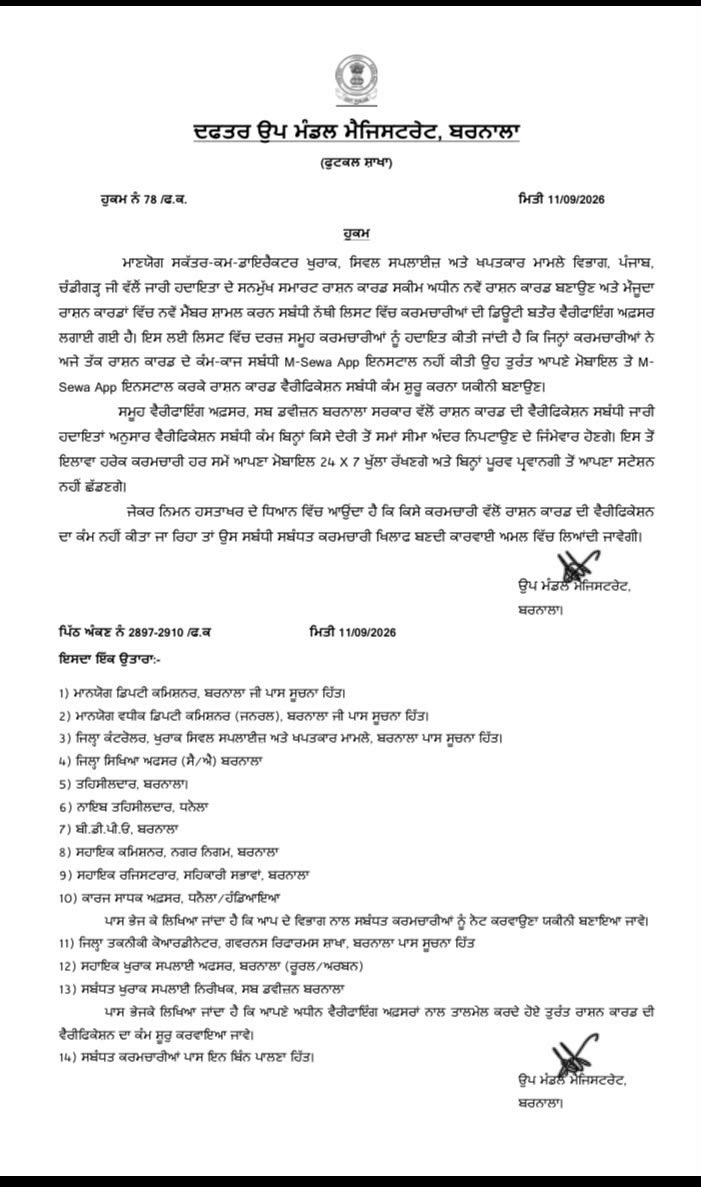
A Pattern of Non-Academic Duties
The ration-card assignment has also revived a larger debate over the growing number of responsibilities being given to government-school teachers outside the classroom.Earlier this year, teachers were reported to have been assigned door-to-door survey duties for a state government pilgrimage initiative after being deployed as Booth Level Officers during the electoral-roll revision process.Teachers have also been involved in Special Intensive Revision (SIR)-related election work.In June, the Democratic Teachers Front said teachers were already burdened with surveys, census-related work and election duties, arguing that such assignments were affecting the education system.The latest ration-card assignment therefore comes against an already contentious background.Vacancies Inside the Education System
The debate becomes more significant in the context of reported vacancies in Punjab’s education administration.A recent report by The Tribune, citing figures compiled by the Democratic Teachers Front, said 14 of 46 District Education Officer posts in the state were vacant.The same report said more than 110 of 228 Block Primary Education Officer posts were vacant, while nearly 1,100 principal posts were also reportedly lying vacant.
Against this backdrop, questions are being raised over whether teachers should be removed from classrooms to perform administrative functions that could potentially be handled by dedicated personnel.
The ‘Sikhya Kranti’ Question
The controversy also comes at a politically sensitive moment for the Punjab government’s education campaign.
The Mann government has repeatedly presented its education reforms under the banner of ‘Sikhya Kranti’.
But an education system cannot be judged only by new buildings, plaques or announcements. The availability of teachers inside classrooms and the amount of teaching time available to students are equally important.
Earlier this month, the Indian Express reported that teachers in several districts were still awaiting reimbursement for expenses they had incurred during the government’s much-publicised school inauguration campaign. The campaign involved more than 25,000 works in government schools.
The growing list of responsibilities being placed on teachers therefore raises a broader question about whether Punjab’s education workforce is being used primarily for teaching or increasingly as an administrative field force.
Timeline of Teachers’ Non-Academic Duties
February 2026: Government-school teachers were assigned door-to-door survey work for a state pilgrimage initiative after earlier involvement in Booth Level Officer duties connected with electoral-roll revision.
June 2026: Teachers involved in SIR duties faced additional administrative complications, with teacher organisations raising concerns over the impact of election-related assignments on education.
July 2026: The Punjab government announced a drive to issue 10 lakh new ration cards, with physical household verification forming part of the process.
September 2026: 658 government-school teachers in Ludhiana were deployed to verify ration-card applications under the Meri Rasoi scheme. The move coincided with the approaching internal examinations.
The Question for Bhagwant Mann
The latest development raises a straightforward question for Chief Minister Bhagwant Mann:
If teachers are primarily meant to teach, why are they repeatedly being assigned administrative, survey, election and now ration-card duties?
Punjab certainly needs an efficient ration-card verification system. It also needs accurate electoral rolls and other government services.
But the responsibility for those tasks raises a question of administrative capacity: should already stretched teachers be taken away from classrooms to compensate for shortages elsewhere in the government machinery?
The answer matters because every hour a teacher spends performing a non-academic assignment is an hour away from students.
Is This the Education Revolution?
The Punjab government has called its education programme a ‘Sikhya Kranti’.
The government will ultimately be judged not simply by the number of announcements or inaugurated projects, but by what happens inside classrooms — teacher availability, teaching time, student learning and the quality of education.
The ration-card controversy has therefore become more than an administrative dispute.
It has reopened a fundamental question about Punjab’s education policy:
Are teachers being given the time and conditions necessary to teach, or are they increasingly being used to fill gaps in the government’s administrative machinery?
For a state claiming an education revolution, that is a question the Mann government will have to answer.