
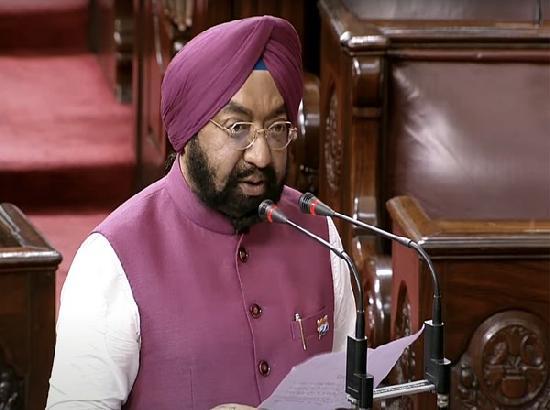
 NEW DELHI: India-UAE relations are increasingly moving from diplomatic engagement and traditional trade toward a deeper economic partnership built around investment, technology, logistics, manufacturing and strategic connectivity. Rajya Sabha MP Vikramjit Singh Sahney has called for the next phase of this relationship to focus firmly on delivery rather than dialogue.
Speaking at the India-UAE Business Networking Dinner, Sahney said the relationship had moved “far beyond trade” and was becoming a partnership for the future. He identified the India-UAE Comprehensive Economic Partnership Agreement (CEPA) as the economic engine and the India-Middle East-Europe Economic Corridor (IMEC) as the connectivity engine for a potentially much larger economic ecosystem.
The numbers show why the UAE has become increasingly important to India’s export strategy. The India-UAE CEPA entered into force on May 1, 2022, and the Indian government says India exported merchandise worth approximately US$37.36 billion to the UAE in FY2025-26, making the UAE India’s largest individual export market among its free-trade-agreement partners.
But the bigger story may be emerging beyond conventional trade. At the same networking event, Cochin Shipyard Limited and Drydocks World, a DP World company, signed a 50:50 joint venture agreement to operate and expand the International Ship Repair Facility at Kochi. The agreement was signed on September 11, 2026, during the BRICS Summit in New Delhi.
The scale of the proposed maritime collaboration is significant. The existing International Ship Repair Facility was built at a reported cost of around ₹970 crore, while the transaction transferring the facility into the JV has been valued at approximately ₹1,800 crore. The facility currently has six workstations, a 6,000-tonne ship lift and about 1,400 metres of berthing space, with the partners planning to add 10 more workstations.
The facility generated approximately ₹207 crore in revenue in FY2025-26, according to company-related reporting. The new partnership is intended to bring international expertise, technology and operating practices into India’s ship-repair industry while expanding Kochi’s capacity to service Indian, regional and international vessels.
There is, however, an important detail beneath the headline 50:50 ownership structure. While the equity stake is equally divided, Drydocks World is expected to nominate three of the five directors and senior management positions including the CEO, CFO and COO under the proposed structure, according to maritime-industry reporting. That makes the arrangement more than a simple financial partnership: it represents a substantial operational and technological collaboration.
For India, the strategic significance is obvious. A country located along some of the world’s busiest shipping routes cannot afford to remain heavily dependent on foreign facilities for high-value ship repair and maintenance. Developing Kochi as a major maritime-services hub could help India retain more repair business domestically, attract international fleets and create skilled employment in engineering, fabrication, maintenance and associated services.
For the UAE, the partnership offers an opportunity to extend its maritime expertise and commercial ecosystem into India’s rapidly expanding industrial and logistics market. For India, it offers access to global experience and potentially new international customers. The commercial logic therefore extends well beyond one ship-repair facility.
Sahney’s emphasis on CEPA plus IMEC is particularly relevant in this context. Trade agreements can reduce barriers, but infrastructure and logistics determine whether businesses can actually move goods, capital and services efficiently. If IMEC develops as envisioned, the combination of trade facilitation, ports, logistics networks, manufacturing and investment could give the India-UAE relationship a much broader economic footprint.
The challenge now is implementation. India and the UAE have signed agreements, announced ambitious corridors and expanded cooperation across multiple sectors. The real test will be whether these initiatives translate into factories, investments, jobs, faster logistics, higher exports and measurable benefits for businesses.
Sahney’s message that “it is time to move from dialogue to delivery” therefore goes to the heart of the issue. The India-UAE relationship has already accumulated considerable diplomatic momentum. The next benchmark should be economic performance.
Punjab Outlook Analysis: The India-UAE partnership illustrates a larger lesson for India: global relationships increasingly compete on infrastructure, speed, technology and execution. CEPA can open the door and IMEC can potentially build the road—but businesses will ultimately judge the partnership by what actually moves through that door and along that road.
The Kochi ship-repair JV is an early test case. If it delivers expanded capacity, international customers, skilled jobs and stronger maritime competitiveness, it could become a model for similar India-UAE industrial partnerships. The era of signing agreements must now give way to the era of measurable delivery.