
The Finance Department’s order of 13 September 2026, issued over the signature of Additional Chief Secretary Alok Shekhar, does something governments rarely do in the months before an election. It tells employees plainly what the State can afford. It clarifies that the notification of 18 November 2022 was meant to give a guaranteed pension on the principles of the Old Pension Scheme, while the scheme itself continues to be a Defined Contributory Pension Scheme. Put simply, employees are to get an assured pension, funded jointly by themselves and the State.That is the honest position, and the only sustainable one.
Punjab’s Budget for 2026–27 puts committed expenditure at ₹90,335 crore, or 72 per cent of revenue receipts: salaries take 31 per cent, interest 23 and pensions 18. Anyone who has held the Finance assignment in Chandigarh knows that pensions are the one line in the Budget that never comes down. A non-contributory pension for another 1.75 lakh employees, paid out of each year’s revenue with no corpus set aside, would have been a cheque drawn on the salaries of teachers not yet born. The government has declined to sign it, and has chosen a design that can last. That candour spares employees a larger disappointment later, and spares a future Finance Secretary an unfunded liability he did not create.
The order also puts the word “guaranteed” on a government file, and files have long memories. The NPS (National Pension System, as the New Pension Scheme was later renamed) never offered that. For a cohort whose retirement has ridden on market returns for twenty-two years, this is the first written assurance of a floor.The journey has been a long one. In October 2022, on the Friday before Diwali, the Cabinet took an in-principle decision to restore the Old Pension Scheme, and on 18 November 2022 it approved the move and issued a notification. On 27 January 2023 the Finance Department set up an officers’ committee under the Chief Secretary to work out the procedure, reporting to a Cabinet Sub-Committee that now comprises Harpal Singh Cheema, Aman Arora and Harjot Singh Bains. Employee unions have pressed the demand throughout. The design question itself has moved on since then. The Union Cabinet approved UPS on 24 August 2024, giving the States a tested template that did not exist when Punjab first notified its intent.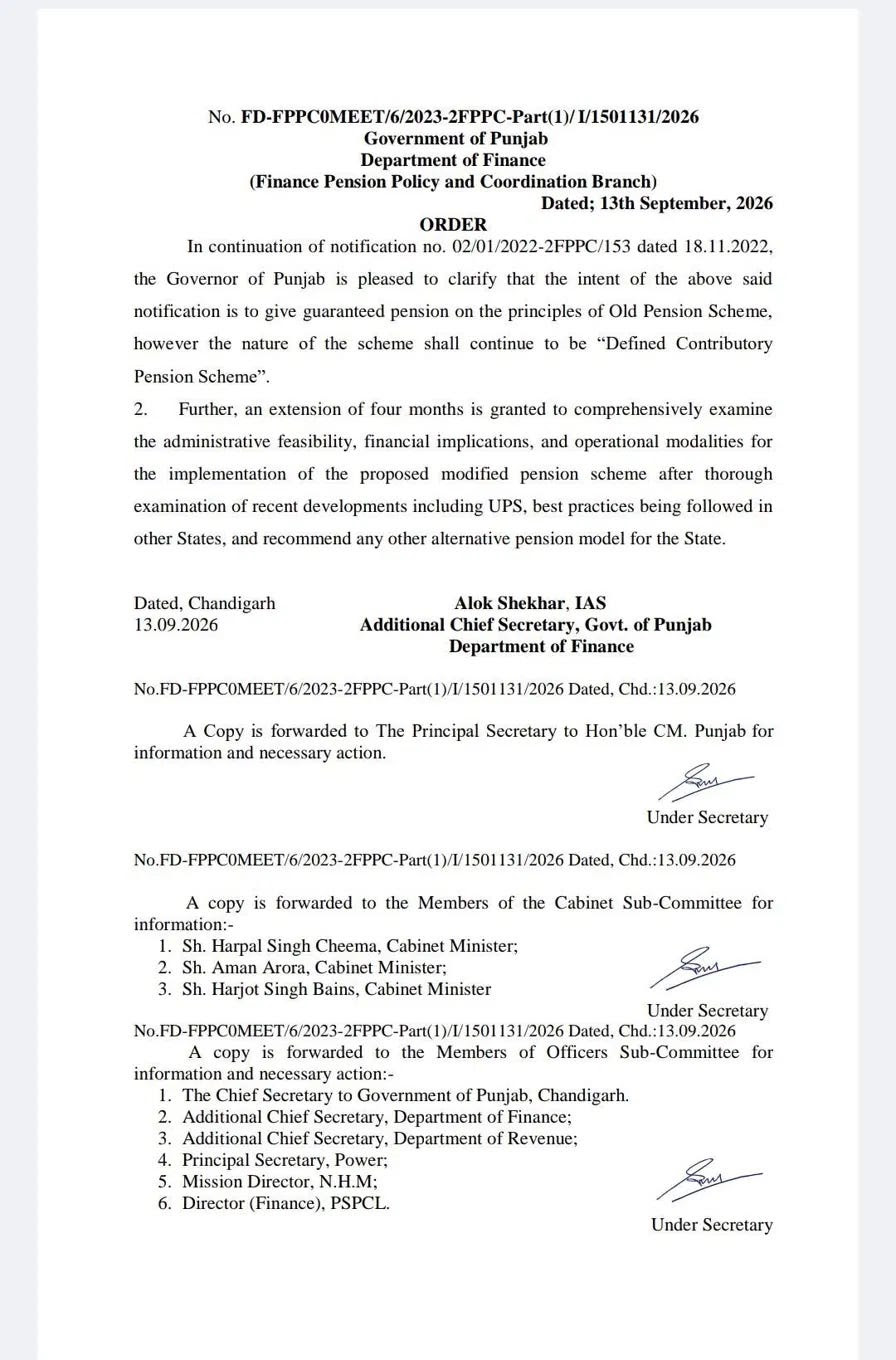
The 13 September order turns a statement of intent into a choice of design. It asks the committees to study the Centre’s UPS (Unified Pension Scheme), the practice of other States and any better model, and gives them four more months to do so. With the principle settled, the government now has to get the particulars right.In railway terms, employees were handed a waitlisted ticket in 2022. The 2026 order moves it to RAC (Reservation Against Cancellation): a seat on the train is assured, and the final chart confirming the berth is due in four months. Five pitfalls could still keep that berth from being confirmed.
Formula. UPS pays half the average basic pay of the last twelve months after 25 years of qualifying service. Punjab has many employees who entered service late, often after years on contract, and a teacher regularised at thirty-five retires at fifty-eight with twenty-three years. On 8 September 2026, in Punjab School Education Board v. Satnam Singh, the Supreme Court held that pre-regularisation service must count for pension. Building that principle into the scheme from the start would avert years of litigation and earn goodwill in every school and hospital.
Floor. Employees will judge the scheme by what they can quote to their families. A stated minimum pension, a family pension and indexation to dearness relief, all written into the rules, would make the guarantee concrete. The guarantee should also reach those who have already retired under NPS on thin annuities. The Centre extended UPS to past retirees with at least ten years of regular service, and Punjab can offer its own retirees no less.
Fund. Some twenty-two years of NPS deductions are the employee’s own money, in law and in sentiment. Under UPS, the full assured payout presumes that the corpus stays in the system, and withdrawing up to 60 per cent reduces the pension proportionately. A transparent statement of each employee’s options, and perhaps a partial return of the employee’s own contributions, would answer the sharpest objection before anyone raises it.
Fisc. Employees who joined before 2004 paid nothing towards their pension, and newer employees will make the comparison. The fairest answer is a generous State share. The Centre contributes 18.5 per cent of pay under UPS, and a Punjab contribution that at least matches it would present the employee’s deduction as a partnership.
Finality. A pension becomes enforceable through amended service rules backed by a Budget provision. The 2022 notification had neither, and the next instrument should carry both.
By 19 July 2026, 1,18,195 central employees had opted for UPS, against roughly 23 lakh eligible. Employees hesitate over a guarantee they do not fully understand, so Punjab’s scheme will need clear communication, worked examples for each pay level and a sensible option window.
Four Months to the Final Chart
The four months run from 13 September to about 13 January 2027. In the last cycle, the Election Commission announced the Punjab schedule on 8 January 2022, and the Model Code of Conduct took effect the same day. If the calendar repeats even roughly, a report delivered on the last day of the extension could arrive after the Code has begun, when no new scheme can be announced.
The extension is best treated as an outer limit. The comparative material is readily available: UPS has been in force since 1 April 2025, Maharashtra adopted it in August 2024, Himachal returned to OPS and Andhra Pradesh devised a guaranteed scheme of its own. An actuarial valuation of the post-2004 cohort takes a few weeks. With focused work, the committees can report by November, the Cabinet can approve the scheme in early December, and the amended rules can be notified before the year ends. Keeping the committees’ attention on a UPS-type design, instead of reopening the search for “any other alternative pension model”, would save precious weeks.
The extension also allows time for consultation. A draft scheme placed before the recognised employee unions in October, with worked examples for a clerk, a teacher and a lineman, would bring objections to the surface while there is still time to meet them. Employees who have helped shape a scheme are far more likely to opt for it.
Punjab’s 1.75 lakh NPS employees are teachers, clerks, patwaris, nurses and linemen, and their word carries weight at family gatherings, ward meetings and the village sath (the common gathering place where opinion forms). For four years their unions have been among the government’s most organised critics. A notified scheme with a clear formula, recognition of contractual service, a respected corpus and a generous State share would turn that constituency into beneficiaries with a monthly reason to remember who delivered. The fiscal burden stays manageable because a funded scheme spreads it: the State pays its share month by month, and the larger pension outgo arrives only as the post-2004 cohort retires, mostly from the 2030s onwards.
It would also give the ruling AAP a Punjab model to set beside the Centre’s UPS, one that honours the Supreme Court’s view on contractual service and speaks directly to the late entrants a 25-year threshold leaves behind. Carried out in this manner and notified before the Model Code of Conduct, the scheme would swing a substantial bloc of employee households towards the ruling AAP in 2027.