
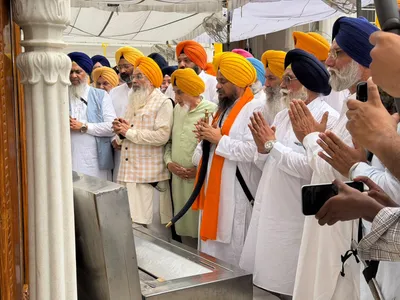
Sources said the BSF restricted the gathering from approaching the Zero Line, citing border security and protocols. This led to an argument between the two sides.Golden Temple manager Rajinder Singh Ruby and Gurdwara Dera Baba Nanak manager Ranjit Singh claimed that the Jathedar’s visit had been discussed in the morning with BSF and Punjab Police officials.The Jathedar had asked the BSF to at least allow five ‘Singhs’ to approach the Zero Line to hand over ‘Rumala Sahibs’ for Sri Guru Granth Sahib and siropas for the Panj Piaras. However, permission was not granted.Expressing displeasure and condemning the Centre, the Jathedar said Sikhs had faced discrimination since 1947.
“Since Independence, a line has been drawn but the Sikhs can’t be denied access to their shrines across the border. When the Pakistan government allowed its Sikh community to gain access to the Zero Line, why was there a hitch with the Indian Government,” he said.Talking to The Media, the Inspector General, BSF, Punjab Frontier, Atul Fulzele, said the devotees had been requested to remain within the “agreed limits”, but they breached the protocol.
“There was a mutual agreement between the Sikh devotees and the local administration that they would be allowed to offer ardas at the gurdwara located just a few yards ahead of the Zero Line. But, they insisted on proceeding towards the Zero Line, which could not be allowed as per the security protocol,” he said.When stopped from approaching the Zero Line, the Jathedar and devotees sat in protest near the barricades. They recited ‘Rehras Sahib’, followed by Shabad kirtan and offered ardas for the reopening of the corridor and peace between the two neighbouring nations.A devotee said across the border, a large Sikh sangat took part in the nagar kirtan and conducted ardas.
Meanwhile, the Jathedar announced that he would visit Dera Baba Nanak every month along with sangat to offer ardas for the early reopening of the Kartarpur Corridor. He said once it reopens, he would join the first jatha to pay obeisance at Gurdwara Sri Darbar Sahib.The corridor connects Dera Baba Nanak in Punjab’s Gurdaspur district with Gurdwara Darbar Sahib at Kartarpur in Pakistan, one of Sikhism’s holiest shrines and the place where Guru Nanak Dev spent the final years of his life.Inaugurated in November 2019 by Prime Minister Narendra Modi to mark the 550th birth anniversary of Guru Nanak Dev, the visa-free corridor enabled Indian pilgrims to visit the historic shrine without requiring a Pakistani visa.Sikh Jatha Stopped at Zero Line as Kartarpur Corridor Reopening Ardas Turns Into Border-Security Standoff
Punjab Outlook Investigative Report | September 21, 2026
A planned joint religious prayer by Sikh devotees from India and Pakistan for the reopening of the Kartarpur Sahib Corridor at the India-Pakistan Zero Line on Monday turned into a confrontation after the Border Security Force (BSF) stopped a Sikh jatha led by Akal Takht Jathedar Giani Kuldeep Singh Gargaj from proceeding to the designated border point at Dera Baba Nanak in Gurdaspur district. The development has once again brought the prolonged closure of the historic corridor and the competing demands of religious access and border-security protocols into public focus.
The programme had been planned as a symbolic joint religious effort by Sikh communities on both sides of the international border. On the Pakistan side, a Nagar Kirtan was organised from Gurdwara Sri Darbar Sahib, Kartarpur Sahib, towards the Zero Line under the leadership of Ramesh Singh Arora, president of the Pakistan Sikh Gurdwara Parbandhak Committee (PSGPC), to mark the Jyoti Jyot Diwas of Guru Nanak Dev Ji.
On the Indian side, Giani Kuldeep Singh Gargaj had called upon the Sikh sangat, particularly devotees from Dera Baba Nanak and adjoining border areas, to gather for the programme. The intended prayers included Rehras Sahib, Gurbani Kirtan and Ardas seeking the early reopening of the Kartarpur Corridor and peace between India and Pakistan.
The Zero Line became the point of dispute
According to the BSF, the disagreement arose because the gathering sought to proceed beyond the limits agreed with the local administration. BSF Punjab Frontier IG Atul Fulzele told The Tribune that devotees had been asked to remain within the agreed area, where they could offer prayers at a gurdwara located a short distance from the actual Zero Line. The BSF maintained that proceeding to the actual border point was not permissible under security protocol.
However, representatives accompanying the Jathedar gave a different account. Golden Temple manager Rajinder Singh Ruby and Dera Baba Nanak Gurdwara manager Ranjit Singh said the Jathedar’s visit had been discussed with BSF and Punjab Police officials earlier in the day and that the understanding was that he and a limited number of devotees would be permitted to offer Ardas from the Indian side.The disagreement became particularly significant when the Jathedar reportedly requested that at least five Singhs be allowed to proceed towards the Zero Line to hand over a Rumala Sahib for Sri Guru Granth Sahib and Siropas for the Panj Piaras participating in the programme on the Pakistani side. That request was also not permitted.
After being stopped, Giani Kuldeep Singh Gargaj and the devotees sat near the BSF barricades in protest. The religious programme was nevertheless conducted there, with Rehras Sahib followed by Shabad Kirtan and Ardas for the reopening of the corridor and peace between the two neighbouring countries. Karah Parshad was subsequently distributed before the gathering dispersed.The episode therefore did not prevent the Ardas itself; rather, the dispute centred on where the Sikh delegation would be permitted to conduct it and how close it could approach the actual Zero Line.
The latest incident cannot be separated from the larger history of the Kartarpur Corridor. The corridor, inaugurated in November 2019 to commemorate the 550th birth anniversary of Guru Nanak Dev Ji, provides visa-free access for Indian pilgrims to Gurdwara Darbar Sahib Kartarpur in Pakistan. The shrine is one of the most important Sikh religious sites and is associated with the final years of Guru Nanak Dev Ji’s life.The corridor has remained closed since May 2025 following the escalation associated with Operation Sindoor. The closure has generated repeated demands from Sikh religious bodies for its restoration. The SGPC, for example, passed a resolution in March 2026 calling for its immediate reopening and said the continuing closure had hurt Sikh religious sentiments.
The incident has also given the issue a continuing religious dimension. Following Monday’s protest, Giani Kuldeep Singh Gargaj announced that he would visit Dera Baba Nanak every month with the Sikh sangat to offer Ardas for the early reopening of the Kartarpur Corridor. He also said that once the corridor is reopened, he would join the first jatha travelling to Gurdwara Sri Darbar Sahib, Kartarpur.The events at Dera Baba Nanak highlight an unresolved question: how can religious aspirations for access to Kartarpur Sahib be accommodated while maintaining the security protocols governing an international border?Monday’s confrontation did not produce an immediate reopening of the corridor. Instead, it demonstrated that the demand for reopening remains active on both sides of the border and that the issue continues to carry substantial religious significance for Sikh communities in India and Pakistan.
For the Sikh sangat, the Zero Line is not merely a geographical boundary. It is also the point from which devotees can see the historic shrine of Kartarpur Sahib across the border. The continued closure has consequently transformed the daily visual connection with the shrine into a continuing demand for physical pilgrimage access.
Punjab Outlook Analysis: The Dera Baba Nanak episode should therefore be viewed not simply as a dispute between a religious delegation and border personnel, but as another chapter in the continuing debate over the future of the Kartarpur pilgrimage route. The immediate disagreement was over the Zero Line and security protocol; the larger unresolved issue remains when, and under what conditions, Sikh pilgrims will again be able to travel through the Kartarpur Corridor to Gurdwara Darbar Sahib.
Sources: The Tribune, NDTV, Times of India and other reports published September 21–22, 2026. The accounts differ on the prior understanding regarding access to the Zero Line; those differences have been attributed above rather than treated as settled fact.