
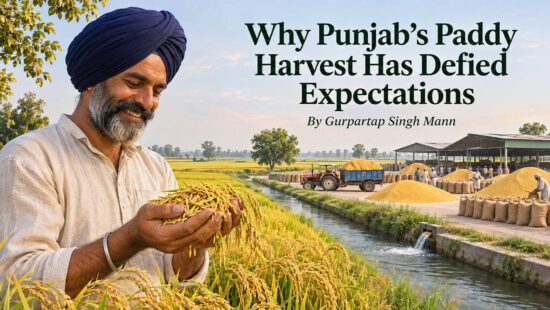
 Punjab’s farmers have produced a harvest exceeding official expectations. Agriculture officials report yield increases of 7–8 per cent across several districts. Final statewide results remain awaited, but the additional grain already reaching mandis requires an immediate procurement response.
Five published annual production totals provide perspective:
Figures include basmati and non-basmati before milling. The table covers five published years ending in 2024–25; a comparable final total for 2025–26 remains unverified.By November 14, arrivals had reached 185.23 lakh metric tonnes (LMT), with government agencies and private traders together purchasing approximately 181.3 LMT. Punjab now seeks an increase in its procurement target from 180 to 200 LMT—another 20 LMT, or 11.1 per cent.
The state has consequently approached the Centre to enhance its Cash Credit Limit. The existing ₹42,786.68-crore facility covered the original procurement requirement. More purchases require adequate credit, timely payments, storage and faster lifting. Farmers should not suffer because their harvest exceeds an administrative estimate.
The financial gain could be substantial. On an illustrative 180-LMT baseline, a uniform 7–8 per cent yield increase with unchanged acreage implies 12.6–14.4 LMT extra grain, worth approximately ₹3,100–3,540 crore at the Grade A MSP of ₹2,461 per quintal. Procurement of 200 LMT would generate ₹4,922 crore above the original target’s value. These overlapping scenarios measure gross farmer receipts before additional costs and exclude basmati.
Several factors probably worked together to improve yields.
First, paddy needs sufficient water and sunshine. Punjab Agricultural University identifies assured irrigation and prolonged sunshine as favourable conditions. Where canals and tubewells met water requirements, relatively dry weather could support crop growth and grain filling.
Second, improved canal availability is a credible contributor. Reliable irrigation prevents moisture stress. In south-western Punjab, suitable canal water can also reduce dependence on saline or sodic groundwater. The government deserves credit wherever delivery improved, although its precise statewide contribution requires scientific measurement.
Third, former PAU vice-chancellor B.S. Dhillon identifies reduced disease and lower nutrient leaching, alongside sunshine and irrigation, as favourable factors. Improved varieties and farm management also helped realise the crop’s potential.

Basmati offers further encouragement. Private traders and exporters have purchased it at substantially higher prices. At Amritsar’s Bhagtanwala market, Pusa 1509 reportedly fetched ₹4,200–4,500 per quintal against about ₹2,800 last year. Stronger overseas buying interest, particularly Middle Eastern restocking demand, supports prices. Exporter KRBL also identifies low carryover stocks and higher export realisations as contributing factors. International demand is helping farmers obtain better returns despite a larger crop.
Yet the bumper harvest exposes Punjab’s diversification paradox. Despite repeated programmes to shift farmers away from water-guzzling paddy, the broader cropping pattern remains stubbornly unchanged. Paddy acreage reportedly reached 32.76 lakh hectares this season, a record. Assured procurement and predictable returns continue to attract farmers, while alternatives struggle to offer comparable security. Diversification will achieve meaningful results only when maize, pulses, oilseeds and other crops have dependable buyers and remunerative returns.
Punjab must ensure that every eligible farmer can sell the additional crop while creating credible alternatives to its continuing dependence on paddy.