
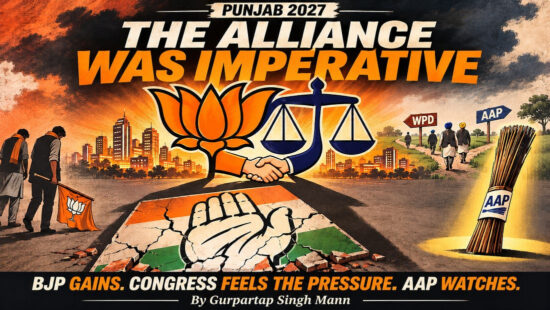
 On 27 December 2025, I argued that BJP would need a Panthic partner in Punjab. I called such an alliance socially imperative. Eleven months later, the party has returned to the Shiromani Akali Dal and accepted that an Akali would be Chief Minister if they win. Refernce to my earlier Opeds are given below.
The reason seemedclear to me then. BJP had a problem its national election machinery could not readily solve: winning trust in villages where it was still viewed with suspicion. It could recruit Sikh leaders, organise large rallies and improve its vote share. Governing Punjab would require a wider acceptance of its place in the state’s politics.
That was what I meant by psychological legitimacy. A voter may want better policing or closer cooperation with the Centre and still worry about whether Punjab’s identity and interests will receive a fair hearing. A credible Panthic partner, with an effective say in government, can offerr some reassurance.
Amit Shah’s acceptance of SAD as the senior partner should be understood in that light. BJP polled more votes than SAD in the 2024 Lok Sabha election. It has nevertheless agreed to regional leadership in Punjab. The arrangement acknowledges something that the earlier talk of fighting all 117 seats tended to overlook.
In August, I argued for a broader understanding that accommodated SAD (Punar Surjit) with dignity. There may still be room for that. The parties announced their reunion on 24 November without announcing a seat-sharing formula. Seats can therefore be kept available forr other partners or leaders willing to join them.
I expect that BJP will try to pursue smaller formations and individuals who can work within its nationalist outlook. Punar Surjit and perhaps BSP, or sections of their leadership, could figure in that effort. Both have also been exploring an alternative front with Waris Punjab De. Their hostility towards the Badal-led SAD makes an understanding difficult. Any accommodation would require them to explain a considerable change of position.
The clearest gain for BJP will come in the towns (Urban and semi urban). An Akali endorsement can bring additional Sikh votes to a BJP candidate who already has an urban base. Congress will feel that pressure directly.
Take for example the Amritsar West seat. On the 2024 parliamentary segment figures, Congress led BJP by 4,075 votes, while SAD polled 11,451. Just under 36% of those Akali votes would have been enough to reverse the lead. BJP does not need every Akali voter to follow the alliance for its urban strike rate to improve.
Congress should be concerned about seats where it has depended on a divided opposition. It will also have to defend its Scheduled Caste support against several competitors. A change in the candidate facing it can matter as much as a change in the statewide mood.
There could, however, be trouble inside BJP when the tickets are distributed. Aspirants who expected the party to expand independently will now find some constituencies allotted to SAD. Within BJP’s own share, old workers will compete with influential newcomers. A disappointed aspirant may contest as a rebel, or simply allow the campaign to struggle without him. The leadership will need the booth workers long after the celebration in Delhi is over.
SAD has a different difficulty. Some Panthic voters have spent years opposing BJP and the RSS. A decision by Sukhbir Badal will not automatically persuade them to change their minds. Some may move towards WPD. Others may choose AAP because they regard it as better placed to defeat the alliance.
This could make the exchange/tranfser of votes unequal. BJP may gain useful Akali support in a town, while an Akali candidate in rural Punjab loses part of his own following. Receiving BJP votes will be little consolation if the reunion costs him as many votes among his existing supporters.
My 15 November analysis tried to measure the opportunity. In each constituency, I retained the stronger partner’s vote and added 75% of the smaller partner’s vote. On the 2024 results, the alliance would have led in 52 Assembly segments, compared with the 32 that the parties led separately. It would have taken eight leads from Congress, eleven from AAP and one from an independent.
The same exercise on the 2022 Assembly results yielded only 11 seats. The contrast shows how much the parties’ positions changed between those elections. These calculations hold rival votes unchanged; they cannot tell us how many voters will follow a common candidate in 2027.
The eleven AAP leads that change hands are reason enough for Bhagwant Mann to take the alliance seriously. Yet he could also benefit from the reaction to it. If reluctant Akali voters move to AAP, or divide among smaller parties while AAP holds its support, the government may survive in seats where it appears vulnerable.
WPD’s role will depend on whose voters it attracts. Taking support from SAD could help AAP retain a constituency. Taking dissatisfied young voters from AAP could hurt the incumbent. Its effect may be felt in more seats than it wins.
The October surveys reviewed in my earlier report put AAP ahead, with SCORE projecting 69–82 seats and Spick Media 62. They assumed separate BJP and SAD candidacies. The field has since changed, but AAP’s welfare support remains a reason to take it seriously. Free electricity and money reaching women’s accounts have a value that opposition speeches cannot wish away. I would still keep the possibility of a hung Assembly open.
Congress, meanwhile, has been given fair warning. It cannot win this election by waiting for enough people to get tired of Bhagwant Mann. In the towns, it now faces the prospect of BJP candidates backed by the Akalis. That should concentrate its leaders’ minds rather more than the next argument over who will be Chief Minister.