
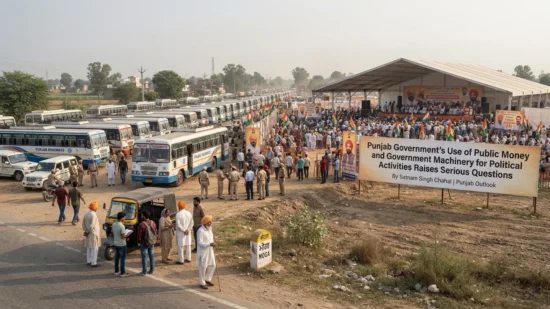
The controversy surrounding the deployment of government buses for the Aam Aadmi Party’s (AAP) November 26, 2026, rally in Moga has once again raised an important question about the use of public resources for political activities. Can a government use state-owned transport corporations, government employees and administrative machinery to facilitate a programme that is also being projected as the ruling party’s political and electoral campaign? This is not merely a controversy between political parties. It concerns the rights of taxpayers, ordinary commuters and citizens who finance the functioning of the government through their hard-earned money.
According to the order issued by the District Magistrate, Moga, dated November 24, 2026, a total of 1,497 buses were requisitioned, comprising 802 Punjab Roadways buses and 695 PRTC buses. The order refers to the Punjab Requisitioning and Acquisition of Movable Property Act, 1978, and states that the buses were required for transporting people for a state-level programme relating to the distribution of Smart Ration Cards on November 26. However, the political context of the event has raised questions because the Moga gathering was also being promoted as the AAP’s foundation-day rally and the launch of its 2027 Assembly election campaign.
The central issue is not whether the government should distribute ration cards or provide welfare benefits to eligible citizens. Such programmes are legitimate responsibilities of an elected government. The real question is whether public transport resources should be diverted from their regular duties to bring crowds to a gathering that also serves the political interests of the ruling party. A welfare programme can be organised through government departments without necessarily turning the state’s transport infrastructure into a mechanism for mobilising people for a political rally.
Government buses: Who will bear the financial burden?
The requisitioning of 1,497 buses raises several practical and financial questions. Punjab Roadways and PRTC are public transport institutions established to provide affordable transportation to the people. Their buses are expected to operate on scheduled routes, generate revenue and provide essential connectivity to villages, towns and cities. When a substantial number of these buses are diverted for a political gathering, ordinary passengers are the first to face the consequences.
The diversion also involves more than simply taking buses off the roads. There are expenses relating to diesel, drivers, conductors, maintenance, additional working hours, vehicle wear and tear and the loss of normal ticket revenue. If buses are required to travel long distances to collect people from different villages and transport them to Moga, the government must explain the complete cost of this operation. How much money will be spent? Who will pay the transport corporations? Will the ruling party reimburse the full cost, or will the financial burden ultimately fall on public institutions?
AAP Punjab president Aman Arora reportedly stated that the party would pay PRTC for using its buses and that the corporation would not suffer a financial burden. This statement makes transparency even more important. The government should publish the actual amount charged, the payment received, the number of buses deployed and the expenses incurred. A political assurance is not a substitute for audited financial accounts.
Punjab and Haryana High Court raises questions
The controversy has also reached the Punjab and Haryana High Court following a public interest litigation filed by Arshdeep Singh Sra. The petitioner questioned the diversion of government buses from their regular routes and sought details about the statutory authority and financial approvals for their deployment.
On November 25, the High Court questioned whether buses operating under statutory permits could be requisitioned and diverted for another purpose. The bench of Chief Justice Ashwani Kumar Mishra and Justice Rohit Kapoor also raised the issue of inconvenience to ordinary commuters.
The state government argued that the programme was an official function for distributing Smart Ration Cards and food kits to approximately six lakh citizens. It relied on provisions of the Motor Vehicles Act, 1988, to defend the arrangement. The court, however, made it clear that it was not questioning the welfare scheme itself; the question was whether diverting public transport buses was legally justified and necessary.
The state subsequently produced the November 24 order of the Moga District Magistrate. The matter was listed for further hearing on November 26. The legal questions and the court’s eventual findings deserve public attention.
Government employees and administrative machinery
The issue does not end with government buses. Whenever a ruling party organises a large political gathering, questions arise about the involvement of government departments, administrative officers, police personnel and public employees.
Government employees are paid by taxpayers to perform their official responsibilities. Their primary duty is to serve the public without political discrimination. If government staff are assigned duties connected with a political gathering, the government should disclose the nature of those assignments, the legal authority behind them and whether normal public services have been affected.
The administration belongs to the people of Punjab, not to the party occupying power. District administrations, transport corporations, police departments and other government institutions must function impartially, regardless of which political party is in office.
The double standard that taxpayers must question
Punjab is already facing serious financial pressures. The state government has to manage its debt, interest payments, employee salaries, pensions, infrastructure expenditure, healthcare, education and agricultural commitments. Ordinary families are struggling with inflation, unemployment and the rising cost of living.
At such a time, every rupee of public expenditure requires accountability. The government cannot simply expect taxpayers to finance every administrative arrangement without explaining its necessity and financial implications.
If a political party wants to organise a rally to celebrate its foundation day, demonstrate its popularity or launch an election campaign, it should clearly distinguish its party activities from government programmes. Party workers and supporters should not be treated as beneficiaries of public expenditure merely because a ruling party is organising an event.
There is also an important question about political equality. Would the same administrative assistance and transport facilities be made available if an opposition party wanted to organise a gathering of similar size? Would government departments requisition thousands of buses for Congress, Shiromani Akali Dal, BJP or any other political organisation? The rules governing public resources must apply equally to every political party.
Who is accountable for public money?
The Moga bus controversy should become an opportunity to establish clear rules governing the use of government machinery during political events. The Punjab government should make public the complete details of the 1,497 requisitioned buses, including their district-wise allocation, kilometres travelled, fuel expenditure, driver and conductor payments, loss of regular transport revenue and the amount charged to the event organisers.
It should also clarify whether the amount paid by the party, if any, covers the complete economic cost of the deployment. The public deserves to know whether the transport corporations received full compensation and whether passengers were provided alternative arrangements.
The responsibility of the opposition is also to raise these questions with documentary evidence rather than limiting the debate to political accusations. The High Court proceedings have already demonstrated that the matter involves questions of statutory authority, public convenience and accountability.
Conclusion: Public resources are not party property
Democracy provides every political party with the right to organise rallies, hold public meetings and communicate its political message. However, the resources of the government are not the personal property of the ruling party. The government is a temporary custodian of public institutions and public money.
A government may change after five years, but the financial consequences of its decisions can remain with taxpayers for decades. Political leaders may receive applause at a rally, but ordinary citizens must continue to pay the bills, repay government debt and depend on public transport for their daily needs.
The people of Punjab therefore have a legitimate right to ask the Bhagwant Mann government: If the Moga gathering was an official welfare programme, why was the same event also projected as the ruling party’s political and election campaign launch? If public transport was required for welfare beneficiaries, what prevented the government from making separate and transparent arrangements without disrupting regular bus services?
These are questions of public accountability, not simply political rivalry. Every government must remember that it governs with the money and trust of the people. Public resources must serve the public interest, not become an instrument for strengthening the political position of whoever happens to be in power.
Editorial note: The 1,497-bus figure is taken from the Moga District Magistrate’s order reproduced in the supplied news graphic. Media reports have also cited other deployment figures, so the actual number of buses used should be established through official records. The allegations of political use and the government’s explanation are presented separately; the High Court’s final determination should not be presumed.
Sources for the report:
The Tribune — High Court questions Punjab’s legal authority to divert buses for Moga rally
Hindustan Times — Over 50% PRTC buses pulled off to ferry crowds to AAP’s Moga rally
Times of India — High Court questions diversion of buses for Moga function