
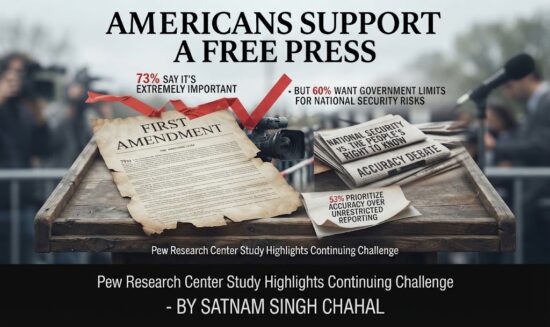
A new Pew Research Center study has highlighted a significant tension in American public opinion: Americans broadly recognize the importance of a free press, yet many also believe there are circumstances in which news reporting may legitimately be restricted.
The Pew-Knight Initiative survey, conducted among U.S. adults in June 2026, found that 73% of Americans consider freedom of the press extremely or very important to the well-being of society. At the same time, support for press freedom is not absolute when Americans are asked to weigh it against concerns such as inaccurate information and national security.
One of the most striking findings concerns accuracy. When respondents were asked to choose between allowing the press to report freely even when some information may be inaccurate and preventing inaccurate reporting even if that places limits on press freedom, 53% chose preventing inaccurate reporting, while 45% prioritized unrestricted reporting.
The survey also found that 60% believe the government should be able to require a news organization to remove a story if it poses a risk to national security, while 51% said the same when a story contains false information. By contrast, only 14% supported government-ordered removal when a story clearly favors one political side, and just 10% supported it when a story is critical of the government.
The findings underline an important distinction between government censorship and journalistic responsibility. Americans overwhelmingly expect news organizations to correct mistakes: 81% said a news organization should issue a public correction when it publishes false information in all, almost all or most cases. Views are considerably more divided over whether governments should be able to impose fines or require stories to be removed.
Public opinion is also divided along political lines. Pew found that Democrats and Republicans frequently approach press freedom from different concerns. Democrats are more likely to express concern about government restrictions, while Republicans are more likely to focus on inaccurate information and the role of news organizations in determining what information reaches the public.
The survey found that 46% of Americans are extremely or very concerned about possible restrictions on press freedom, roughly comparable with concern about restrictions on voting rights and somewhat below concern about freedom of speech. Meanwhile, only 28% said the media is completely free to report the news in the United States, down from 33% in 2025.
Another notable finding is Americans’ understanding of the First Amendment itself. Pew’s March 2026 survey found that only 9% correctly answered all eight questions testing knowledge of First Amendment protections. About seven in ten correctly understood that the First Amendment protects information and opinions expressed by both news organizations and ordinary citizens, but substantially fewer understood how constitutional protections apply to social-media companies and private businesses.
The broader message from the Pew research is that Americans continue to place substantial value on freedom of the press, but the public debate is increasingly focused on where freedom ends, where responsibility begins, and who should decide when information crosses that line.
For journalists, media organizations and the public alike, the findings point to a continuing challenge: protecting the independence of the press while maintaining accuracy, accountability and public trust. The Pew study does not provide a simple answer to that debate. Instead, it shows just how strongly Americans value press freedom and how differently they understand its boundaries.
Pew Research Center — Americans Value Press Freedom but Differ on Its Limits
Disclaimer: This article and accompanying images are for informational and illustrative purposes only. Some visuals may be AI-generated or digitally enhanced and may not depict actual events or persons.Views expressed are based on publicly available information and analysis