
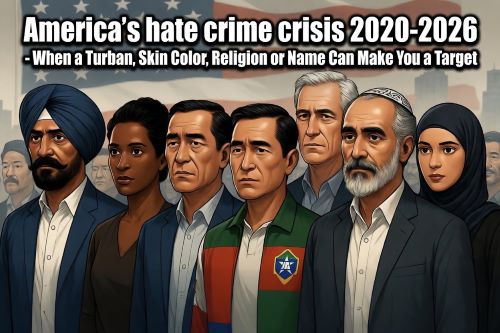
 America likes to describe itself as a nation where people of every race, religion, nationality and background can live together under the protection of the law. It is a powerful ideal, but the years from 2020 to 2026 have shown that America still has a serious problem with hate. Behind the statistics are people who have been threatened, assaulted, harassed and intimidated simply because of who they are, what they believe, what they look like or where their families came from.
The Federal Bureau of Investigation’s hate-crime statistics provide a disturbing warning. In 2024, law-enforcement agencies reported 11,679 hate-crime incidents involving 13,683 related offenses. Race, ethnicity and ancestry remained among the largest categories, while religion and sexual orientation also accounted for significant numbers of reported incidents. These figures are not simply numbers on a government spreadsheet. Every number represents a person, a family or a community whose sense of safety has been damaged.
The statistics must also be understood with caution. Hate crimes are not always reported to police, and not every law-enforcement agency participates in the federal reporting system in exactly the same way. Victims may fear retaliation, may not trust authorities, may face language barriers or may believe that reporting the incident will accomplish nothing. Consequently, the official statistics should not be interpreted as a complete count of every act of hatred occurring in America. They represent what was reported and successfully captured in the national system.
The year 2020 was an important warning. The COVID-19 pandemic created an atmosphere in which Asian Americans were increasingly subjected to racial hostility, harassment and abuse. Political rhetoric and misinformation sometimes encouraged people to blame Asians and people of Chinese descent for a disease that knew no race or nationality. The lesson should have been obvious: when an entire community is blamed for a crisis, prejudice can quickly become discrimination, and discrimination can become violence.
The following years demonstrated that the problem was not temporary. The “Stop Asian Hate” movement brought national attention to attacks and harassment against Asian Americans. Elderly people, women and immigrants were among those who reported abuse. Some were targeted simply because of their appearance, language or ancestry. When an elderly Asian American becomes afraid to walk down the street, that is not merely an Asian-American problem. It is an American problem.
The same concern applies to religious minorities. Jewish Americans, Muslims, Sikhs, Hindus and members of other faith communities have all experienced incidents of religious bias. The FBI specifically recognizes anti-Sikh bias as a category of religious hate crime. That recognition is important because Sikhs have sometimes been targeted because perpetrators misunderstand Sikh identity or mistake Sikhs for members of another religious or ethnic group.
For Sikh Americans, the problem has a particular dimension because Sikh identity can be immediately visible. A turban is not a political symbol. A beard is not evidence of extremism. The kirpan is not a symbol of violence. These are connected to Sikh religious identity and practice. Yet ignorance about Sikhism can turn religious identity into vulnerability. When a Sikh is attacked because of his turban or beard, the victim is not the only person affected. The entire Sikh community receives the message that it may not be safe to be visibly Sikh in America.
The FBI’s recognition of anti-Sikh hate crimes is therefore significant, but recognition alone is not enough. Sikh Americans need law enforcement agencies to understand Sikhism, Sikh articles of faith and the particular forms that anti-Sikh harassment can take. Police officers should know that a turban represents religious identity and dignity, not danger. Schools should teach students about the communities that make up America. Ignorance should not be allowed to become a weapon.
The years 2022 and 2023 demonstrated how deeply hate remained embedded in American society. In 2023, law-enforcement agencies reported 11,862 hate-crime incidents and 13,829 related offenses. Religious hatred was particularly troubling. The Department of Justice reported substantial numbers of anti-Jewish, anti-Muslim and anti-Sikh incidents. Behind every statistic was an individual who experienced fear, humiliation, intimidation or violence because of identity.
The danger became even more complicated as international conflicts increasingly entered American political and social life. Americans have every constitutional right to debate foreign policy, criticize governments and protest international events. But foreign conflicts must never become excuses for targeting American citizens because of their religion or ancestry. An American Muslim is not responsible for the actions of a foreign government. An American Jew is not responsible for the actions of Israel. An American Sikh is not responsible for the actions of any political organization. An American Hindu is not responsible for the policies of the Indian government. Citizens must be judged as individuals, not collectively punished because of their identity.
One of the most disturbing developments has been the movement of hate from the street to the internet. Social media has allowed hateful messages, conspiracy theories and threats to spread faster than ever before. A racial insult that once might have been heard by a few people can now reach thousands. A threat can be delivered instantly to a victim’s phone. A conspiracy theory can become a movement. Online hatred does not always remain online, and authorities must take credible threats seriously while continuing to protect legitimate freedom of expression.
America must also confront the problem of normalization. When racial insults become political entertainment, when religious communities are collectively blamed for the actions of individuals, when immigrants are portrayed as inherently dangerous, or when people are judged by their skin color, turban, hijab, yarmulke or name rather than their conduct, society moves toward a dangerous place. The greatest threat may not always be one extremist acting alone. It can be the gradual acceptance of language and attitudes that make discrimination appear normal.
Law enforcement has a central responsibility in confronting this crisis. Police departments should receive meaningful training about the religious and cultural communities they protect. Officers should understand Sikhism, Islam, Judaism, Hinduism and other faith traditions represented in their communities. They should understand why some immigrant victims may hesitate to report crimes and should create an environment where victims believe they will be heard and protected.
The problem also requires political courage. Hate cannot be condemned only when it comes from the opposing political party or ideological camp. A hate crime is wrong whether the victim is Republican or Democrat, conservative or liberal, immigrant or native-born, Sikh or Muslim, Jewish or Hindu, Black or White, Asian or Latino. Selective outrage is not leadership. If political leaders genuinely believe in equality, they must defend the rights and safety of communities even when those communities do not share their political views.
The North American Punjabi Association believes that the fight against hate must never become a competition between communities. An attack on a Sikh is an attack on religious freedom. An attack on an Asian American is an attack on equality. An attack on a Muslim is an attack on religious liberty. An attack on a Jewish American is an attack on the right to live without fear. An attack on any minority ultimately attacks the American principle that every citizen deserves equal protection under the law.
As of 2026, the latest complete nationwide FBI hate-crime dataset is for 2024, so responsible reporting should not present an unverified national 2025 or 2026 figure as an official FBI total. But America does not need to wait for another annual report to understand the danger. Continuing threats, prosecutions, community concerns and reports of bias show that the country must remain vigilant. The question is not simply how many people were attacked. The deeper question is how many Americans are changing the way they live because they are afraid they might become the next target.
America must draw a clear line. Citizens have the right to disagree with one another. They have the right to criticize governments, debate immigration, challenge religions, protest policies and express political opinions. But no one has the right to threaten, assault, intimidate or murder another person because of race, religion, ethnicity, nationality, sexual orientation or another protected identity. That must be the country’s red line.
The true test of American democracy is not how comfortably the majority lives. It is whether a minority can walk safely through an American city. Can a Sikh father leave his home wearing a turban without wondering whether someone will attack him? Can a Muslim woman wear her hijab without fear? Can a Jewish family attend a synagogue without worrying about threats? Can an Asian-American elderly person walk through a neighborhood without being told to “go back” to a country they may never have lived in? Can a Black American child grow up believing that the law will protect him? Can an immigrant proudly say, “This is my country too”?
These are not unreasonable demands. They are the basic expectations of citizenship in a democratic society.
The years from 2020 to 2026 should therefore not become merely another chapter in an FBI statistical report. They should become a turning point. America can either allow hatred to become increasingly normalized, or it can confront it with education, law enforcement, accountability, political courage and solidarity.
The United States does not need to become a country where everyone looks alike, thinks alike or worships alike. It needs to remain a country where people with completely different identities can live together without being hunted for those identities.
The turban must be safe. The hijab must be safe. The yarmulke must be safe. The cross must be safe. The skin of every American must be safe. The name of every American must be safe.
Above all, every American must be able to say, without fear and without apology: “I belong here.”
That is not a favor.
That is the promise of America.
Disclaimer: This article and accompanying images are for informational and illustrative purposes only. Some visuals may be AI-generated or digitally enhanced and may not depict actual events or persons.Views expressed are based on publicly available information and analysis.