
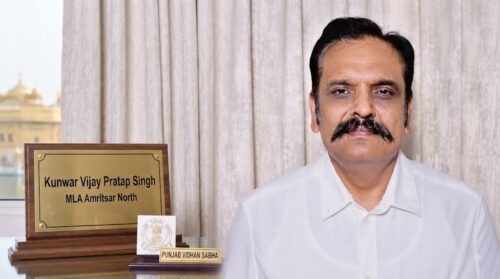
Amritsar: Amritsar North MLA Kunwar Vijay Partap Singh has raised serious concerns over the ongoing Special Intensive Revision (SIR) of electoral rolls in Punjab, questioning the reliability of the voter-mapping exercise and the level of control exercised by the Election Commission of India over the process.
The MLA has described the situation as a “totally faulty process”, expressing unease over the way voter mapping is being carried out at the ground level. His concerns assume greater significance as Punjab has entered a crucial stage of the SIR exercise, with the draft electoral rolls already published.
The mapping process is particularly important because it forms the foundation for identifying voters and linking their present electoral records with earlier rolls. Any error at this preliminary stage can potentially create problems later when voters seek to establish their eligibility or challenge an incorrect entry or deletion.
Official data itself shows the scale of the exercise. In May, the Amritsar administration reported that 88.27% of mapping had been completed, with 1,739,946 voters mapped while more than 231,000 remained unmapped. (The Tribune) The Chief Electoral Officer’s office also reported that more than 1.10 lakh voters were mapped in a single day during a statewide pre-SIR mapping camp in June. (Facebook)
The controversy has now become even more sensitive following the publication of Punjab’s draft electoral rolls. According to reports, around 20.66 lakh names were removed from the draft rolls, making the accuracy of the underlying verification and mapping exercise a matter of enormous public importance. (The Times of India)
Kunwar Vijay Partap Singh’s central question is therefore not simply about the number of names mapped or deleted, but about who is actually exercising effective oversight over the mapping process. If the Election Commission is responsible for the electoral roll, voters naturally expect a transparent chain of accountability for every stage—from mapping and verification to objections, corrections and final inclusion.
The Election Commission has laid down the SIR schedule and procedure, while the field-level exercise involves the state election machinery and Booth Level Officers. (Hindustan Times) That makes it important for the authorities to clearly explain what safeguards are in place to prevent faulty mapping, duplicate records, wrongful exclusion and errors in linking voters with previous electoral rolls.
For Punjab, this is not merely an administrative exercise. A voter list is the foundation of democracy. If the mapping is faulty, the consequences can go far beyond paperwork. A genuine voter who finds his or her name missing may have to go through a lengthy process to establish a right that should never have been questioned in the first place.
The concerns raised from Amritsar North therefore deserve a transparent and public response. The authorities must demonstrate that every voter has been treated equally, every mapping entry can be independently verified, and every genuine objection will receive a fair hearing.
The message is simple: SIR cannot become a numbers game. Accuracy must come before speed, and accountability must accompany every deletion.