
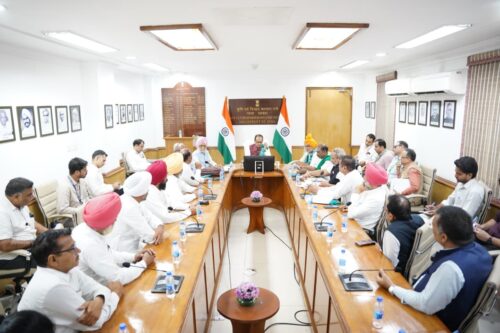
 New Delhi-The All India Kisan Coordination Committee (AIKCC) on Tuesday submitted a detailed memorandum to Union Minister of Agriculture and Farmers’ Welfare Shivraj Singh Chouhan, calling for a comprehensive overhaul of agricultural policies centred on farmers’ incomes, competitive markets, modern technology and greater freedom of choice.The memorandum was presented during a meeting held on 4 August 2026 at Krishi Bhawan. It was led by AIKCC and signed by Bhupinder Singh Mann, former MP, along with representatives from farmers’ organisations across several states.The farmers’ body emphasised that diversification of crops cannot succeed without assured markets and remunerative prices for alternative produce.
 It outlined five priority areas for urgent government action.On the ethanol programme, the memorandum described the initiative as a positive step for energy security but stressed that its benefits must reach farmers. It urged the government to address the E20 debate through independent scientific evidence and to promote maize, sugarcane, sorghum, crop residue and other low-water feedstocks in water-stressed regions rather than further incentivising paddy.Citing data, the note stated that the Food Corporation of India (FCI) supplied about 63.5 lakh tonnes of rice to ethanol plants between June 2025 and June 2026 at ₹2,250–2,320 per quintal, well below the average acquisition cost of ₹3,719.72 per quintal in 2024-25 and ₹3,889.46 in 2025-26, and also below the maize MSP of ₹2,410 per quintal for 2026-27. The committee demanded MSP-linked procurement or price support for maize and sugarcane growers before large quantities of FCI rice are released to distilleries, along with a stable five-year feedstock and ethanol-pricing policy.
It also called for an aggressive communication campaign to counter negative narratives around ethanol-blended fuels. On minimum support price (MSP) and markets, the memorandum said MSP remains an essential safety net but cannot cover every crop. Farmers should retain the choice of selling through APMC mandis or alternative markets. It sought strengthening of e-NAM into a genuine national market with common quality standards, reliable assaying, interstate logistics, dispute resolution and unified trader licensing. Regulated access to futures and options through exchanges such as NCDEX was also recommended, along with an independent review of the blanket suspension of futures trading in major agricultural commodities.The committee pressed for farmers’ access to biotechnology-enabled, climate-resilient and high-yielding seeds through a scientific, transparent and time-bound approval process. Once safety is established, farmers should be free to choose the technology, it argued. The proposed Seeds Bill, 2025, must protect farmers’ rights to save, sow, re-sow, exchange and share farm-saved seed while holding commercial suppliers accountable. Misinformation about the Bill should be countered through credible scientists, agricultural universities and farmer representatives, and universities should receive greater research funding linked to improved varieties and extension work.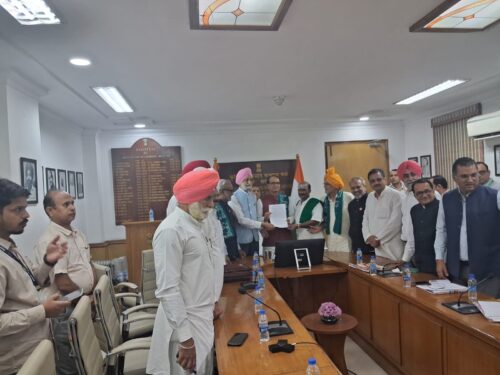
Highlighting the special situation of Punjab and Haryana, the memorandum noted that farmers in these states had ensured India’s food security through heavy investment in machinery, irrigation and inputs for the national wheat and rice pool. The same system, however, locked them into the wheat-paddy cycle, leading to groundwater depletion, soil deterioration and rising debt. It sought a Centre-State agricultural transition package covering restructuring of verified distressed institutional farm loans with interest relief, MSP-linked support and assured marketing for maize, pulses and oilseeds, income protection for farmers shifting away from paddy, infrastructure for alternative crops, greater fiscal support for horticulture, livestock, agroforestry and micro-irrigation, and central assistance for restoring canal systems.Finally, the AIKCC called for a comprehensive National Agricultural Policy prepared in consultation with states and genuine farmers’ organisations. It recommended reviewing overlaps in the Seventh Schedule and related laws without weakening federalism, reforming the Essential Commodities Act, 1955, so that stock limits and movement restrictions are imposed only during clearly defined shortages, and ensuring stable import-export policies announced before sowing seasons. Consumers should be protected through the Public Distribution System and a price-stabilisation fund rather than by suppressing farm-gate prices.
The committee requested the government to constitute a National Agricultural Policy Commission with a six-month mandate, comprising Union ministries, states, farmers’ organisations, ICAR, agricultural universities, economists and market experts, to prepare a draft policy and a time-bound implementation roadmap.“India’s farmers need fair prices, modern technology, competitive markets and freedom from sudden policy reversals, with emphasis on agro-processing including ethanol and bio-waste management for compressed biogas,” the memorandum concluded, seeking the minister’s personal intervention to initiate these reforms.Those present at the meeting included Bhupinder Singh Mann (Ex-MP), Gurpartap Singh Mann, Gunvant Patil (General Secretary, AIKCC), Guni Prakash (President, BKU Mann, Haryana), Manikandam (President, Vasagal Sangam, Tamil Nadu), Balraj Singh Randhawa (General Secretary, BKU Mann), Binod Anand (Vice-President, AIKCC), Balpreet Singh (General Secretary), Shivraj Singh, Subhakar Rao (President, Kisan Organisation, Telangana), Balwant Singh Nadiali (President, BKU Mann, Mohali), Manphool Singh, Lalit Bahale (President, Shetkari Sangathana, Maharashtra), Dinesh Sharma (General Secretary, Shetkari Sangathana), Ajay Anmol (President, BKU Mann, Uttar Pradesh) and Kisan Subrat Mani Tripathi (National General Secretary, BKU Mann).