
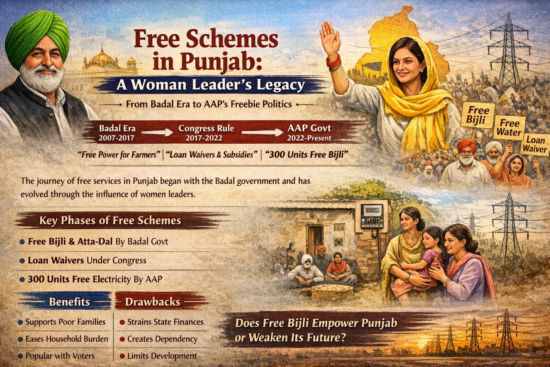
 In recent years, the idea of providing free public services such as free electricity, water, transport, and welfare subsidies has become a major feature of electoral politics in Punjab. While often referred to as “freebies” in political debate, supporters argue these schemes are extensions of welfare governance meant to reduce inequality and support economically weaker sections. Critics, however, question their long-term financial sustainability and political motivation.
The roots of large-scale subsidy politics in Punjab can be traced back to earlier state governments, including the tenure of the Shiromani Akali Dal–BJP alliance under former Chief Minister Parkash Singh Badal. During this period, several welfare-linked schemes were expanded, particularly in agriculture, such as free or subsidised electricity for farmers. These policies were largely framed as support for the agricultural economy, which remains the backbone of Punjab.
Over time, competitive politics in the state led to an expansion of such welfare promises across party lines. As elections became more contested, political parties increasingly committed to broader subsidies such as free or heavily subsidised electricity for households, water supply relief, and social support schemes for women, students, and marginalised communities. This created a cycle where welfare promises became central to electoral campaigns.
A significant shift came with the rise of the Aam Aadmi Party in Punjab politics, which strongly promoted the idea of extensive free public services as part of its governance model. After forming the government, the party expanded schemes such as free electricity up to certain units for domestic users and other public relief measures, positioning them as “rights-based governance” rather than electoral promises.
Supporters of these policies argue that such measures are necessary in a state facing rural debt, agrarian distress, and unemployment challenges. They believe that free or subsidized services help stabilize household incomes and ensure basic dignity for vulnerable populations. In this view, welfare spending is seen as a social investment rather than a financial burden.
On the other hand, critics argue that increasing reliance on subsidies can strain the state’s fiscal health and reduce funds available for infrastructure, industrial development, and long-term economic growth. They also warn that excessive dependence on “free schemes” may create expectations that are difficult for any future government to sustain.
Overall, the debate around free services in Punjab reflects a larger national discussion about the balance between welfare and fiscal responsibility. While these schemes remain politically popular, they continue to raise important questions about economic planning, governance priorities, and the long-term development path of the state.