
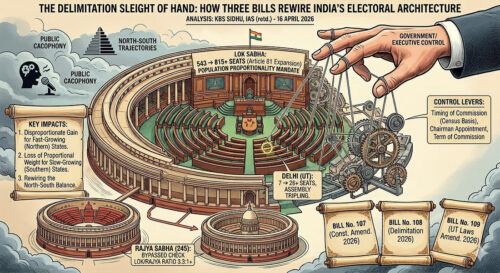
 Three Bills introduced in the Lok Sabha on 10 and 11 April 2026 — Bill No. 107 (The Constitution (One Hundred and Thirty-first Amendment) Bill, 2026), Bill No. 108 (The Delimitation Bill, 2026), and Bill No. 109 (The Union Territories Laws (Amendment) Bill, 2026) — together constitute the most consequential restructuring of India’s electoral architecture since the freeze on delimitation was imposed by the Constitution (Eighty-fourth Amendment) Act, 2001. They deserve to be read as a single integrated instrument, not as three separate legislative measures.
The 131st Amendment Bill is the keystone. It amends Article 81(1) to raise the Lok Sabha ceiling from 530 to 815 seats for States and from 20 to 35 seats for Union territories. It amends Articles 82 and 170 to decouple delimitation from the mandatory post-census trigger, replacing ‘upon the completion of each census’ with a formulation that empowers Parliament by law to determine which census shall be the operative basis. It substitutes Article 334A to operationalise one-third reservation of seats for women — the unfulfilled promise of the Nari Shakti Vandan Adhiniyam of 2023 — without waiting for a post-2026 census. The Delimitation Bill 2026 provides the statutory machinery. The UT Laws Amendment Bill aligns the governing statutes for Delhi, Puducherry and Jammu and Kashmir with the revised constitutional scheme.
These Bills do not operate in isolation. They must be read against the unamended provisions of the Constitution — particularly Article 81(2), Articles 330 and 332, and the unchanged structure of Presidential election under Article 55 — that constrain and shape what the Delimitation Commission may do once constituted. The architecture rewards careful reading. It is considerably more intricate than the headlines suggest.
There is one structural change that has escaped almost all commentary but which deserves immediate attention before the analysis proceeds. These Bills leave the Rajya Sabha entirely untouched. The Council of States retains its current composition of 245 members. As the Lok Sabha expands from 543 to potentially 800-plus seats, the ratio of Lok Sabha to Rajya Sabha strength — already approximately 2.2:1 — will move to approximately 3.3:1 or beyond. In Money Bills the Lok Sabha already has the whip hand under Article 110 — the Rajya Sabha can only make recommendations which the Lok Sabha is free to accept or reject. In the unlikely event of a deadlock on ordinary legislation, a joint sitting under Article 108 — which was last invoked for POTA in 2002 — would produce an outcome in which the Rajya Sabha’s theoretical role as the Council of States becomes arithmetically irrelevant. The constitutional design intended the Rajya Sabha as a check on majoritarian excess. That check diminishes with every seat added to the Lok Sabha without a corresponding revision of the upper chamber. The silence of these Bills on Rajya Sabha reform is itself a constitutional choice, and not a neutral one.
II. The 53.8 Per Cent Ceiling: An Inference, Not a Mandate
Public commentary has described these Bills as providing for a 50 per cent increase in Lok Sabha seats. That characterisation is imprecise on two counts. The actual increase in the constitutional ceiling is from 530 to 815 — a rise of 53.8 per cent, not 50. More importantly, no provision in any of these three Bills mandates a uniform proportional increase across all States. The 131st Amendment fixes the ceiling. The Delimitation Bill 2026 entrusts actual allocation to the Delimitation Commission on the basis of the latest census figures. The two instruments are legally distinct and the outcome for individual States will vary substantially.
The Delimitation Commission will not be distributing a proportional increment to every State. It is constitutionally obligated — under the unamended Article 81(2)(a), which none of these Bills touches — to ensure that the ratio between the number of seats allocated to each State and the population of that State is, so far as practicable, the same for all States. Population proportionality is not a policy preference. It is a binding constitutional mandate, judicially enforceable. The Commission’s discretion to depart from it is limited to what the phrase ‘as far as practicable’ permits — rounding, administrative exigency, and the requirement that every State receive at least one seat. No more.
The practical consequence is that fast-growing States — Uttar Pradesh, Bihar, Madhya Pradesh, Rajasthan — will gain seats disproportionately relative to slow-growing States. Slow-growing States gain in absolute numbers but lose in proportional weight. This is the constitutional arithmetic from which there is no escape under the existing text of Article 81(2)(a), and these Bills have deliberately not amended that provision.
III. The Census Lock-in: The Pivotal Drafting Choice
The most consequential provision in this entire legislative package is not in the Constitution Amendment Bill. It is in Section 2(h) of the Delimitation Bill 2026, which defines ‘population’ as ‘the population ascertained at the latest census of which the relevant figures have been published as on the date of the constitution of the Commission.’
The operative phrase is ‘as on the date of the constitution of the Commission.’ The definition does not refer to the census available when the Commission completes its work or publishes its orders. It refers to the census available on the day the Commission is constituted by the Central Government. If the Commission is constituted in 2026 — as the entire architecture of these Bills contemplates — the only census with published figures on that date is the 2011 census. The 2021 census was never conducted during the pandemic years. No post-2026 census has been undertaken, much less published.
The Central Government has therefore effectively predetermined, through the mechanics of timing, that the 2011 census shall be the operative basis for this delimitation — without having to say so explicitly in the statute. It is a drafting choice of considerable political intelligence. It achieves a specific political outcome while maintaining the outward form of a neutral, criteria-based process delegated to an independent Commission.
It is equally important to note what this drafting choice does not permanently foreclose. The amended Articles 82 and 170 provide that delimitation shall be undertaken ‘on the basis of such census as Parliament may by law determine.’ Parliament’s current law — the Delimitation Bill 2026 — has chosen the latest published census as on the Commission’s constitution date. Parliament can amend this in future. The Central Government thus retains, for subsequent delimitation exercises, the ability to specify a different census basis — potentially a post-2026 census with its full demographic implications for north-south seat distribution.
IV. The Central Government Holds Multiple Keys
The degree of central control embedded in this legislative architecture is worth examining in full, because it is greater than the Bills’ neutral statutory language might suggest.
First, under Section 3(1) of the Delimitation Bill 2026, the Central Government constitutes the Commission by notification. It decides when. The timing decision, as demonstrated above, is outcome-determinative on the census question.
Second, the composition of the Commission is substantially pre-determined before it begins work. Section 3(2) provides that the Chief Election Commissioner, as an ex officio member, may make an irrevocable nomination of an Election Commissioner to represent the Election Commission of India on the Delimitation Commission. Once that nomination is made, no further nomination under that clause is permissible except to fill a casual vacancy arising from death or resignation. The CEC’s nomination choice therefore locks in the ECI’s representative for the Commission’s entire term. Notably, the recently enacted Chief Election Commissioner and Other Election Commissioners (Appointment, Conditions of Service and Term of Office) Act 2023, which changed the CEC appointment process, means the Central Government has already shaped the composition of the ECI whose nominee will sit on the Delimitation Commission.
Third, Section 3(2)(a) provides that the Chairperson — a sitting or retired Supreme Court Judge — is appointed by the Central Government. The choice of Chairperson is an executive decision with no parliamentary confirmation requirement.
Fourth, Section 3(3) empowers the Central Government to specify the term of the Commission and to extend it on the Commission’s request. The Central Government controls the clock under which the Commission works.
Fifth, the Commission’s associate members — five Lok Sabha members and five MLAs per State under Section 5 — are nominated by the respective Speakers. They have no vote and cannot sign any decision of the Commission. Their role is consultative, not determinative.
Taken together: the Central Government constitutes the Commission, determines its timing, nominates its Chairperson, indirectly shapes the ECI representative through the CEC appointment process, controls the Commission’s term, and through the timing mechanism determines which census it works on. The Commission’s independence is real within those parameters — but the parameters are set entirely by the executive.
V. Who Decides Which Seats Are Reserved — and How
The question of which specific constituencies carry the reservation tag — for Scheduled Castes, Scheduled Tribes, and women — is one of the most practically significant aspects of any delimitation exercise. The answer under these Bills is the Delimitation Commission, and the criteria are a layered combination of constitutional mandate, statutory direction, and residual Commission discretion.
On SC and ST reservation, the constitutional framework is binding and non-negotiable. Articles 330 and 332 mandate that the number of seats reserved for Scheduled Castes and Scheduled Tribes shall bear, as nearly as may be, the same proportion to the total number of seats as the SC or ST population bears to the total population of the State. This is a hard constitutional floor. The Commission has no discretion on the number of SC or ST reserved seats — it flows directly from census-based population proportionality. Section 8(a) and 8(b) of the Delimitation Bill replicate this obligation.
The discretion lies in the location of reserved constituencies — which specific delimited constituencies carry the SC or ST reservation tag. Here Section 9(1)(c) and (d) of the Delimitation Bill provide the criteria, and the language is deliberately differentiated. For SC-reserved constituencies: they ‘shall be distributed in different parts of the State and located, as far as practicable, in those areas where the proportion of their population to the total is comparatively large.’ For ST-reserved constituencies: they ‘shall, as far as practicable, be located in areas where the proportion of their population to the total is the largest.’ The ST criterion is stricter — maximum concentration. The SC criterion is a distribution-with-concentration formulation that gives the Commission somewhat more geographic flexibility, particularly in States like Punjab where SC population is dispersed rather than geographically clustered.
On women’s reservation, the mechanism is entirely the Commission’s creation. Section 8(c) of the Delimitation Bill mandates reservation of as nearly as may be one-third of total seats for women. Section 9(1)(e) directs the Commission to delimit constituencies in which seats are reserved for women and to determine the rotation of such seats. The substituted Article 334A(3) provides that women-reserved seats shall be allotted by rotation to different constituencies. There is no provision in any of these Bills for determination of women-reserved seats by draw of lots. The Commission determines which constituencies are women-reserved through its delimitation order — an exercise of quasi-judicial discretion guided by the rotation principle and by the requirement that the distribution span different parts of the State.
The third proviso to Section 8 of the Delimitation Bill addresses the intersection of women’s reservation with SC and ST reservation: ‘seats reserved for women belonging to the Scheduled Castes and the Scheduled Tribes shall be rotated within the constituencies reserved for the Scheduled Castes or the Scheduled Tribes, as the case may be.’ This means the Commission must carve out, from within the SC-reserved and ST-reserved pools, a sub-category of constituencies that are simultaneously SC-reserved-for-women and ST-reserved-for-women — seats in which only women belonging to the respective community may stand.
Rotation of women-reserved seats — both general and within SC/ST pools — takes effect only after subsequent delimitation exercises, not within a single cycle. The first delimitation order fixes the women-reserved constituencies for the entire period until the next delimitation. The Election Commission has no role in mid-term rotation. Rotation is exclusively a function of the next Delimitation Commission.
The terms of reference issued by the Central Government when constituting the Commission can legitimately provide guidance on geographic distribution, the census tables to use for SC/ST calculations, administrative boundary units to treat as inviolable, and sequencing of Parliamentary versus Assembly delimitation. What the terms of reference cannot do is override the statutory criteria in Section 9 or the constitutional proportionality mandate in Articles 330 and 332. Executive terms of reference cannot amend a statute or override the Constitution. Any attempt to do so would be judicially unsustainable.
VI. The Sequencing Problem: A Multi-Variable Constitutional Optimisation
The Delimitation Commission faces what is, in mathematical terms, a multi-variable constrained optimisation problem of formidable complexity. It must simultaneously satisfy the following requirements through a single integrated order that has the force of law and is not callable in question in any court.
First, it must determine Lok Sabha seats per State on the basis of Article 81(2)(a) population proportionality using 2011 census figures — this is constitutionally determined and arithmetically follows from the data. Second, it must determine the number of SC-reserved and ST-reserved Lok Sabha seats per State using Articles 330 and 332 population proportionality — again constitutionally determined. Third, it must delimit constituency boundaries within each State satisfying the geographic compactness criterion, the requirement that every Assembly constituency fall wholly within one Parliamentary constituency, and the principle that each constituency within a State have as nearly as practicable the same population-to-seat ratio. Fourth, having delimited boundaries, it must locate SC-reserved constituencies in areas of comparatively large SC concentration, distributed across the State. Fifth, it must locate ST-reserved constituencies in areas of maximum ST concentration. Sixth, it must designate approximately one-third of all constituencies — drawn from across the State, including from the SC and ST pools — as women-reserved. Seventh, within the SC-reserved pool it must designate a proportion as SC-women-reserved, and similarly within the ST pool.
These seven requirements interact and constrain each other simultaneously. A constituency boundary that satisfies geographic compactness may not align with SC population concentration. An SC-reserved constituency location that satisfies the population criterion may conflict with the requirement that women-reserved constituencies be distributed across different parts of the State. The Commission must find a solution that satisfies all constraints simultaneously — for every State and Union territory in the country, in a single exercise. This is why delimitation exercises historically take years, and why Section 3(3) of the Delimitation Bill empowers the Central Government to extend the Commission’s term on its request.
VII. Punjab: Working Through the Full Arithmetic
Punjab’s case illustrates the full complexity with specific numbers. Punjab’s current electoral architecture rests on a clean arithmetical foundation: 13 Lok Sabha seats, each containing nine Assembly segments, giving exactly 117 Vidhan Sabha seats. The delimitation exercise will disturb this structure at every level.
On Lok Sabha seats, Article 81(2)(a) is effectively determinative. Punjab’s 2011 census population was approximately 2.77 crore out of a national total of 121 crore — a share of 2.285 per cent. Applied to 815 seats, this yields 18.62, which rounds to 19. Punjab getting 20 seats would require departing from population proportionality in Punjab’s favour and would be constitutionally contestable under Article 81(2)(a). The most probable outcome is 19 Lok Sabha seats — a gain of six in absolute terms, but a marginal reduction in proportional share from 2.39 per cent of the current 543-seat House to 2.33 per cent of the new 815-seat House. Punjab gains seats but loses proportional weight. This is the inexorable arithmetic of a State that controlled its population growth while others did not.
On Vidhan Sabha seats, the Delimitation Bill’s integral multiple requirement means Punjab’s Assembly seats must be an exact multiple of 19. The options are 171 (19×9) or 190 (19×10). The nine-segment ratio is not constitutionally fixed — it is the current arithmetic outcome, not a statutory requirement, and the Commission may change it. However, 171 has a decisive advantage: one-third of 171 is exactly 57 — a clean number for women’s reservation with no rounding required. One-third of 190 is 63.33, requiring rounding to 63 and producing a marginally sub-one-third outcome. The Commission is therefore likely to prefer 171, preserving the nine-segment convention while yielding cleaner reservation arithmetic.
On SC reservation, Punjab presents a distinctive challenge. Punjab has the highest SC population share of any State in India — approximately 31.9 per cent on 2011 census figures. On 19 Lok Sabha seats, Articles 330 and 332 proportionality yields approximately 6.06 SC-reserved seats, rounding to 6. On 171 Vidhan Sabha seats, the same proportionality yields approximately 54.5 SC-reserved seats, rounding to 54 or 55. These numbers are constitutionally determined — the Commission has no discretion on them.
The location of those six SC-reserved Lok Sabha constituencies is where Commission discretion operates — but Punjab’s unusual demographic geography constrains even that. Punjab’s SC population, unlike that of States such as Tamil Nadu or Uttar Pradesh, is not geographically concentrated in identifiable belts. It is distributed with relative uniformity across the State, particularly through the Doaba and Malwa regions. The ‘comparatively large SC concentration’ criterion of Section 9(1)(c) is more difficult to apply with precision in Punjab than in most States. The Commission will need tehsil-level SC population data from the 2011 census to make these determinations, and the geographic distribution requirement will operate as an additional constraint on concentration-based selection.
At the Vidhan Sabha level on 171 seats, the full reservation arithmetic runs: 57 women-reserved seats, of which approximately 17 to 18 will be within the SC-reserved pool of 54 to 55. The sheer scale of the exercise — determining the location of 57 women-reserved and 54 SC-reserved Assembly constituencies simultaneously within a framework of 171 geographically compact single-member constituencies, each falling wholly within one of 19 Parliamentary constituencies — gives a measure of the Commission’s task for Punjab alone, replicated in some form across every State in the country.
VIII. Delhi’s Electoral Transformation — and Chandigarh’s One-Line Story
Chandigarh’s story is the shortest in this entire exercise. It has one Lok Sabha seat, no Legislative Assembly, and a 2011 population of approximately 10.56 lakh — roughly 0.087 per cent of the combined UT population aggregate. Whatever the Commission does with the 35-seat UT quota, Chandigarh remains one seat. There is no arithmetic basis for anything else, and no Assembly delimitation implications whatsoever.
Delhi is an entirely different matter — and it is here that the UT quota of 35 seats conceals the most dramatic single outcome of this entire delimitation exercise. Delhi is widely discussed as though it were a State. It is not. It is a Union territory with a Special Status under Article 239AA, and its Lok Sabha seats fall within the 35-seat UT ceiling of the amended Article 81(1)(b), not within the 815-seat State quota of Article 81(1)(a). This distinction, largely overlooked in public commentary, has staggering arithmetic consequences.
Delhi’s 2011 census population was approximately 1.678 crore. The combined population of all Union territories — Delhi, Puducherry, Jammu and Kashmir, Ladakh, Chandigarh, Dadra and Nagar Haveli and Daman and Diu, Lakshadweep, and the Andaman and Nicobar Islands — was approximately 2.2 crore in 2011. Delhi alone accounts for roughly 76 per cent of the total UT population. Applied to 35 UT Lok Sabha seats on population proportionality within the UT pool, Delhi’s share works out to approximately 26 to 27 seats.
Delhi currently has 7 Lok Sabha seats. A jump to 26 or 27 seats would make Delhi’s Parliamentary delegation larger than that of Punjab (19), Rajasthan (approximately 33 on 2011 figures from the State quota), and comparable to major States in absolute numbers — while still counting within the separate UT ceiling. The political implications are enormous. Delhi’s 7 seats are currently a significant but manageable prize in national elections. Delhi with 26 or 27 seats becomes a political battleground of the first order — a single Union territory whose Lok Sabha delegation would dwarf that of most States.
The Vidhan Sabha consequence is equally dramatic. The UT Laws Amendment Bill amends Section 3(1) of the GNCT Act 1991 to say the Assembly shall consist of ‘such number of members as may be determined by the Delimitation Commission, which shall not be less than seventy.’ The Delimitation Bill’s integral multiple requirement then applies — Delhi’s Assembly seats must be an exact multiple of its Lok Sabha seats. Currently the ratio is 10 Assembly segments per Parliamentary constituency (70 ÷ 7 = 10). If Delhi gets 26 Lok Sabha seats, the Assembly options are 234 (26×9), 260 (26×10), or 286 (26×11). If 27 seats, the options are 243 (27×9) or 270 (27×10). The current 70-seat Assembly is arithmetically unsustainable at any Lok Sabha allocation above 7. Delhi’s Legislative Assembly is heading for a tripling or near-tripling in size.
For the AAP-BJP contest that has defined Delhi politics for a decade, this transformation changes everything. Constituency sizes will shrink dramatically in a city where urban density is already extreme. Campaign dynamics, ward-level organisation, and the economics of contesting elections will all shift. Delhi’s SC population of approximately 16.9 per cent on 2011 figures would translate to approximately 4 to 5 SC-reserved Lok Sabha seats out of 26 to 27 — compared to the current single SC-reserved seat in Delhi’s 7-seat configuration. The political geography of the Capital is about to be redrawn more fundamentally than at any point since Partition.
IX. The SIR Question: Sound Policy, Impossible Law
A legitimate question arises. The Special Intensive Revision of electoral rolls is currently underway across India, capturing door-to-door data on adult citizens with a currency and granularity that the 2011 census cannot match. Could SIR data not serve as a more accurate basis for delimitation — at least for locating SC-concentration constituencies and distributing women-reserved seats — than figures that are fifteen years old?
The policy instinct is sound. The legal answer is no, and the barrier is constitutional.
Article 81(2) mandates delimitation on the basis of ‘population’ — a constitutional term that courts have consistently interpreted to mean total population as ascertained through a formal census, not the adult citizen electorate enumerated through an electoral roll revision. SIR is conducted under the Representation of the People Act 1950. It captures electors, not population. Children are population but not electors. Non-citizen residents are population but not electors. Prisoners and persons of unsound mind are population but excluded from electoral rolls. Conversely, NRIs registered as overseas electors are electors but not resident population. The two concepts are constitutionally distinct.
The amended Article 81(3) defines population as that ‘ascertained at such census as Parliament may by law determine.’ The word ‘census’ forecloses the SIR route entirely. Parliament cannot by law declare an electoral roll revision to be a census — the Census Act 1948 defines census with specific methodology under Entry 69 of List I, and ‘census’ in the Constitution carries its ordinary meaning as a formal demographic enumeration of total population. Any delimitation founded on SIR data would be struck down by the Supreme Court on a straightforward application of Article 81(2).
The deeper irony is that SIR data, if constitutionally permissible, might produce outcomes different from what either side in the north-south political debate expects. As electorate data, SIR excludes the vast migrant worker populations from Bihar and Uttar Pradesh who are resident in southern industrial and IT hubs — Bengaluru, Hyderabad, Chennai — but registered as voters in their home States. Their residential presence inflates the actual current population of southern cities relative to what both the 2011 census and electoral rolls capture. A true current population count might not disadvantage the south as dramatically as feared. But the constitutional text does not permit this calculation to be made on SIR data. The 2011 census is what the Commission must use.
X. Chandrababu Naidu Was Sitting Pretty — and Stalin Was Burning the Bill in the Middle of TN Elections
The political economy of these Bills is best understood through the contrasting postures of N. Chandrababu Naidu of the Telugu Desam Party and M.K. Stalin of the Dravida Munnetra Kazhagam.
Stalin led a dramatic symbolic protest in the Tamil Nadu Vidhan Sabha — the burning of copies of the 131st Amendment Bill — framing it as an assault on southern States that had responsibly controlled their populations and would now be punished by a delimitation that rewards demographic profligacy. The political imagery was powerful. The legal and arithmetic analysis behind it was not. More problematically, the protest was staged in the middle of Tamil Nadu Vidhan Sabha elections, converting a serious constitutional question into partisan spectacle and handing the BJP a ready-made opportunity to frame the Opposition as obstructionist on women’s reservation. Stalin was fighting the right issue on the wrong facts at the worst possible moment, making a political fool of himself on a national stage while his own State’s election campaign absorbed the collateral damage.
Chandrababu Naidu’s response was the opposite. He supported the constitutional amendments and the supporting legislation without public drama. He was not being naive or supine. He had done the arithmetic — and almost certainly had prior information of the direction of travel on these Bills well before they were tabled.
The scenario that southern politicians genuinely and legitimately feared was delimitation based on a post-2026 census — one that would reflect fifty-five years of divergent demographic trajectories between north and south since the 1971 freeze. Under that scenario, States that had invested in family planning, female literacy and demographic transition would face a structural reduction in their proportional representation. That scenario does not materialise under these Bills if the Commission is constituted immediately on 2011 figures. Section 2(h) of the Delimitation Bill locks in the latest published census as on the date of constitution — and the only published census available in 2026 is 2011.
On 2011 census data, Andhra Pradesh and Telangana together retain a broadly proportional seat share and gain in absolute terms. Naidu had understood, before these Bills were tabled, that the NDA government’s political interest lay in constituting the Commission immediately to deliver women’s reservation before the 2029 general elections, and that immediate constitution meant 2011 figures. His support for the Bills was therefore not coalition loyalty but a coldly rational calculation that early constitution served Andhra Pradesh’s arithmetic interests. He was sitting pretty — and he knew it.
Stalin’s error was to treat these Bills as the vehicle for the demographic punishment he feared, when in fact they were its deferral. The south’s real exposure is not this delimitation but the next one — whenever a future Commission is constituted after a post-2026 census is published, which Parliament may trigger by amending the Delimitation Bill 2026 at any future point. Naidu secured the immediate gain while leaving the long-term battle for another day. Stalin chose to fight the wrong battle at the wrong time.
XI. Akhilesh Yadav and the Samajwadi Party: The Pivotal Vote
The 131st Amendment Bill is a constitutional amendment requiring, under Article 368(2), passage by a majority of the total membership of each House and by not less than two-thirds of members present and voting in each House. Since it amends Article 81(1) — the representation of States in Parliament — the proviso to Article 368(2) additionally requires ratification by the Legislatures of not less than one-half of the States, meaning at least 15 of 28 States must pass resolutions by simple majority before Presidential assent can follow.
In the Lok Sabha, the NDA’s current strength of approximately 293 to 295 seats falls well short of the two-thirds of members present and voting threshold, which at full attendance would require approximately 362 votes. The government cannot pass this constitutional amendment without significant Opposition support or strategic mass abstention.
This is where Akhilesh Yadav and the Samajwadi Party hold a card of extraordinary value. The SP currently has approximately 37 Lok Sabha members. But the real calculation for Akhilesh is not about the present — it is about what these Bills mean for Uttar Pradesh’s future. Uttar Pradesh’s 2011 census population was approximately 19.98 crore — 16.51 per cent of the national total of 121 crore. Applied to 815 seats under Article 81(2)(a) population proportionality, UP’s allocation works out to approximately 134 seats — with a realistic Commission outcome likely in the range of 120 to 130 seats. UP currently has 80 Lok Sabha seats. Even at the conservative end, UP is looking at an increase of 40 to 50 seats.
The arithmetic for the SP is transformative. In the 2024 general elections the SP won 37 seats from UP — a performance share of approximately 46 per cent of UP’s Lok Sabha seats. If UP’s delegation expands to 120 seats and the SP replicates even a conservative version of its 2024 performance, the SP could be looking at 55 to 60 seats in the post-delimitation Lok Sabha — making it one of the largest single parties in the House. For Akhilesh Yadav, opposing these Bills is not a rational option. It would mean voting against an expansion of UP’s Lok Sabha delegation, against women’s reservation, and against the single constitutional change most likely to increase his own party’s absolute seat count. His political opponents in UP — principally the BJP — would hammer him for opposing UP’s interests with a ferocity that no amount of constitutional principle could withstand in the electoral arena.
Akhilesh’s realistic options are three. He can actively support the Bills, breaking formally with the INDIA bloc but extracting a political price from the government for doing so — positioning SP as a UP-first party of UP’s interests rather than an ideological Opposition formation. He can abstain structurally — ensuring thin SP attendance on voting day, thereby reducing the effective denominator for the two-thirds calculation and making the government’s task easier without SP having to own the outcome publicly. Or he can vote against while allowing enough SP members to be conveniently absent to achieve the same practical effect. The most likely scenario, given the SP’s consistent track record as an interest-maximisation party rather than a constitutional principles party, is structured abstention — the classic regional party manoeuvre that claims credit if popular and maintains deniability with allies.
The INDIA bloc’s coherence on this vote is, to put it plainly, a fiction. The Trinamool Congress, the DMK, the Congress, and the SP all have divergent arithmetic interests under these Bills. The TMC governs West Bengal, which has slow demographic growth and will not gain proportionally. The DMK’s interests we have already examined. The Congress is a national party whose interest is ambiguous. The SP’s interest is the clearest of all — and it points in exactly the direction opposite to Opposition solidarity. Watch the attendance register on voting day, not the press conferences the night before.
On State Legislature ratification, the NDA governs approximately 17 to 18 States in its own right or in coalition. The 15-State threshold for ratification is therefore manageable without requiring Opposition-governed States to cooperate. Bihar under Nitish Kumar, where the arithmetic case for ratification is overwhelming given Bihar’s expected seat gains, will ratify without difficulty. The ratification hurdle is the less difficult of the two thresholds.
XII. The Second Delimitation: Where the Real Battle Lies
The substituted Article 334A(2) provides that seats reserved for women shall cease to have effect on the expiry of fifteen years from the commencement of the Constitution (One Hundred and Sixth Amendment) Act, 2023 — unless Parliament by law extends the period. The clock started in 2023. A second delimitation exercise will therefore be constitutionally necessary before 2038 — both to re-rotate women-reserved constituencies and to reconsider overall allocation.
By 2038, a post-2026 census will almost certainly have been conducted and its figures published. Under the amended Articles 82 and 170, Parliament may by law determine that the second Delimitation Commission shall be constituted on the basis of those figures. At that point, the demographic divergence between north and south — fifty-five years of accumulated differential population growth since the 1971 freeze — will be fully in play. Southern States will face their real arithmetic reckoning in that second delimitation, not this one.
The question of whether Article 81(2)(a)’s strict population proportionality mandate should be modified to provide some floor protection for slow-growth States — through a constitutional amendment, a statutory minimum seat guarantee, or some other mechanism — is the political negotiation that will define Centre-State relations over the next decade. These three Bills have deferred that negotiation, not resolved it.
There is also the Article 55 dimension that these Bills address but which has attracted virtually no public comment. Presidential elections are conducted on the basis of the value of votes of elected members of Parliament and State Legislative Assemblies, calculated under Article 55 on population figures. The 131st Amendment substitutes the definition of population in Article 55 to mean population ‘as ascertained at such census as Parliament may by law determine under Article 82 or Article 170.’ The value of votes of MPs from fast-growing States will increase. That of MPs from slow-growing States will decrease. The implications for coalition arithmetic in Presidential elections — where the value of individual electoral college votes determines the outcome — are real and have been entirely absent from the public debate so far.
XIII. Conclusion: A Carefully Engineered Outcome — Read Before the Morning Papers
This analysis has been placed before readers this evening — 16 April 2026 — on the basis of authenticated copies of the Bills tabled in the Lok Sabha today, before any newspaper edition reaching the stands tomorrow morning will carry a comparable examination of what these texts actually say. That head start matters, because the commentary cycle that begins tomorrow will be shaped by political positioning rather than textual precision. The Bills reward precision.
What they say, in summary: the 131st Amendment lifts the Lok Sabha ceiling to 815 for States and 35 for UTs, operationalises women’s reservation, and decouples delimitation from any mandatory census trigger. The Delimitation Bill 2026 locks in 2011 census figures through the Commission-constitution-date mechanism, vests substantial process control in the Central Government — through Chairperson appointment, CEC nomination irrevocability, term control, and census-basis determination — and provides the Commission a statutory framework that is simultaneously enabling and constrained. The UT Laws Amendment Bill tidies the consequential changes for Delhi, Puducherry and Jammu and Kashmir. The Rajya Sabha is left entirely untouched, its already diminished checking function set to diminish further as the Lok Sabha expands by 50 per cent while the Council of States stands still.
The political architecture is equally considered. The 2011 census basis neutralises southern opposition sufficiently to secure NDA’s coalition arithmetic — Chandrababu Naidu, who almost certainly had prior information of the direction of travel, was always going to support these Bills. Women’s reservation delivers a transformative electoral promise ahead of 2029. The seat expansion satisfies aspirations across the political spectrum. Delhi’s hidden transformation — from 7 to potentially 26 or 27 Lok Sabha seats within the UT quota — will reshape the politics of the Capital more fundamentally than any development since Partition. Akhilesh Yadav’s SP, staring at a potential expansion from 37 to 55 or 60 seats if UP grows from 80 to 120, has no rational basis for opposing these Bills — and the INDIA bloc’s coherence on this vote should be assessed accordingly.
What these Bills do not do is resolve the fundamental constitutional tension between Article 81(2)(a)’s population proportionality mandate and the democratic equity claims of States that invested in demographic transition. That tension has been managed for now, not addressed. It will return — with compounded force — when the second Delimitation Commission is eventually constituted on post-2026 census figures, sometime before 2038.
The burning of the Bill in the Tamil Nadu Vidhan Sabha was premature by at least one delimitation cycle. The occasion for genuine constitutional alarm has merely been deferred. Chandrababu Naidu understood this. M.K. Stalin, for all his political theatre, apparently did not. The arithmetic, as always, is the only honest guide.