
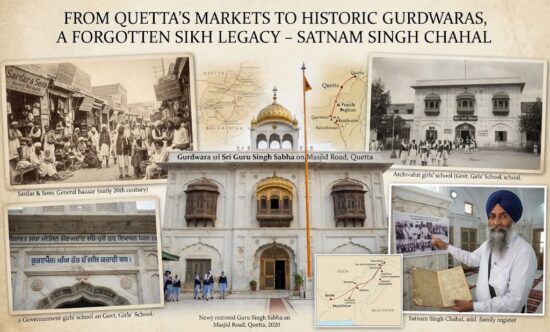
 The story of Sikhs in Balochistan did not end with the journeys associated with Guru Nanak Dev Ji. Over the following centuries, Sikh traders, families and community members established a more permanent presence in the region. By the nineteenth and early twentieth centuries, Sikhs had become part of the commercial and social landscape of cities such as Quetta.Quetta was particularly important because of its location. Situated close to the routes leading toward Afghanistan, the city developed into a major frontier centre under British rule. Its military importance, growing transport connections and expanding markets attracted people from different parts of the subcontinent.
Sikh traders participated in this commercial life. They became involved in businesses and established family networks in the city. As the community grew, religious institutions became essential to Sikh life. Gurdwaras served not only as places of worship but also as community centres where families gathered, travellers found support and religious ceremonies were conducted.The Sikh presence in Balochistan was never comparable in size with the Muslim population of the province, but its historical significance was considerable. The existence of gurdwaras and established Sikh families demonstrated that Sikhs had become part of the region’s urban and commercial society.
Quetta’s historic Sikh institutions provide some of the clearest physical evidence of this past. Among them is Gurdwara Sri Guru Singh Sabha on Masjid Road, a building that has been described in contemporary reporting as approximately two centuries old.The gurdwara’s history also reflects the enormous disruption caused by Partition.In 1947, British India was divided into India and Pakistan. The new border transformed the lives of millions of people. Sikhs and Hindus living in areas that became part of Pakistan faced a rapidly changing political and security environment. Large numbers eventually migrated to India, leaving behind homes, businesses, land and religious institutions. The Sikh community of Balochistan was similarly affected.
Many Sikh families left Quetta and other areas. Their departure dramatically reduced the size of the community. Businesses changed hands, family networks were broken and religious institutions lost much of their original congregations.For the families who migrated, however, Balochistan did not disappear from memory. Stories of Quetta, ancestral homes, businesses, neighbourhoods and gurdwaras continued to be passed from one generation to another.One of the most striking examples of this lost heritage is Gurdwara Sri Guru Singh Sabha in Quetta. After Partition, the historic gurdwara was used as a government girls’ school. According to reports published around the time of its restoration, the building remained in educational use for approximately seven decades.
The physical survival of the building is remarkable. While much of the community had disappeared through migration, the gurdwara remained standing as a reminder of the Sikh population that had once worshipped there.For decades, the building was therefore a silent witness to a vanished chapter of Quetta’s social history.Then came a significant development in 2020.The historic gurdwara was restored and handed back to the Sikh community. The return of the building enabled Sikh religious activities to resume and attracted renewed attention to the history of Sikhs in Balochistan.
For the Sikh community, the restoration carried a meaning far beyond the recovery of a property. It represented the return of a religious institution to the community whose ancestors had built and used it.The reopening also reminded the wider public that Balochistan had once contained a more religiously diverse urban society than its present demographic profile might suggest.A gurdwara is not merely a building. It is a record of community history. Its architecture, inscriptions, rooms and surrounding property can reveal information about the people who built it, the resources they possessed, the size of their congregation and the importance of the institution to local society.The surviving gurdwaras of Balochistan should therefore be regarded as part of the province’s historical heritage as well as Sikh religious heritage.
The community itself has also survived, although in much smaller numbers than before Partition. Community representatives have periodically provided estimates of Sikh families living in different parts of Balochistan, including Quetta and other districts. Because reliable, consistently updated official demographic data are limited, such estimates should be treated with appropriate caution.Nevertheless, the continuing presence of Sikhs in Balochistan demonstrates that Partition did not completely erase the community.Quetta remains the most important centre of Sikh life in the province. Religious institutions provide spaces for worship and community gatherings, while Sikh families continue to maintain their identity and traditions.
Their survival has not always been easy. Like other religious minorities in the region, Sikhs have experienced the challenges associated with security, migration, economic pressures and demographic change. Yet the community has continued to maintain its religious identity.The history of Sikhs in Balochistan also offers an important lesson about Partition. The division of 1947 did not merely create two countries. It transformed neighbourhoods and communities that had existed for generations.The disappearance of Sikh and Hindu communities from many parts of Pakistan and the disappearance of Muslim communities from many parts of India changed the cultural landscape of the subcontinent permanently.
Balochistan’s Sikh heritage is therefore part of the larger Partition story.It reminds us that the subcontinent’s history cannot be understood only through political borders. Behind every border were people who had homes, businesses, places of worship and memories.The old gurdwaras preserve some of those memories.The restoration of Gurdwara Sri Guru Singh Sabha in 2020 demonstrated what can happen when historical heritage is recognized and protected. It created an opportunity for the surviving Sikh community to reconnect with its past.The next challenge is preservation.
Historic Sikh sites across Balochistan should be properly documented and protected. Their histories should be recorded in archives and digital databases. Old photographs, property documents, community registers and oral histories should be collected before they disappear.The descendants of Sikh families who migrated from Balochistan after 1947 also possess an invaluable historical resource. Their family stories can help reconstruct the social history of Quetta and other towns in which Sikhs once lived.A photograph of an old shop, a letter written from Quetta, a property document, a family register or a memory of a neighbourhood may appear insignificant on its own. Collectively, however, such materials can recreate an entire community’s history.The Sikh heritage of Balochistan should therefore be preserved not as a political weapon but as a shared historical inheritance.
It belongs to Sikh history, but it is also part of the history of Balochistan.It tells the story of a time when traders, families and religious communities from different backgrounds lived and worked alongside one another in frontier towns.It also demonstrates the power of cultural memory.People may leave a place, but they do not necessarily leave its history behind.The Sikh families who migrated from Balochistan carried memories of their homeland with them. Their descendants continue to remember Quetta and other places through family stories and photographs.At the same time, the gurdwaras that survived in Balochistan remained physical reminders of those who had once prayed within their walls.
The story of Sikhs in Balochistan is therefore a story of migration, survival and memory.It began with the wider movement of Sikh teachings and travellers across the northwest. It developed through trade and settlement. It was shattered by Partition. Yet it survived through people, buildings and memories.Today, the Sikh community of Balochistan may be small, but its historical footprint is far larger than its numbers suggest.The gurdwaras of Quetta stand as monuments to that history.They remind us that the past cannot always be divided according to the borders of the present.And they offer a powerful message for future generations: communities may be displaced, borders may change, and institutions may fall silent for decades—but history has a remarkable ability to survive.