
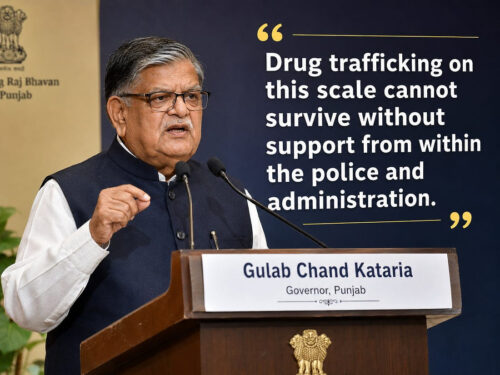
 Punjab Governor Gulab Chand Kataria has said what most Punjabis have believed for years, but few people holding constitutional office have stated so openly: “drug trafficking on this scale cannot survive without support from within the police and administration.”This was not an ordinary statement. It should have started a major public debate. Unfortunately, it did not get the news space it deserved.
https://indianexpress.com/article/political-pulse/punjab-governor-kataria-drug-trafficking-cannot-flourish-without-police-administration-connivance-10797409/
Punjab has been fighting the drug menace for nearly three decades. Governments have changed. Police chiefs have changed. New slogans and campaigns have been launched. Yet synthetic drugs continue to reach our villages and towns. Young men continue to die, families are destroyed and one network is quickly replaced by another.
The question is simple.
Can huge quantities of drugs cross the border, travel across Punjab, reach small villages and generate hundreds of crores without help from people inside the system?Governor Kataria has given a clear answer. No, it cannot.His statement is important because it takes the debate beyond addicts and small-time peddlers. Catching a few peddlers may produce good headlines, but it does not break the larger network.
Drug cartels need money, transport, information and protection. They need someone to inform them about police movements. They need someone to ignore what is happening. At times, they may also need police officers and officials who actively help them.Recent events show how serious the degradation has become.
In July, the FBI and the United States Department of Justice linked a local Punjab Police SHO, Gurinderjit Singh Nagra, to an alleged $400,000 extortion attempt against a family in the United States. The allegation was part of Operation Hard Ball, an international crackdown on organised criminal groups involved in extortion, drugs, shootings and illegal weapons. (link below)
It raises a frightening question: if the officer sitting in the police station is himself accused of being part of an extortion network, where will an ordinary citizen go for protection?
Punjab did not need the FBI to tell us that gangsters operate from abroad and from inside jails. Traders, transporters, builders and NRI families already know this. Extortion calls come from foreign numbers. Threats are issued from jails. Local shooters are arranged, and money is collected through fear.
What the FBI case exposed was something more disturbing. Punjab’s criminal network has not only gone international. Parts of the police system itself may have become mixed up with it.
I had written earlier that organised crime in Punjab now works almost like a company (link below). It has investors, managers and workers on the ground. Its workforce includes drug peddlers, shooters, extortionists and local gang members. But no such company can function for long without political, police or administrative protection.
Governor Kataria also linked the drug problem with extortion, corruption and the worsening law and order situation. These are not seperate problems. They are different parts of the same criminal system.
Drug money buys illegal weapons. Weapons are used for extortion and murders. Gangsters sitting abroad issue threats while their local men carry out the crime. The money is then moved through properties, businesses, middlemen or benami transactions.
Punjab’s fight against drugs cannot be won through awareness marches and publicity campaigns alone. Awareness is needed. Rehabilitation is important. Border security must be strengthened. But none of this will work unless the links between traffickers, gangsters and compromised police officers are broken.
Punjab needs investigations that follow the money, not just the packets of heroin. Police postings, jail contacts, mobile phones inside prisons, benami properties and political links must be investigated.
Officials found helping criminal networks must face the same law as the traffickers. Honest police officers must be protected. Cases should be taken to their logical end instead of being forgotten after the press conference.
Political parties must also stop treating drugs and law and order as election slogans. Every government has promised a clean-up. Yet the dirt has only gone deeper.
Governor Kataria has said aloud what Punjab has whispered for years. If police and administrative collusion is the oxygen keeping the drug trade alive, then cutting off that oxygen must be the first priority.
Punjab does not need another slogan but needs a clean-up of the police system itself. Every trafficker must know there is nowhere to hide, and every corrupt officer must know that his uniform, rank or political connection will not save him. Only then will people believe that the police protects citizens, and not the criminals who threaten them.