
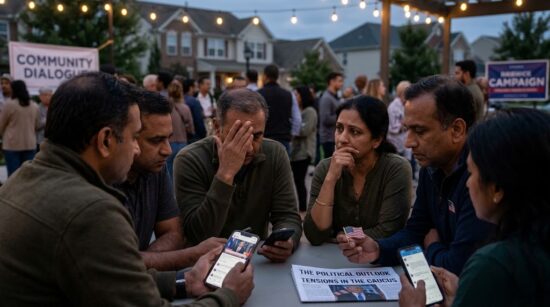
 Political backlash over immigration, H-1B visas and racial hostility raises questions about Republican outreach to Indian American voters ahead of the 2026 midterm elections. Indian Americans who supported Donald Trump and Republican candidates in the 2024 elections are increasingly expressing concern about anti-Indian rhetoric within sections of the Republican Party, raising questions about whether the GOP can retain support among a community it has worked to attract.
Recent reporting by The Verge and IndiaWest highlights growing frustration among some Indian American conservatives who say that political commentary targeting Indians, immigrants and South Asian communities has made them feel unwelcome, despite their citizenship, professional achievements and contributions to American society. <Cite refs={[“turn578651news7″,”turn578651search0”]}/>
Although Indian Americans have traditionally leaned towards the Democratic Party, a portion of the community moved towards Trump in 2024. The shift reflected a range of considerations, including economic policies, conservative social values, business interests and dissatisfaction with the Democratic Party. However, criticism of Indian immigrants and South Asian Americans by some conservative commentators and political figures is now creating tension within that political coalition.
Polling Reveals Changing Attitudes
A February 2026 survey by the Carnegie Endowment for International Peace found that approximately seven in ten Indian Americans disapproved of Trump’s performance during his second term. The survey also found that the proportion identifying as Democrats had declined from 52 per cent in 2020 to 46 per cent in 2026, with more respondents identifying as independents. The findings indicate dissatisfaction with the administration but do not establish that all dissatisfied voters intend to support Democrats. <Cite refs={[“turn578651search1”]}/>
A separate poll cited in recent reporting by IndiaWest found that approximately one-quarter of Indian Americans who voted for Trump in 2024 intended to vote for Democratic candidates in the 2026 midterm elections. That finding suggests that some previous Republican supporters may reconsider their choices, although voting intentions do not necessarily translate into final election results. <Cite refs={[“turn578651search0”]}/>
The findings are significant because Indian American voters are an influential constituency in several closely contested areas, including parts of Texas, Georgia, Michigan, New Jersey and Pennsylvania.
Immigration Debate Turns Into a Question of Identity
The H-1B visa programme, which allows US employers to hire eligible foreign workers in specialised occupations, has become a major point of disagreement within conservative politics. Supporters argue that skilled immigration contributes to innovation and economic growth, while critics contend that some employers use the programme in ways that disadvantage American workers or suppress wages.
However, concerns about employment practices are different from rhetoric that portrays an entire ethnic community as disloyal, culturally incompatible or responsible for taking American jobs. Indian American community leaders quoted in recent reports say that criticism of visa policies has, in some cases, expanded into broader attacks on people of Indian origin, including US citizens.
The Texas Tribune has documented similar tensions in Frisco, Texas, where Indian American residents and local political figures have faced hostile comments about immigration, demographic change and the presence of Indian families in the community. <Cite refs={[“turn578651search3”]}/>
Political Figures Under Scrutiny
Recent controversies have involved Republican candidate Bo French, who drew criticism over a social media post concerning South Asian spectators at a University of Texas football game. Other conservative commentators have also faced criticism for discussions portraying Indian immigration and cultural integration as threats.
These disputes illustrate a challenge for Republican leaders: how to pursue stricter immigration enforcement and address legitimate concerns about employment programmes without encouraging ethnic stereotyping or hostility towards American citizens of Indian descent. Some Republican figures have condemned racist comments, while others have focused on defending immigration restrictions or disputing accusations of racism. <Cite refs={[“turn578651news7″,”turn578651search3”]}/>
The issue also extends beyond party politics. Indian American professionals, entrepreneurs, students and families contribute to communities across the United States. Sikh, Hindu, Muslim, Christian and other Indian-origin communities have distinct religious and cultural identities, but members of these groups can all be affected when public debate treats Indian heritage itself as a reason for suspicion or exclusion.
Implications for the 2026 Midterm Elections
The debate could affect Republican efforts to retain and expand support among Asian American voters. In competitive districts, even a relatively small shift in voting preferences may attract attention from campaigns, particularly where Indian American communities have grown substantially.
Nevertheless, Indian American voters are not a single political bloc. Some continue to support Republicans because of economic policy, entrepreneurship, taxation, public safety or conservative social values. Others prioritise immigration policy, civil rights, religious freedom and protection against discrimination. Many voters weigh these issues alongside healthcare and the cost of living.
The Republican Party’s challenge is therefore not simply to retain voters who supported Trump in 2024, but to demonstrate that its policies and public messaging can address immigration concerns without making Indian Americans feel that their ancestry undermines their place in American society.
For Democrats, the situation presents an opportunity to engage voters who are reconsidering their political affiliations. However, the Carnegie findings also indicate that dissatisfaction with Republicans does not automatically restore the level of Democratic support seen in earlier years. Both parties will need to earn voters’ confidence through policies and conduct that address their concerns.
Conclusion
The growing dispute over anti-Indian rhetoric highlights a broader question about belonging and political representation in the United States. Indian Americans can support immigration enforcement, debate the H-1B programme, hold conservative views and participate in Republican politics while also expecting equal treatment and respect.
As the November 3, 2026, midterm elections approach, the response of political leaders to ethnic hostility may become one factor shaping voter attitudes. The ultimate impact remains uncertain, but the message from concerned community members is clear: disagreement over immigration policy should not become a justification for treating an entire community as outsiders.
By Satnam Singh Chahal | Punjab Outlook — Political Analysis