
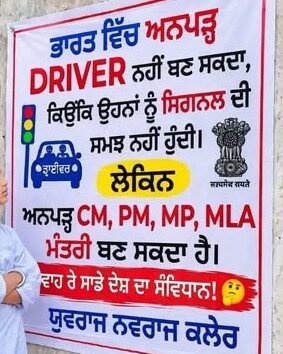
 A poster circulating on social media raises an important question about the state of Indian democracy. It says that an uneducated person cannot become a driver in India because driving requires an understanding of traffic signals and road safety. However, an uneducated person can become a Chief Minister, Prime Minister, Member of Parliament, Member of the Legislative Assembly or even a minister. Presented as satire, the poster carries a serious message: if a person needs training, a licence and the ability to understand traffic rules to drive a vehicle, why is there no minimum educational requirement for those who make laws and run the country?
This question is not about any one political party or government. It concerns the structure of Indian democracy, the electoral system, the responsibility of political parties and the role of voters. Democracy does not simply mean holding elections every five years and allowing a party or candidate to take power after securing a majority. A meaningful democracy requires elected representatives to protect people’s rights, respect the Constitution, spend public money responsibly and ensure justice for every section of society.
Articles 84 and 173 of the Indian Constitution lay down the qualifications for membership of Parliament and State Legislative Assemblies. These include citizenship, minimum age and other legal conditions, but they do not generally prescribe a minimum school or university education. Consequently, a person without formal educational qualifications can contest elections and become an MP or MLA if they meet the legal requirements and win the election. There is also no separate minimum university-degree requirement for becoming Prime Minister or Chief Minister.
This constitutional approach is based on an important democratic principle: participation in politics should not be restricted only to educated or wealthy sections of society. In a diverse country like India, farmers, workers, people from poor backgrounds and representatives of rural communities must also have the opportunity to contest elections. If only highly educated individuals were permitted to enter politics, there would be a risk of concentrating political power in the hands of a limited and privileged section of society.
However, this does not mean that education and understanding are unimportant. Running a government, preparing budgets, making laws, developing health and education policies, understanding foreign affairs and protecting constitutional institutions are serious responsibilities. They require knowledge, experience, sound judgment and the ability to understand expert advice. Therefore, the country needs a serious discussion about strengthening the training and constitutional awareness of elected representatives.
The poster uses the example of a driver. While the comparison is effective in drawing public attention, the legal position also needs to be understood correctly. In India, a specific school or university degree is not generally compulsory for every driver. Under motor vehicle laws, a valid and appropriate driving licence is required to drive a vehicle in a public place. The licensing process includes prescribed requirements and an assessment of driving ability. In other words, the law focuses on the person’s ability to drive safely, rather than simply on whether they hold an academic degree.
Similarly, a university degree should not necessarily be the only measure of a political representative’s ability. However, those responsible for governing a country or state should have a basic understanding of the Constitution, law, economics, administration and public policy. A highly educated person can still be corrupt or incompetent, while someone with little formal education may be honest, experienced and deeply connected with ordinary people. Therefore, the real question is not merely whether a leader holds a degree, but whether that leader is capable, honest and accountable.
It is important to understand that academic qualifications and practical wisdom are not the same thing. A person with advanced degrees may lack the commitment to public service and may not necessarily become a good leader. On the other hand, someone with limited formal education may become an effective representative through life experience, honesty and a genuine understanding of people’s problems.
However, when elected representatives make decisions about public budgets, government debt, employment, healthcare, education and law and order, their responsibilities are enormous. If they do not fully understand these subjects, they should seek expert advice and remain answerable to the public for the consequences of their decisions. Holding public office does not place anyone above public scrutiny.
During elections, political parties in India often give importance to caste, religion, regional influence, personal popularity, money and electoral promises. At times, a candidate’s integrity, administrative understanding, public record and actual contribution to society receive less attention. This weakens the quality of democracy.
Political parties should not select candidates merely because they believe those candidates can win elections. They should also examine their public reputation, connection with ordinary people, understanding of constitutional responsibilities and ability to handle public funds transparently. Strengthening democracy requires transparency, accountability and democratic practices within political parties themselves.
In any democracy, the final decision rests with the voters. If citizens examine a candidate’s education, experience, public service record, criminal cases, declared assets and election promises before voting, political parties will face greater pressure to field capable candidates.
The Supreme Court of India has also recognised the importance of voters’ right to obtain information about candidates. Voters should be able to make informed decisions based on a candidate’s background and public record. A vote is not merely a mark placed against a party symbol; it is an expression of public opinion and democratic responsibility.
Voters must therefore move beyond emotional slogans, personal loyalties and temporary election promises. They should ask what a candidate has actually done for the constituency, whether promises made in previous elections were fulfilled and whether the candidate is prepared to answer difficult questions.
This subject deserves an open and serious national debate. One argument is that members of Parliament and State Assemblies should have minimum educational qualifications so that they can understand legislation, public budgets and government policies. Another argument is that compulsory degree requirements could exclude poor and rural citizens from political participation. Formal education cannot be treated as the only measure of a person’s ability to serve the public.
A balanced approach could be to introduce compulsory training for all elected representatives on the Constitution, the legislative process, government budgets, public administration and ethical responsibilities. Such training could be provided after election, without excluding anyone from democratic participation simply because they lack formal qualifications. The objective should be to help representatives perform their duties more effectively.
In addition, the performance of elected representatives should be regularly reviewed, and they should be required to explain their decisions and use of public resources to the people.
The Indian Constitution gives citizens the right to elect their representatives and requires governments to function within constitutional limits. The real strength of democracy does not lie merely in the buildings of Parliament or State Assemblies; it lies in public trust.
If elected representatives become disconnected from ordinary people, avoid questions, fail to fulfil promises or use public office for personal benefit, the mere holding of elections cannot be considered proof of a healthy democracy.
We must remember that in a democracy, the government is not the master of the people. It is an institution elected to serve them. The Prime Minister, Chief Ministers, ministers, MPs and MLAs are not above the public. They are accountable for their decisions, expenditure and promises.
The message of the poster opens the door to a much wider debate. The question is not whether people without formal education should be prevented from entering politics, nor whether every political leader must possess an advanced degree. The real questions are: Do elected representatives understand the problems of ordinary citizens? Do they respect the Constitution? Do they use public money responsibly? Are they willing to explain their decisions and account for their promises?
India does not simply need degree-holding politicians. It needs honest, capable, responsible and public-service-oriented leaders. Education can improve a leader’s ability, but integrity and accountability define that leader’s character.
The real success of democracy is not determined by who occupies the chair of power, but by how responsibly that person serves the people.