
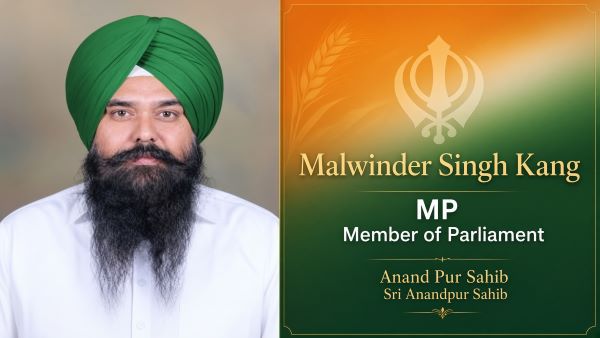
 The political temperature inside the Aam Aadmi Party (AAP) Punjab appears to be rising, with questions increasingly being raised about internal coordination, leadership, organisational democracy and the growing influence of different political camps. What was once projected as a tightly controlled political machine is now showing signs of internal debate, with some leaders openly calling for greater consultation and a more democratic functioning of the party.
One of the clearest indications came from Anandpur Sahib MP Malwinder Singh Kang, who publicly argued in April 2026 that AAP needs to “recalibrate” its strategy and function more like a democratic political organisation in which leaders have an equal say. Kang also stressed the need for better coordination between the party leadership and its MPs and MLAs.Kang’s remarks are significant because he is not an outsider attacking AAP. He is a sitting Lok Sabha MP, a senior Punjab party functionary and a prominent public spokesperson. AAP’s own organisational announcement in May 2025 listed Kang as a State General Secretary of the Punjab unit. His criticism therefore raises a larger question: if senior leaders themselves are demanding greater internal democracy, what is happening inside the organisation?
Kang’s “Broom” Message
The political symbolism of Kang’s position is particularly interesting. The broom, or jhaadu, is AAP’s election symbol and has always represented the party’s promise to clean up the political system.But the political question today is whether the broom is being used only against opponents or whether it also needs to sweep through the party’s own organisational house.Kang’s call for a more democratic structure can be interpreted as a demand for greater collective decision-making rather than personality-driven politics. His argument that better coordination with MPs and MLAs could prevent defections is particularly important at a time when AAP has experienced significant organisational challenges elsewhere.The remarks also come after a period in which AAP has seen prominent political departures and realignments. The Tribune reported Kang’s view that stronger communication between the leadership and party representatives could have prevented some defections.
From One Movement to Multiple Camps?
AAP’s Punjab story has always contained an element of internal tension. The party’s spectacular 2022 Assembly victory, when it won 92 of Punjab’s 117 seats, gave it enormous political strength. But such a large mandate also brought together politicians with different backgrounds, ambitions and political styles.Some leaders came from the original anti-corruption movement and grassroots politics. Others entered AAP after leaving Congress, BJP or other political formations. Kang himself had earlier been a senior BJP functionary before joining AAP in 2021 after resigning over the farm-law issue.That diversity helped AAP expand rapidly. But it can also become a source of factionalism when different leaders begin to develop independent political identities.The central question now is whether AAP Punjab can maintain unity while allowing legitimate internal disagreement.
Baba Dhumme and the “Taksali” Question
At another level, Punjab’s political landscape is also witnessing renewed discussion around the idea of a “Taksali” political formation associated in public discourse with Sikh religious and traditional political currents.Claims circulating on social media about Baba Dhumme and the formation of a separate “Taksali Party” should, however, be treated cautiously unless there is a formal announcement, organisational structure or independently verified statement confirming the development. The searches reviewed for this article did not establish a reliable mainstream source confirming the creation of a new political party under that name.That distinction matters. Punjab politics has frequently seen political rumours, informal groupings and discussions about new fronts long before any formal party actually comes into existence.
Nevertheless, the broader political significance of such discussions cannot simply be dismissed. Punjab has historically witnessed attempts to create political alternatives around religious identity, Panthic issues, regional rights and questions of Punjab’s political autonomy. Whenever established parties face internal disputes, space naturally emerges for new political formations to present themselves as alternatives.
AAP Faces a Different Kind of Challenge
For AAP, the challenge is therefore not merely opposition from Congress, BJP or the Shiromani Akali Dal. The bigger challenge may be maintaining internal cohesion while remaining a broad political movement.A party can survive criticism from its opponents. It becomes much more vulnerable when its own elected representatives begin publicly discussing organisational shortcomings.Kang’s call for a more democratic AAP should therefore not automatically be interpreted as rebellion against Chief Minister Bhagwant Mann or the national leadership. It may instead be viewed as an internal warning that the party needs stronger institutional mechanisms before factional disagreements become permanent divisions.The distinction is important. Internal democracy does not necessarily weaken a political party. In many cases, the absence of internal democracy is what eventually weakens it.
The Bhagwant Mann Factor
Bhagwant Mann remains the most recognisable political face of AAP in Punjab and led the party to its historic 2022 victory. But the party’s evolution since then has created a broader leadership structure involving ministers, MLAs, MPs and organisational leaders.The question is whether these different centres of influence can coexist.If every disagreement becomes a question of loyalty to one leader or another, factional politics can deepen. If, instead, differences are discussed through party forums, organisational meetings and transparent decision-making, internal disagreements can strengthen the institution.This is where Kang’s comments acquire importance. His emphasis on coordination and equal participation suggests that the problem, at least in his assessment, is organisational rather than merely electoral.
The “Broom” Must Clean Its Own House
AAP was born with the promise of cleaning politics. Its broom became one of the most recognisable symbols in Indian politics.But political parties are ultimately judged not only by their slogans or symbols but by the way they function internally.If senior MPs feel that there is insufficient consultation, the leadership should listen. If MLAs feel disconnected from decision-making, the organisational structure should respond. If workers believe that political appointments and tickets are being determined by a small circle, the party must address those concerns before they become electoral liabilities.The same principle applies to any emerging “Taksali” or Panthic political formation. Punjab’s voters have repeatedly demonstrated that they are capable of supporting new political experiments—but they also expect clarity, credibility, leadership and a convincing programme.
Punjab’s Political Battlefield Is Changing
The developments surrounding AAP should therefore be viewed as part of a larger transformation in Punjab politics.Congress is attempting to rebuild. The Akali Dal continues to confront questions about its political future and identity. BJP is expanding its organisational footprint. Smaller Panthic and regional forces periodically attempt to occupy political space. And AAP, despite its enormous 2022 mandate, must now demonstrate that it can convert electoral dominance into durable political organisation.The coming political period could therefore become a test of whether AAP Punjab remains a single disciplined organisation or evolves into a collection of competing political centres.Malwinder Singh Kang’s call for a more democratic AAP is an important signal. Whether the party treats that signal as constructive advice or as an internal challenge could have consequences far beyond the party’s organisational meetings.The broom may still be firmly in AAP’s hands. The real question is whether it can keep the broom together while sweeping Punjab’s political floor.
Disclaimer: This article and accompanying images are for informational and illustrative purposes only. Some visuals may be AI-generated or digitally enhanced and may not depict actual events or persons.Views expressed are based on publicly available information and analysis