
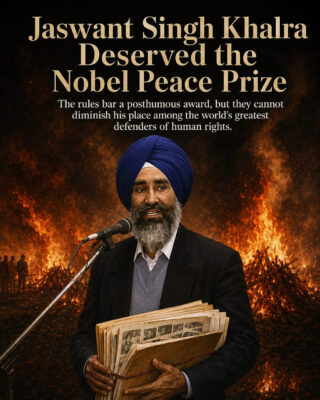
 The Nobel Peace Prize is not reserved for those who end wars or sign agreements. Over time, it has also become the world’s highest recognition for people who defend human dignity through peaceful means. The Nobel tradition accepts a basic truth: there can be no real peace where citizens are picked up, made to disappear, killed and denied even the dignity of a known grave. (Nobel Prize)
Martin Luther King Jr was honoured for his non-violent struggle for civil rights. Andrei Sakharov stood against repression in the Soviet Union. Adolfo Pérez Esquivel defended victims of dictatorship in Latin America. Liu Xiaobo struggled peacefully for fundamental rights in China. Narges Mohammadi resisted the oppression of women in Iran. Memorial and other civil society organisations were recognised for documenting human rights abuses and the misuse of state power. (Nobel Prize)
Measured against this standard, Jaswant Singh Khalra’s claim stands beside the strongest of them.
Khalra was neither a minister nor an international celebrity. He had no government, no NGO, large institution or publicity machinery behind him. His weapons were cremation registers, firewood receipts, names, dates and extraordinary courage. His inquiry did not distinguish between the religions of the dead. A body secretly cremated as “unclaimed” was a human rights violation, whatever the victim’s faith.
During Punjab’s years of militancy and counter-insurgency, families were searching for young men who had been taken away and never returned. Khalra followed the paper trail. Along with fellow activists, he examined records from cremation grounds in Amritsar, Patti and Tarn Taran. The records showed bodies brought by the police and cremated as unidentified or unclaimed, even when information existed that could help establish their identity.
These were not merely political allegations. Acting on petitions concerning Khalra’s disappearance and the mass cremations, the Supreme Court ordered a CBI investigation. The final report dealt with 2,097 cremations in Amritsar district. Of these, 585 bodies were fully identified, 274 partially identified and 1,238 remained unidentified. The Supreme Court said the findings disclosed a flagrant violation of human rights on a mass scale. The National Human Rights Commission later took up identification and compensation. (The Indian Express)
Khalra knew the danger. He had received threats, but he continued to speak, including before Canadian parliamentarians. On September 6, 1995, he was abducted from outside his home in Amritsar. Evidence later established that he remained in illegal police custody, was severely tortured and was killed on October 27, after nearly seven weeks of detention. His body was thrown into a canal and never returned to his family. Five police officials ultimately received life sentences, upheld by the Supreme Court in 2011. (House of Commons of Canada)
That is what makes Khalra’s sacrifice exceptional. He did not discuss human rights from the safety of a seminar hall. He recovered evidence from the records of the very system accused of erasing the dead. He stood between grieving families and official silence. He knew those he was exposing had the power to eliminate him, yet he refused to stop.
Canada heard him while much of India looked away. Three decades later, the film Satluj has brought his story before a new generation and shaken Punjab out of its long silence. Popular remembrance, however, cannot substitute for institutional recognition. (House of Commons of Canada)
A search of publicly available records reveals no disclosed nomination of Khalra for the Nobel Peace Prize by any government, political party or eligible individual. Nobel nominations remain secret for 50 years, so no absolute claim can be made about the official record. What can be said is that no serious public campaign was mounted while he was alive. (Nobel Prize)
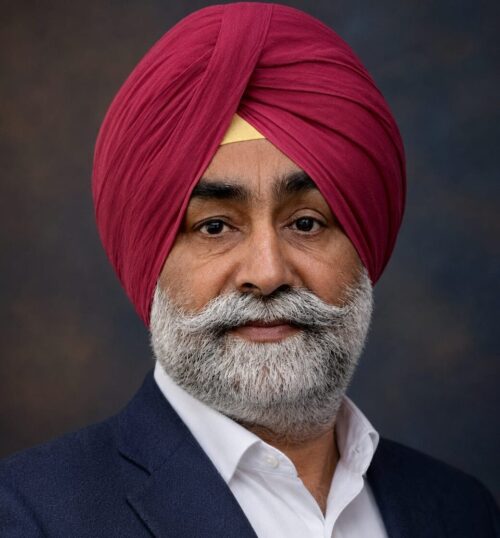
There is now a painful obstacle. Nobel rules do not permit a posthumous prize, except when a selected laureate dies after the announcement. Khalra, therefore, cannot be validly nominated today under the existing rules. (Nobel Prize)
That must not become another excuse for silence.
The Punjab government should pass a unanimous Assembly resolution recognising Jaswant Singh Khalra as one of the great human rights defenders of the modern era. It should approach the Nobel Foundation and the Norwegian Nobel Committee for an exceptional commemorative acknowledgement of his work. This may not fall in the category, but at least the Nobel Committee and the world should also know about the story of a unmatched human rights activist.
The government should also establish an independent Khalra archive, publish all available records relating to the disappearances and cremations, and support the Nobel nomination of an eligible institution carrying forward his mission.
This would not be a favour to one family, community or political party. It would be Punjab’s apology to truth and its tribute to a man who gave his life so that the disappeared would not also be forgotten.
Khalra may now be beyond the reach of the Nobel medal. His sacrifice, however, stands at the very heart of the Nobel ideal.