
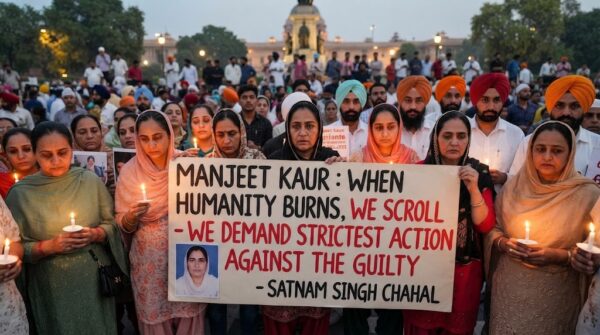
Manjeet Kaur: When humanity burns, we scroll- we demand the strictest action against the guilty. A society that can watch cruelty, discuss it for two days and then forget it needs to examine not only its criminals, but also its conscience. The shocking death of 28-year-old Punjabi social-media influencer Manjeet Kaur at PGIMER Chandigarh should not be treated as just another crime story appearing between political controversies, celebrity gossip and the latest social-media drama. If the allegations made by her family are proved, what happened to Manjeet represents an appalling level of brutality that should disturb the conscience of every civilised human being. According to her family, she was allegedly abducted, assaulted, tied to a tree and set on fire in Morinda. After fighting for her life for weeks, she died at PGIMER on August 26. The police have registered a case of kidnapping and murder, and the investigation is underway. The allegations against the accused must be established through evidence and due process, and the seriousness of the case requires a thorough investigation.
We strongly condemn the alleged crime and demand that every person found responsible must face the strictest punishment provided under law after a fair and speedy trial. There must be no political influence, no financial settlement, no intimidation of witnesses and no attempt to close the matter quietly. If the investigation establishes that the accused deliberately subjected Manjeet to such horrific violence, then the law must respond with the full force available to it. A crime of this nature cannot be reduced to another FIR number, another press conference and another file eventually buried under mountains of paperwork.
What makes this tragedy even more disturbing is the society surrounding it. We often proudly describe Punjab as a land of courage, humanity, hospitality, brotherhood and sewa. We proudly quote Gurbani, celebrate our traditions and tell the world about Punjabi generosity. But what happens when humanity is actually tested? What happens when a vulnerable woman needs protection? What happens when violence is taking place in front of us? That is when society’s real character is revealed.
Today, we have smartphones in practically every hand. We have cameras everywhere. We have social-media platforms capable of turning an ordinary incident into a global story within minutes. We have thousands of people who can become instant commentators, investigators, lawyers and judges from their sofas. But somehow, when a real human being needs help, our humanity often goes offline.
We have become a society of “likes, shares, comments and RIP.”
A tragedy happens. People become angry. Somebody posted a photograph. Another person writes an emotional paragraph. Someone demands justice. Somebody else blames the government. A hashtag begins trending. Television channels run the story. Social-media influencers make videos. Politicians issue statements. Everyone becomes a champion of justice for approximately 48 hours.
And then?
The next controversy arrives. The next celebrity makes a statement. The next political fight begins. The next reel starts playing. And the victim’s family is left alone with the empty chair at home. This is the new comedy of our conscience: we mourn loudly online and forget quietly offline. Manjeet Kaur reportedly had a substantial following on social media. But NAPA believes her number of followers should have absolutely nothing to do with the value of her life. A woman does not become more deserving of justice because she has 1.46 lakh Instagram followers. A poor woman with no social-media account deserves the same protection, dignity and justice.
In fact, that raises an uncomfortable question: Have we reached a point where justice needs a follower count?
If a victim has one million followers, everybody notices. If she has 100 followers, perhaps nobody cares. If she has powerful relatives, the machinery moves quickly. If she belongs to an ordinary family, the family may spend years knocking on doors. That is not equality before the law. That is the VIP culture of justice. The Manjeet Kaur case must therefore become bigger than one individual crime. It should force Punjab and Chandigarh to examine how vulnerable people are treated when they enter the criminal-justice system. The family has alleged that Manjeet regained consciousness and wanted to give a statement to police but that no police officer reached her at the relevant time. Police authorities have disputed allegations of inaction and stated that assistance was provided and that Chandigarh Police had jurisdiction over the place of occurrence. These competing claims must not be settled through competing press statements. They must be settled through evidence.
If the police performed their responsibilities properly, the investigation should establish that clearly. If any officer neglected a duty, delayed action, ignored critical information or failed to take appropriate steps, then responsibility must also be fixed according to law. A uniform cannot become a permanent immunity card. There is another problem that ordinary citizens understand only too well: jurisdiction. When a serious crime crosses an administrative boundary, the victim and family should not be forced to participate in a bureaucratic game of “not my jurisdiction.”Chandigarh may have one police force. Punjab may have another. One police station may say another police station has jurisdiction. Another may say the incident occurred elsewhere. Files can travel from one desk to another at remarkable speed. But pain does not understand jurisdiction.
A critically injured victim does not have the luxury of waiting while government departments decide which boundary line applies. A person fighting for life cannot be expected to become an expert in police jurisdiction. This is precisely why governments need effective inter-jurisdictional protocols. When a victim is seriously injured, the priority must be saving life, securing evidence and recording crucial information, not protecting departmental boundaries. The most heartbreaking dimension of Manjeet’s death is her seven-year-old son. Behind every murder statistic is a family whose life has been permanently altered. When a mother dies, the victim is not the only person who suffers. A child loses a parent. Parents lose a daughter. Relatives lose a loved one. A family loses its sense of security. And the child will eventually ask the most painful question of all:
“Why did this happen to my mother?”
What answer can society give him?
Were that criminals cruel?
That institutions had procedures?
That everybody posted condolences?
That thousands of strangers wrote “Justice for Manjeet” online?
A child does not need a hashtag. He needs justice. We therefore believe that the authorities must ensure not only a proper criminal investigation but also appropriate support for Manjeet’s minor son and family. The state cannot bring his mother back, but it can demonstrate that the society in which he lives does not abandon families after tragedy strikes. There is also a larger cultural problem that we must have the courage to discuss. Violence has increasingly become normalised in parts of our society. Domestic disputes become physical confrontations. Personal disagreements become threats. Social-media arguments become abuse. Substance abuse fuels violence. Criminal elements exploit fear. Young people are sometimes taught that aggression is strength. It is not strength. A man who needs violence to prove his power is not powerful. He is simply dangerous. Real strength is self-control. Real courage is protecting the weak. Real manhood is respecting women.
Real Punjabi values are not demonstrated by shouting slogans about honour while humiliating another human being. We have to stop confusing masculinity with brutality and honour with control. A society that talks endlessly about protecting family honour while allowing women to be abused has misunderstood the meaning of honour. There is no honour in violence. There is no courage in attacking the vulnerable. There is no bravery in destroying another person’s life. Our politicians also need to stop treating every horrifying crime as an opportunity for a statement. Citizens do not need another carefully drafted condolence message. They need functioning institutions. They need police investigations that move. They need forensic evidence collected properly.
They need witnesses protected. They need prosecutors prepared. They need courts to hear serious criminal matters without endless unnecessary delays. They need families to know that when they approach the authorities, somebody will listen. The victim’s family does not need sympathy alone. They need the machinery of justice to work. We therefore demand a comprehensive investigation into every aspect of the Manjeet Kaur case. CCTV footage, telephone records, digital evidence, forensic material, medical records, movements of the suspects and every other relevant piece of evidence must be examined professionally. Every person who may have information must be questioned. Every possible motive must be investigated. And if additional individuals are found to have participated in, facilitated or concealed the crime, the law must proceed against them as well.
At the same time, the family and witnesses must receive appropriate protection from intimidation, threats or pressure. Criminal investigations collapse when witnesses become frightened, or evidence disappears. The state has a responsibility to ensure that the investigation remains independent and evidence-driven. We also demand that if any person connected with the investigation is found to have deliberately neglected legal duties, suppressed evidence, interfered with the investigation or otherwise acted unlawfully, appropriate departmental and criminal action must follow. Accountability cannot stop at the accused. It must extend to institutional failure wherever such failure is established.
But we also have a message for ordinary citizens. Stop turning every tragedy into entertainment. Stop forwarding disturbing videos simply because they are shocking. Stop converting victims into social-media content. Stop making jokes about crimes. Stop blaming victims before knowing the facts. Stop treating violence as something that happens only to “other people.”Today it is somebody else’s daughter. Tomorrow it could be somebody else’s mother. The day after tomorrow it could enter your own family. Society cannot outsource morality to the police and courts. Police can investigate. Courts can punish. Governments can legislate. But citizens must decide what kind of society they want to live in.
If we want a Punjab known for compassion, we must demonstrate compassion. If we want a Punjab known for courage, we must have the courage to confront criminals. If we want a Punjab where women are safe, we must stop excusing violence against women. And if we want our children to grow up believing that justice exists, then we must show them that justice is not merely something politicians promise after a tragedy. Justice must be visible. Justice must be timely. Justice must be fearless. The Manjeet Kaur case should therefore not disappear when the television cameras leave. It should not become another social-media trend that survives for three days and then vanishes.
It should not become another case where the family spends years chasing hearings, paperwork and government offices. And it certainly should not end with the familiar Indian response: “Investigation is going on.”Investigation is supposed to go on. But justice must eventually come out.
We would like to make it clear that it does not support mob justice, revenge or punishment outside the law. The accused are entitled to due process and a fair trial. But due process does not mean endless delay, and fairness does not mean weakness. If the allegations are established beyond reasonable doubt, those responsible must receive the strictest punishment permitted under law. The message must be unmistakable: Punjab is not a place where criminals can kidnap, assault, torture or kill people and then hide behind influence, money or connections. The death of Manjeet Kaur must become a wake-up call. Not another hashtag.Not another photograph.Not another political speech.Not another two-day outrage festival.
A wake-up call.
Because the real question is no longer only who allegedly committed this crime?
The larger question is:
What kind of society are we becoming when brutality can happen, humanity can disappear, and the rest of us simply scroll to the next story?
Manjeet Kaur was not a reel. She was not an Instagram number. She was not a headline. She was a daughter. She was a mother. She was a human being. And somewhere in Punjab, a seven-year-old child has lost his mother. He deserves more than our condolences. His family deserves more than our outrage. They deserve justice. We, on behalf of the Punjabi community in North America, therefore demand that the authorities conduct a transparent, professional and time-bound investigation, bring every guilty person before the court, protect the victim’s family and witnesses, examine all allegations of institutional negligence and ensure the strictest lawful punishment if guilt is established.
Let this not be another case where society cries today and forgets tomorrow. Let Manjeet Kaur’s death force us to confront the violence, indifference and institutional weaknesses that allowed this tragedy to become possible. And let the final message from Punjab be loud and unmistakable:
Enough is Enough.
Criminals must fear the law.
Victims must trust the system.
And justice must not be another joke we tell ourselves
Disclaimer: This article and accompanying images are for informational and illustrative purposes only. Some visuals may be AI-generated or digitally enhanced and may not depict actual events or persons.Views expressed are based on publicly available information and analysis