
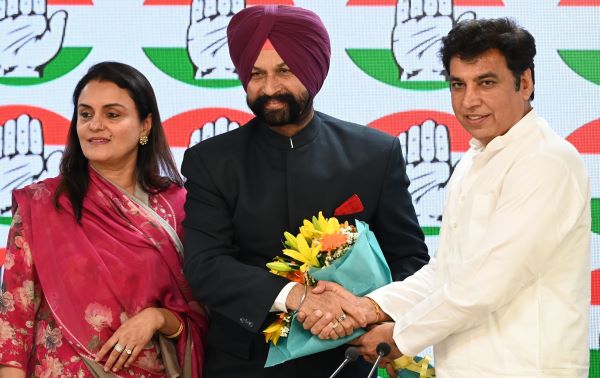
CHANDIGARH: As the BJP launches its “Nasha Mukt Punjab Yatra” with the slogan “Bhajpa Da Naara, Nasha Mukauna Saara,” senior Congress leader and former IPS officer Gurinder Singh Dhillon has raised pointed questions about the effectiveness of the Centre’s expanded border-security jurisdiction in Punjab.Dhillon has asked the BJP and the Union Government to explain what measurable results Punjab has achieved since the BSF’s notified jurisdiction was expanded from 15 kilometres to 50 kilometres from the international border in October 2021.
His central question is blunt:
“Five years later, what did the additional 35 kilometres achieve?”
According to Dhillon, the people of Punjab particularly those living in the border belt—have every right to demand a detailed performance report before political parties embark on campaigns promising to make Punjab drug-free.The six international-border districts of Punjab—Pathankot, Gurdaspur, Amritsar, Tarn Taran, Ferozepur and Fazilka have remained at the centre of the state’s border-security and drug-trafficking concerns.
DRONES, DRUGS AND CROSS-BORDER SMUGGLING
Dhillon pointed to a range of security challenges confronting Punjab, including alleged cross-border drone activity, trafficking of narcotics, weapons and ammunition, local receivers, organised criminal networks, attacks on police establishments and the recruitment of shooters by criminal groups.He argued that these threats require seamless coordination between the BSF, central intelligence and enforcement agencies and the Punjab Police.The Centre’s own figures, he said, make the issue even more serious.In July 2026, the Union Home Ministry informed Parliament that there had been an “exponential rise” in the use of drones for narcotics smuggling, with Punjab emerging as the most affected border state.Government figures showed that in 2025, 305 drone-related drug-trafficking incidents were recorded across India, of which 298 were reported along the Punjab border, accounting for almost 98 per cent of the national total.
“WHAT DIFFERENCE DID THE EXTRA 35 KM MAKE?”
Dhillon has therefore demanded specific answers from the Union Government.How many cross-border drones were detected every year?How many were intercepted or neutralised?How much narcotics, arms and ammunition were seized?How effective have anti-drone systems been?How effectively have intelligence-sharing and surveillance mechanisms worked?
And, most importantly:
What measurable improvement resulted from expanding the BSF jurisdiction from 15 km to 50 km?
ACCOUNTABILITY MUST APPLY TO BOTH DELHI AND PUNJAB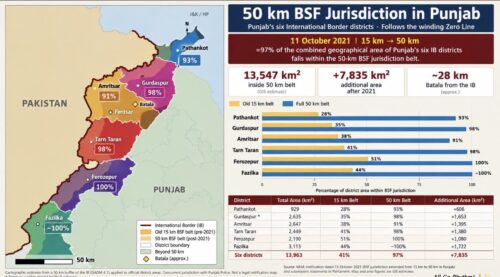
Dhillon also stressed that accountability cannot rest entirely with either the Centre or the Punjab Government.According to his argument, the BSF represents the first line of defence, while the Punjab Police represents the second line of defence once illegal consignments and criminal networks penetrate the border.The Centre and its agencies must therefore answer questions concerning border security and cross-border supply chains, while Punjab Police must address local distribution networks, receivers, organised crime, drug availability and attacks involving criminal gangs.
SIX PUNJAB DISTRICTS DECLARED ‘ULTRA-SENSITIVE’
The issue has gained further significance with the Centre identifying Amritsar, Gurdaspur, Tarn Taran, Ferozepur, Fazilka and Ludhiana as ultra-sensitive drug districts under its broader anti-drug strategy.Five of these districts are located along Punjab’s international border.Dhillon has argued that the combination of an expanded 50-kilometre BSF jurisdiction, continuing drone-assisted smuggling and the classification of multiple Punjab districts as ultra-sensitive makes a detailed assessment of the last five years essential.
“UNDERTAKE THE YATRA — BUT GIVE PUNJAB THE REPORT CARD TOO”
Dhillon’s message to the BJP is that there should be no objection to a campaign against drugs, but such a campaign should also be accompanied by transparency and accountability.He has effectively challenged the BJP to take its campaign beyond Punjab’s streets and ask the Union Home Ministry and Parliament to publish a comprehensive 2021–2026 border-security performance report.Punjab, he says, deserves answers to four basic questions:
What changed?
What worked?
What failed?
And what will be done differently now?For Dhillon, the issue is not simply about slogans or political yatras. It is about determining whether the expanded security framework delivered the results that Punjab was promised.
“YATRA KE SAATH HISAB BHI DO”
The message from the former IPS officer and senior Congress leader can be summed up in one line:Go ahead with the “Nasha Mukt Punjab Yatra”but give Punjab the five-year report card as well.Punjab wants to know what happened between 2021 and 2026, and what concrete steps will now be taken to stop drugs, weapons, drones and organised cross-border criminal networks.
Disclaimer: This article and accompanying images are for informational and illustrative purposes only. Some visuals may be AI-generated or digitally enhanced and may not depict actual events or persons.Views expressed are based on publicly available information and analysis