
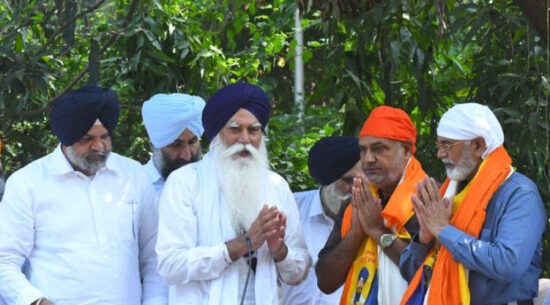
 Niranjan Singh’s political innings with Akali Dal (Waris Punjab De) has lasted barely five days. But the manner of his departure may prove more politically significant than his arrival.The former Enforcement Directorate Deputy Director joined the organisation on September 23. On September 27, he announced that he was dissociating himself from it because of differences on certain issues that were, in his words, “non-negotiable.”He did not identify those issues. That distinction is important. No responsible account should simply declare that Khalistan was the reason for his resignation when Singh himself has not said so.
Yet his own statements immediately before his departure make the obvious question impossible to ignore.In an interview published by The Indian Express on September 25 only two days before his resignation Niranjan Singh was specifically asked about calls for Khalistan associated with Amritpal Singh before his detention. His response was remarkably direct:“There can’t be any compromise on the unity or sovereignty of our country.”Asked specifically about Khalistan, he went further:
“What Khalistan? This is our homeland; we already have it. There is no question of another homeland.”Those are not ambiguous words. They amount to an explicit rejection of the proposition that Sikhs require a separate homeland outside the existing Indian Union. Singh placed national unity and sovereignty beyond compromise.Forty-eight hours later, he resigned saying that he had differences on issues that were “non-negotiable” and adding another pointed sentence: “The conduct of persons in public life has to be within the Constitution of India.”
Put the two statements next to each other.On September 25: no compromise on India’s unity and sovereignty; no question of another homeland.On September 27: differences on non-negotiable issues; public life must remain within the Constitution.That sequence does not prove that a disagreement over Khalistan triggered his resignation. But it certainly makes the ideological question far more substantial than a vague reference to unspecified differences.
Indeed, the constitutional boundary had been visible from the moment Singh entered the party. At his September 23 induction, he described Waris Punjab De as a coming together of people wanting to work “within the Constitution” and called it a secular platform fighting drugs and corruption.
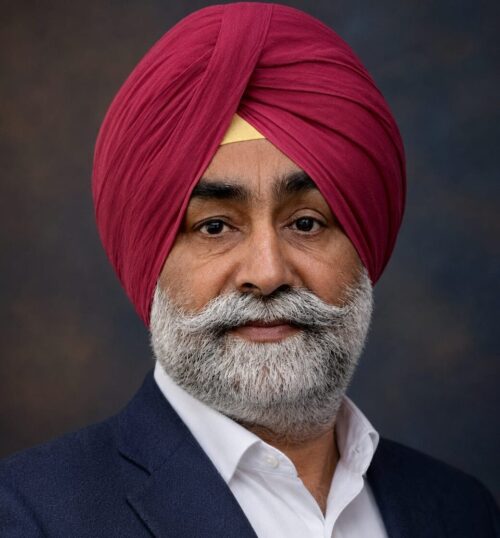
His reasons for joining were equally specific. Singh had spent years investigating Punjab’s drug networks. He had worked on the Jagdish Bhola drug racket, questioned senior political figures and publicly spoken about what he alleged was a nexus between drug traffickers, police officers and political interests. He said he saw common ground with Waris Punjab De on drugs, corruption, gangsterism, extortion and law and order.
His resignation confirms that those issues were not apparently the problem. He expressly reiterated that he had supported the party on the drug menace, corruption, gangsterism, extortion and alleged police involvement in drug trafficking. The break came, according to him, over something else something sufficiently fundamental to be “non-negotiable.”That is what makes this five-day episode politically important.
Waris Punjab De is trying to expand its appeal ahead of the 2027 Punjab Assembly elections. The induction of figures such as Niranjan Singh and Manpreet Singh Ayali had been presented as evidence that the organisation could reach beyond its original constituency. The Indian Express noted that its newer entrants were themselves stressing constitutionalism, national unity and the limits within which the party should operate.
Niranjan Singh’s abrupt departure therefore raises a question larger than one individual resignation: Can the organisation reconcile its broader electoral ambitions with the ideological positions associated with parts of its political movement?For the moment, only Niranjan Singh can definitively explain what crossed his red line. Waris Punjab De can also clarify whether any disagreement arose concerning sovereignty, Khalistan or constitutional politics.
Until that happens, Khalistan should not be reported as the established cause of his resignation.But neither can the context be brushed aside.A man who said on Friday that there could be “no compromise” on India’s unity and sovereignty, and that there was “no question of another homeland,” walked away on Sunday citing “non-negotiable” differences and the Constitution of India.In politics, sometimes the words immediately before a resignation are almost as revealing as the resignation itself.
I am sure that Niranjan Singh will leverage this to jump into some National political party.It may be mentioned that in the past, WPD has tried hard to establish its secular credentials and also its constitutional obeisance, but time will tell how people see their image as.