
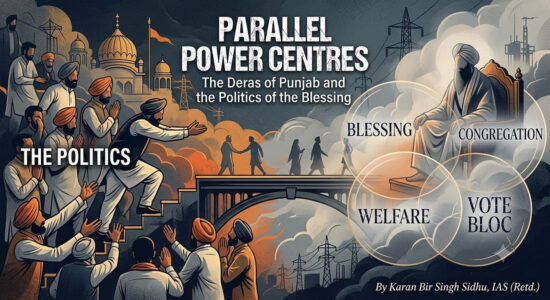
 Punjab is due for Assembly elections in 2027, and the courtship season has begun early. In the second week of July 2026, Prime Minister Narendra Modi flagged off the Shri Sant Ravidas Express connecting Amritsar and Varanasi from a redeveloped Jalandhar Cantonment railway station, inaugurating projects worth several thousand crores across Chandigarh, Haryana and Punjab in a single day. Aboard the inaugural run, he met Sant Niranjan Dass, head of Dera Sachkhand Ballan — following his earlier visit to the dera on Guru Ravidas Jayanti in February, and the recent conferment of a Padma Shri on the dera chief. Chief Minister Bhagwant Mann was conspicuously absent, a fact Union minister Ravneet Singh Bittu and the BJP were quick to publicise, alleging he had instead prioritised party engagements with AAP’s national convener.
This was not an isolated episode. Five months earlier, in February 2026, Punjab had witnessed an altogether more unusual spectacle: a sitting Chief Minister taking a public, if veiled, swipe at a dera chief, after Baba Gurinder Singh Dhillon of the Radha Soami Satsang Beas visited a jailed Akali leader and publicly vouched for him. Mann’s retort broke what had, until then, been an unwritten rule of Punjab politics: chief ministers do not pick public fights with dera heads. That episode is told in full a little further on; for now, it is enough to note that the Beas head was shortly afterwards seen walking publicly alongside BJP and Akali Dal leaders — an unprecedented alignment for an institution that has spent over a century cultivating studied neutrality.
Read together, the two episodes capture the essential dynamic of Punjab’s pre-election season: national and state leaderships competing, sometimes clumsily, for the blessing — or at minimum the neutrality — of religious establishments whose congregations run into the millions. This piece asks a simple question with a complicated answer: how did institutions founded as spiritual and welfare bodies become indispensable stops on the electoral circuit, and what does their power tell us about the health of Punjab’s formal political and constitutional architecture?
II. What Is a Dera? The Conceptual Frame
A dera, in the Punjab context, is a socio-religious establishment built around a living or hereditary spiritual head, offering a mix of devotional practice, social welfare, and communal belonging outside — or alongside — the institutional structures of mainstream religion. Punjab has, by conservative count, over 9,000 such establishments, ranging from small village shrines with a few hundred devotees to sprawling townships with membership in the tens of millions spread across continents.
Their proliferation owes much to the specific social history of the Punjab-Haryana belt: a large population of Dalit and other historically marginalised communities who, having faced exclusion or hierarchy within both mainstream Sikh institutions and caste Hindu society, found in the deras an alternative structure of dignity, ritual access, and material support. Many deras run hospitals, schools, de-addiction centres and langars at a scale that state welfare infrastructure has historically struggled to match. This welfare architecture is the foundation on which their political leverage rests — not scripture or theology, but organisation, discipline, and the capacity to move large, cohesive blocs of grateful followers in a single direction on polling day.
It is worth stating plainly: not all deras behave alike, nor do all deal in politics to the same degree. Some maintain genuine distance from electoral matters; others have institutionalised political engagement into something close to an internal whip system. No single article can be exhaustive, nor does this one attempt to be. The eight establishments examined below are simply those most consistently named in reportage and political calculation as capable of shifting outcomes across a meaningful number of Punjab’s 117 Assembly seats — Radha Soami Satsang Beas, Dera Sacha Sauda, Dera Sachkhand Ballan, the Sant Nirankari Mission, Dera Nurmahal, the Namdhari sect, Dera Baba Nanaksar, and Dera Baba Bhaniarwala. The political callers named against each dera are likewise illustrative of a much longer, ongoing procession of visitors across party lines — a representative sample, not a complete register.
A word of caution on the figures that follow: no dera publishes an audited membership roll, and no two journalistic estimates agree precisely. The numbers below are the ranges most consistently cited in Punjab’s political reportage, offered as orders of magnitude rather than certainties.
III. Radha Soami Satsang Beas: The Quiet Giant
Radha Soami Satsang Beas traces its institutional lineage to Baba Jaimal Singh, who established a modest hermitage on the banks of the Beas river in 1891, having been initiated into the Radha Soami tradition founded some decades earlier in Agra by Shiv Dayal Singh. From that riverbank beginning, the Beas dera has grown into a sprawling township of several thousand acres, formally registered as a charitable society in 1957, with a following claimed to run into the tens of millions across Punjab, Haryana, Himachal Pradesh, Delhi and a substantial global diaspora.
The Beas dera has long cultivated a posture of studied political neutrality — it does not endorse candidates or parties, at least not openly — yet this neutrality is precisely what makes it valuable currency. …