
 Editor’s Note:This editorial is not directed at any particular dera, saint, or religious community. It recognises that many religious and charitable organisations perform valuable services. Its purpose is to encourage accountability, transparency, critical thinking, and the protection of vulnerable individuals from exploitation by anyone who misuses faith for personal, financial, or political gain. In a democratic society governed by the rule of law, no individual or institution should be above scrutiny, and allegations should be assessed fairly through evidence and due process.
Punjab has long been celebrated as the land of saints, martyrs, scholars, farmers, and warriors. Its spiritual identity was shaped by the teachings of the Sikh Gurus, who rejected superstition, ritualism, caste discrimination, and the blind worship of individuals. The message of Guru Nanak Dev Ji emphasised one universal Creator, equality among all human beings, honest labour (Kirat Karni), sharing with others (Vand Chhakna), and remembering God (Naam Japna). Throughout history, Punjab’s spiritual traditions encouraged people to question injustice, stand for truth, and reject exploitation in every form. Yet, over the past several decades, another phenomenon has quietly expanded across Punjab and many other parts of India—the rise of powerful self-styled godmen and personality-centred deras that often operate as influential social, economic, and political institutions.
It is important at the outset to make a clear distinction. Many deras, religious organisations, and spiritual leaders across Punjab and India perform remarkable humanitarian work. They operate schools, hospitals, de-addiction centres, blood donation drives, disaster relief programmes, and community kitchens without expecting personal gain. Thousands of volunteers devote their lives to serving humanity with sincerity and compassion. Their contribution deserves recognition and respect. However, alongside these genuine institutions, there have also been individuals who have allegedly used religious influence to accumulate wealth, political power, and unquestioning loyalty. It is this latter phenomenon that deserves careful public examination.
The growth of self-styled babas is not merely a religious issue; it is also a social, psychological, economic, and political issue. Across Punjab, thousands of families struggle with unemployment, mounting debt, drug addiction, declining agricultural income, migration pressures, family disputes, mental stress, and uncertain futures. In such circumstances, people naturally seek hope, comfort, and guidance. When formal institutions—whether governments, healthcare systems, educational institutions, or employment opportunities—fail to address these needs adequately, charismatic individuals promising instant solutions can become immensely attractive. For someone who has exhausted every available option, the promise of a miracle may appear more convincing than another bureaucratic process or another unanswered application.
This vulnerability should never be mistaken for ignorance. The people who gather at religious congregations come from every section of society. They include farmers, labourers, professionals, businessmen, students, retired officials, and even highly educated individuals. Many attend seeking emotional peace rather than supernatural intervention. Others are searching for community, belonging, or moral guidance. Faith itself is not the problem. Throughout history, faith has inspired countless acts of compassion, sacrifice, and social reform. The concern arises when faith is transformed into unquestioning obedience to a single individual whose words become immune from scrutiny.
In many cases, charismatic personalities begin by offering spiritual discourses, motivational talks, or community service. Over time, however, some build organizations centred almost entirely around themselves. Their photographs become larger than the religious symbols surrounding them. Followers begin celebrating birthdays with extraordinary grandeur. Luxury vehicles, private security, and elaborate stages become symbols of spiritual authority. Public appearances resemble political rallies more than religious gatherings. Gradually, the focus shifts away from spiritual teachings toward the personality of the leader. The distinction between devotion to God and devotion to an individual becomes increasingly blurred.
One of the defining characteristics of personality cults is the belief that the leader possesses extraordinary powers unavailable to ordinary human beings. Followers may be told that diseases can be cured through blessings, immigration problems can be solved through divine intervention, court cases can be influenced by spiritual powers, examinations can be passed through special rituals, businesses can flourish through donations, and family disputes can disappear through unquestioning obedience. Such claims may offer temporary psychological comfort, but they can also discourage people from seeking qualified medical treatment, legal advice, education, counselling, or other practical solutions. When hope is marketed as certainty, vulnerable people may invest not only their money but also their independence and judgment.
History has repeatedly demonstrated that concentrated authority without accountability can become dangerous in any institution—whether political, corporate, educational, or religious. The problem is not spirituality; the problem is unchecked power. Whenever one individual is treated as infallible, questioning becomes discouraged. Critics may be portrayed as enemies of religion, while former followers who raise concerns risk social isolation or intimidation. Families sometimes become divided when one member questions practices that others consider sacred. In such environments, transparency becomes increasingly difficult, and genuine accountability may disappear altogether.
The influence of many prominent deras today extends well beyond religious activity. Some control extensive landholdings, educational institutions, healthcare facilities, charitable trusts, media networks, and business enterprises. Many attract donations worth crores of rupees every year. Thousands of volunteers provide labour without financial compensation, believing they are performing religious service. While volunteerism is a respected tradition in Sikhism and many other faiths, transparency becomes essential whenever organizations manage significant financial and material resources. The public has a legitimate interest in knowing how donations are collected, how funds are spent, who audits the accounts, and how charitable claims are independently verified. Accountability strengthens genuine institutions and protects them from suspicion.
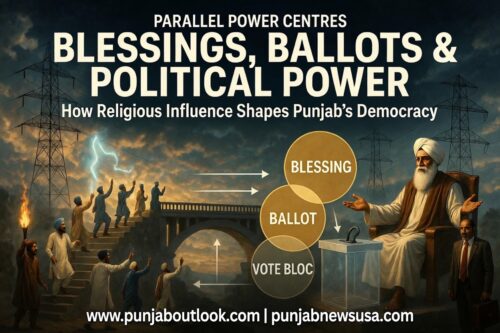
Perhaps the most visible demonstration of the growing influence of these organizations appears during election seasons. Politicians from across the ideological spectrum frequently visit influential religious leaders seeking public blessings and, in some cases, electoral support. These visits are often widely publicized, creating the perception that spiritual endorsement can translate into political success. Whether such endorsements actually influence voting patterns may vary from place to place, but the symbolism is unmistakable. When religious authority and political ambition become closely intertwined, democratic decision-making risks being shaped by personalities rather than informed public debate on governance, education, healthcare, employment, agriculture, and the rule of law.
Punjab’s democratic future depends upon citizens making electoral decisions based on policies, performance, integrity, and constitutional values rather than on instructions issued from any religious or political platform. Religious freedom is a fundamental constitutional right, and every citizen has the freedom to practice and propagate their faith. Equally important, however, is the principle that no individual—regardless of popularity or influence—should stand above public scrutiny or the law. Genuine spirituality has nothing to fear from transparency. On the contrary, accountability strengthens public trust and protects sincere religious institutions from being overshadowed by those who misuse faith for personal gain.
The challenge facing Punjab today is therefore not a conflict between religion and modernity, nor between faith and reason. It is a challenge to distinguish authentic spiritual leadership from personality cults that may exploit human vulnerability. The Gurus encouraged seekers to pursue truth with humility, wisdom, and discernment. They rejected superstition and emphasized ethical living, equality, compassion, and honest labour. Those timeless principles remain as relevant today as they were centuries ago. As Punjab confronts complex social and economic challenges, its greatest strength will not lie in miracle claims or charismatic personalities but in an informed citizenry capable of combining spiritual values with critical thinking, compassion with accountability, and faith with responsibility.
Disclaimer: This article and accompanying images are for informational and illustrative purposes only. Some visuals may be AI-generated or digitally enhanced and may not depict actual events or persons.Views expressed are based on publicly available information and analysis.