
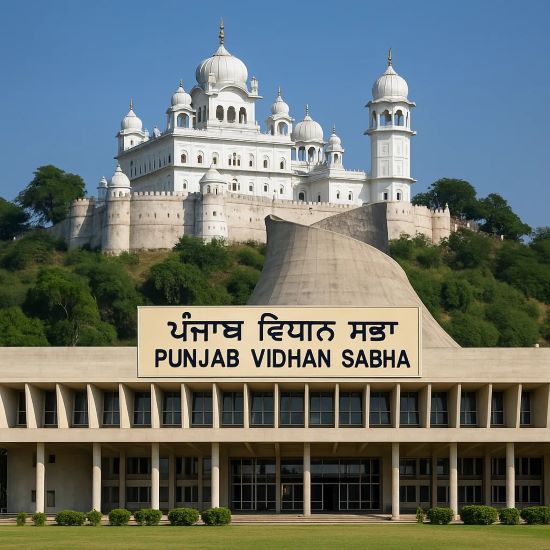
 The Punjab Legislative Assembly session held today in Chandigarh emerged as one of the most significant political developments in recent times. The atmosphere inside the House remained serious and emotionally charged, as the discussion revolved around a highly sensitive issue that had deeply affected the sentiments of people across the state. From the very beginning, it was clear that the government intended to send a strong message through this special session, both politically and socially.
The proceedings began with customary tributes and formalities, setting a respectful tone. Soon after, Chief Minister Bhagwant Mann took centre stage to introduce a crucial amendment bill related to sacrilege. The proposed legislation aimed at ensuring stricter punishment for acts of beadbi, with provisions that include long-term imprisonment, heavy fines, and even property confiscation in serious cases. The government projected the bill as a historic step to safeguard the sanctity of religious scriptures and prevent incidents that have repeatedly shaken Punjab in the past.
During the debate, members from both the treasury benches and the opposition actively participated. While there was broad agreement on the need for a strict law, opposition leaders questioned the timing and intent of the government. Leaders like Partap Singh Bajwa argued that while legislation is important, the real issue lies in the failure to deliver justice in past sacrilege cases. They emphasised that people are still waiting for accountability in incidents that occurred years ago, and merely passing new laws may not address that deep-rooted dissatisfaction.
Despite the political differences, what stood out in today’s session was the rare sense of unity. Almost all parties supported the bill in principle, acknowledging the emotional and religious importance of the issue. This consensus gave the session a sense of purpose and seriousness that is often missing in routine legislative proceedings. It also reflected the pressure on political parties to align with public sentiment on matters that go beyond politics.
One of the major merits of the session was this very unity. In a state often divided by political rivalries, coming together on a sensitive issue sends a strong message of collective responsibility. It reassures people that their concerns are being heard at the highest level. Moreover, the introduction of stricter punishments can act as a deterrent, potentially preventing future incidents and restoring a sense of security among the public.
Another positive aspect was the government’s attempt to give a structured legal framework to the issue. By including provisions such as conspiracy angles and assigning responsibility to institutions for the protection of scriptures, the bill appears more comprehensive rather than symbolic. It shows that the government is trying to move beyond rhetoric and take concrete legislative action.
However, the session also exposed several weaknesses and raised important concerns. One of the biggest criticisms is that the move may be politically motivated. Critics argue that the government is trying to shift focus from unresolved issues such as unemployment, debt, and law and order by bringing an emotionally charged topic to the forefront. This perception, whether true or not, has created a debate outside the Assembly as well.
Another major demerit is the lack of progress in previous sacrilege cases. The people of Punjab have long demanded justice for incidents that took place in the past, but many of those cases remain unresolved or delayed. Without addressing those cases effectively, the introduction of new laws risks being seen as incomplete or even superficial. Justice delayed, in such sensitive matters, often leads to erosion of public trust.
Legal experts have also raised questions about the constitutional validity of such strict provisions. There are concerns about whether the law will stand scrutiny at the national level, and whether it might face challenges similar to past attempts. If the law is struck down or diluted later, it could lead to further disappointment among the people.
Additionally, there is always the risk of misuse of stringent laws. In a politically sensitive environment, laws with severe punishments can sometimes be used selectively or unfairly. Without strong safeguards and transparent implementation, even well-intentioned legislation can lead to controversies and allegations of bias.
Punjab Assembly session was undoubtedly impactful and historic in many ways. It demonstrated political unity, addressed a deeply emotional issue, and introduced a strong legislative framework. At the same time, it also highlighted unresolved challenges, including the need for justice in past cases, legal clarity, and fair implementation. The real success of this session will not be judged by the passage of the bill alone, but by how effectively it is implemented and whether it truly delivers justice and reassurance to the people of Punjab.