
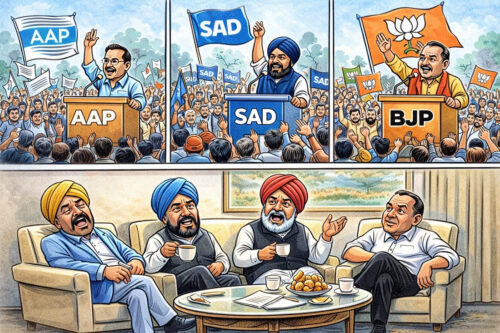
Punjab is approaching another important Assembly election, expected in early 2027. The political atmosphere is changing rapidly, with defections, internal disagreements, leadership questions, alliance discussions and new political formations. The issues of unemployment, drug trafficking, agricultural distress, migration, law and order, public debt and the future of Punjab’s economy are likely to dominate the political debate.
The 2027 Assembly election will be particularly important because Punjab’s political landscape is no longer limited to the traditional competition between the Congress and the Shiromani Akali Dal. The Aam Aadmi Party, which secured an overwhelming mandate in 2022, is preparing to defend its government. The Congress is attempting to regain political ground, the BJP is expanding its independent organisational presence, and different Akali and Panthic formations are trying to establish their own political identities.
The important question is not simply which party is organising the largest rallies or attracting prominent political leaders. The real question is how much public support each party retains at the village, town, constituency and district levels. The political situation must therefore be examined through government performance, organisational strength, leadership credibility, public opinion and the ability of parties to connect with ordinary people.
AAP: The challenge of defending its government
The Aam Aadmi Party entered government in 2022 with an unprecedented mandate, winning 92 of the 117 Assembly constituencies. Its victory created enormous expectations among the people of Punjab, particularly regarding education, healthcare, employment, corruption control, electricity benefits and the elimination of drugs. The party promised a different model of governance and presented itself as an alternative to the traditional political establishment.
After more than four years in government, AAP’s political position must be assessed against its promises and actual performance. Its supporters point to welfare programmes, electricity benefits, mohalla clinics, education initiatives and administrative reforms. However, critics have raised questions about unemployment, public debt, industrial investment, drug trafficking, law and order, agricultural challenges and the implementation of several election promises.
The party is also facing political challenges arising from defections and disagreements. The departure of prominent legislators and the changing political positions of some leaders have added another dimension to its preparations for 2027. AAP still has the advantage of being the ruling party, with an established statewide organisation and access to government-level political visibility. However, the next election will require it to demonstrate that its promises have produced measurable improvements in people’s lives.
Its biggest challenge will be to defend its record while convincing voters that it deserves another opportunity to govern Punjab.
Congress: An opportunity to return to power, but unity remains important
The Congress continues to be an important political force in Punjab. It has a historical organisational network, experienced leaders and an established voter base across different regions. The party hopes to benefit from dissatisfaction with the incumbent government and is attempting to position itself as a credible alternative to AAP.
However, the Congress has its own organisational challenges. Differences among senior leaders, questions about leadership responsibilities and the distribution of political influence have affected its preparations. Leaders such as Charanjit Singh Channi, Partap Singh Bajwa, Amarinder Singh Raja Warring and other senior figures have their own political constituencies and responsibilities. The party needs to establish a common strategy and ensure that its leaders work together rather than allowing internal disagreements to dominate public attention.
Congress also needs to explain how it intends to address the problems that remained unresolved during its previous periods in government. Unemployment, agriculture, drugs, industrial development, education and Punjab’s financial position should be central to its political programme. Merely criticising the ruling party will not be sufficient. Voters will expect a clear alternative policy and credible leadership.
The Congress has an opportunity to rebuild its position, but its ability to translate public dissatisfaction into electoral support will depend significantly on organisational unity and constituency-level preparation.
BJP: Expanding its political ambitions in Punjab
The Bharatiya Janata Party is attempting to establish itself as a major independent political force in Punjab. For many years, the BJP contested elections in alliance with the Shiromani Akali Dal and concentrated much of its political activity in urban constituencies. Following the breakdown of that alliance in 2020, the party has been trying to expand its presence in rural Punjab and develop an organisation capable of contesting a larger number of Assembly seats.
The BJP’s recent political strategy has included recruiting leaders from other parties, strengthening its organisational structure and highlighting the policies and programmes of the Central Government. The joining of three former AAP MLAs, Kunwar Vijay Pratap Singh, Harmeet Singh Pathanmajra and Chetan Singh Jouramajra, in November 2026 has added new political faces to its Punjab unit. However, the entry of prominent leaders does not automatically guarantee the transfer of their previous supporters to the BJP.
The party continues to face the challenge of expanding its acceptance among different sections of Punjab’s electorate, particularly in rural areas and among sections of the Sikh community and farming population. Its position on agricultural issues, federal relations, religious concerns and Punjab’s economic interests will be important in determining its political reach.The possibility of a renewed alliance between the BJP and the Shiromani Akali Dal is another major subject of political discussion. Senior BJP leader Sunil Jakhar has spoken publicly about the possibility of cooperation, although he has emphasised that no final decision should be assumed until formally announced. The two parties will have to resolve questions concerning seat-sharing, leadership and their respective political interests.
Akali Dal Waris Punjab De: A new Panthic political factor
The emergence of Akali Dal Waris Punjab De has introduced another important dimension into Punjab politics. The political formation associated with Khadoor Sahib MP Amritpal Singh is seeking to establish a separate identity around Panthic concerns, Sikh issues and Punjab’s political interests. Its emergence has attracted attention because it is attempting to occupy political space that was traditionally associated with the Shiromani Akali Dal.The organisation’s political influence will depend on its ability to build a structured organisation across Punjab rather than relying only on public enthusiasm surrounding particular leaders or gatherings. It will need to develop credible candidates, establish constituency-level committees and explain its positions on employment, education, agriculture, industry, economic development and governance.
Another important question is whether the organisation can expand its influence beyond its existing geographical and political support base. Its participation could affect the traditional Akali vote as well as sections of voters who are dissatisfied with the established political parties. However, its actual statewide influence cannot be determined without constituency-level evidence and electoral results.
Other Akali factions and Panthic organisations
The division within the wider Akali political family has further complicated Punjab’s political situation. Different factions and Panthic organisations are attempting to establish their own political identities and influence the future direction of Sikh political representation. The Shiromani Akali Dal, breakaway groups and newer political formations face the common challenge of rebuilding public confidence.
The Shiromani Akali Dal (Punar Surjit), associated with Giani Harpreet Singh, is another development that deserves attention in the coming election. The political question is whether different Akali formations will continue to compete against one another or eventually explore some form of political understanding.
The division of the traditional Panthic political space could influence several constituencies, particularly in Majha and Doaba. Sikh religious concerns, the functioning of religious institutions, federal rights, agricultural interests and the future of Punjab’s younger generation are issues that these organisations will have to address. The political future of these formations will depend on their ability to convert their stated objectives into practical programmes and public support.
Bahujan Samaj Party and Left parties
The Bahujan Samaj Party continues to maintain a political presence in Punjab, particularly in parts of the Doaba region. Its historical connection with sections of Dalit communities gives it an established political identity, although its electoral performance has varied considerably over the years. The party’s future will depend on its ability to strengthen its local organisation, identify credible candidates and address issues concerning social justice, education, employment, economic opportunities and representation.
The Left parties, including the Communist Party of India and the Communist Party of India (Marxist), also retain political and organisational influence in selected areas. Their participation in farmers’ movements, labour campaigns and public demonstrations provides them with a presence beyond their Assembly representation. Their influence should therefore be examined not only through the number of seats they contest or win but also through their role in public movements and their ability to mobilise sections of the farming and working population.
Independent candidates and smaller political organisations may also influence the results in closely contested constituencies. In a multi-cornered election, even parties with limited statewide support can become important factors in individual Assembly seats.
What do the opinion polls and election surveys indicate?
The political situation in Punjab has generated different assessments among survey organisations and political observers. However, the available reports should be examined carefully because surveys conducted with different samples, methodologies and questions cannot be treated as directly comparable.
Some surveys have reported continued support for AAP, while others have indicated that Congress is attracting considerable interest among voters dissatisfied with the incumbent government. Seat projections also differ, reflecting uncertainty about the possible effects of defections, alliances, candidate selection and changing regional political preferences.
The available political reporting does not establish a single independently verified statewide opinion measurement that can conclusively identify the party with the strongest support across all 117 constituencies. Therefore, survey estimates should be treated as indications of public opinion at a particular time rather than as predictions of the final election result.
A more meaningful assessment will require reliable constituency-level surveys, clear information about sample sizes and fieldwork dates, and separate analysis of rural and urban voters.Unemployment and migration are likely to remain among the most important issues in Punjab. A large number of young people are looking for employment opportunities outside the state and abroad. Political parties will need to explain how they intend to create sustainable employment, attract investment, improve vocational education and provide young people with opportunities to build their future in Punjab. Merely announcing government recruitment or making promises about employment will not be enough without measurable results.
Drug trafficking and law and order will also remain major subjects of public concern. Families across Punjab want effective action against drug suppliers, organised trafficking networks and individuals involved in protecting the illegal trade. Political parties will have to explain how they intend to strengthen policing, improve rehabilitation facilities and prevent young people from becoming victims of drug addiction. The public will increasingly expect evidence of results rather than repeated election promises.
Agriculture and the future of farmers will be another major political issue. Punjab’s agricultural economy faces challenges involving groundwater depletion, rising cultivation costs, farmers’ income, crop diversification and the financial condition of rural households. Every major party will have to present a practical agricultural policy that protects farmers’ interests while also addressing the long-term sustainability of Punjab’s agricultural economy.
Punjab’s financial condition will be equally important. Public debt, government expenditure, subsidies, revenue generation and industrial development require serious discussion. Voters should be able to examine how different parties propose to manage the state’s finances, generate revenue, attract private investment and improve public services. Political promises without a clear financial plan may become an important subject of public criticism.
Sikh identity and Punjab’s rights will also influence the political atmosphere, particularly in constituencies where Panthic concerns carry significant importance. Issues involving Sikh religious institutions, the protection of Sikh identity, federal relations, the constitutional rights of Punjab and the interests of the Punjabi diaspora will remain part of the wider political debate. Parties will need to demonstrate how they intend to address these concerns through democratic and constitutional means.
What is the actual political ground situation?
The political position of AAP, Congress, SAD, BJP and the other formations cannot be understood through rallies, defections or statements made by party leaders alone. Each party has a different political base, organisational structure and set of challenges.
AAP has the advantage of being the ruling party and retaining a substantial statewide political organisation, but it must defend its governance record and respond to questions about defections and public dissatisfaction. Congress has an established political network and an opportunity to attract voters unhappy with the government, but it needs to demonstrate leadership unity and organisational discipline. The Shiromani Akali Dal is attempting to rebuild its traditional support base, while the BJP is seeking to expand beyond its earlier urban political presence. Newer Panthic formations are introducing additional competition in constituencies where Sikh political concerns are particularly significant.
The May 2026 municipal election results provide another useful reference point. AAP won 958 of the 1,977 wards reported, compared with 397 for Congress, 192 for the Shiromani Akali Dal and 172 for the BJP, while independents secured 251. These figures demonstrate the parties’ performance in those municipal elections, but they should not be interpreted as a direct forecast of the Assembly election. The voting behaviour of rural and urban populations can differ, and Assembly elections involve wider questions of leadership, governance and regional representation.
Conclusion: Punjab’s 2027 election will be a contest of leadership, performance and public confidence
Punjab is entering a politically complicated election period in which several parties are competing for public confidence. The 2022 election was dominated by AAP’s extraordinary victory, but the political circumstances of 2026 are different. The Congress is attempting to regain lost ground, the BJP is expanding its organisation, the Shiromani Akali Dal is working to recover its traditional political position, and newer Panthic organisations are seeking to influence the direction of Sikh political representation.
The possibility of a BJP-SAD alliance, the continuing movement of political leaders between parties, the internal challenges faced by Congress and AAP, and the emergence of new Panthic formations could all influence the final political picture. These developments make constituency-level research particularly important.
At this stage, the available evidence does not justify declaring any party the certain statewide leader. Different surveys, local election results and organisational developments present different aspects of the political situation. The actual outcome will depend on how voters assess the performance of the present government, the credibility of the opposition, the selection of candidates and the ability of each party to address Punjab’s long-standing problems.
Ultimately, the 2027 election should not be reduced to a competition between political personalities. It should be an opportunity for the people of Punjab to examine which political organisation offers a credible vision for employment, agriculture, education, industry, financial accountability, Sikh community concerns and the future of the state.By Satnam Singh Chahal
Disclaimer: This article and accompanying images are for informational and illustrative purposes only. Some visuals may be AI-generated or digitally enhanced and may not depict actual events or persons. Views expressed are based on publicly available information and analysis
.